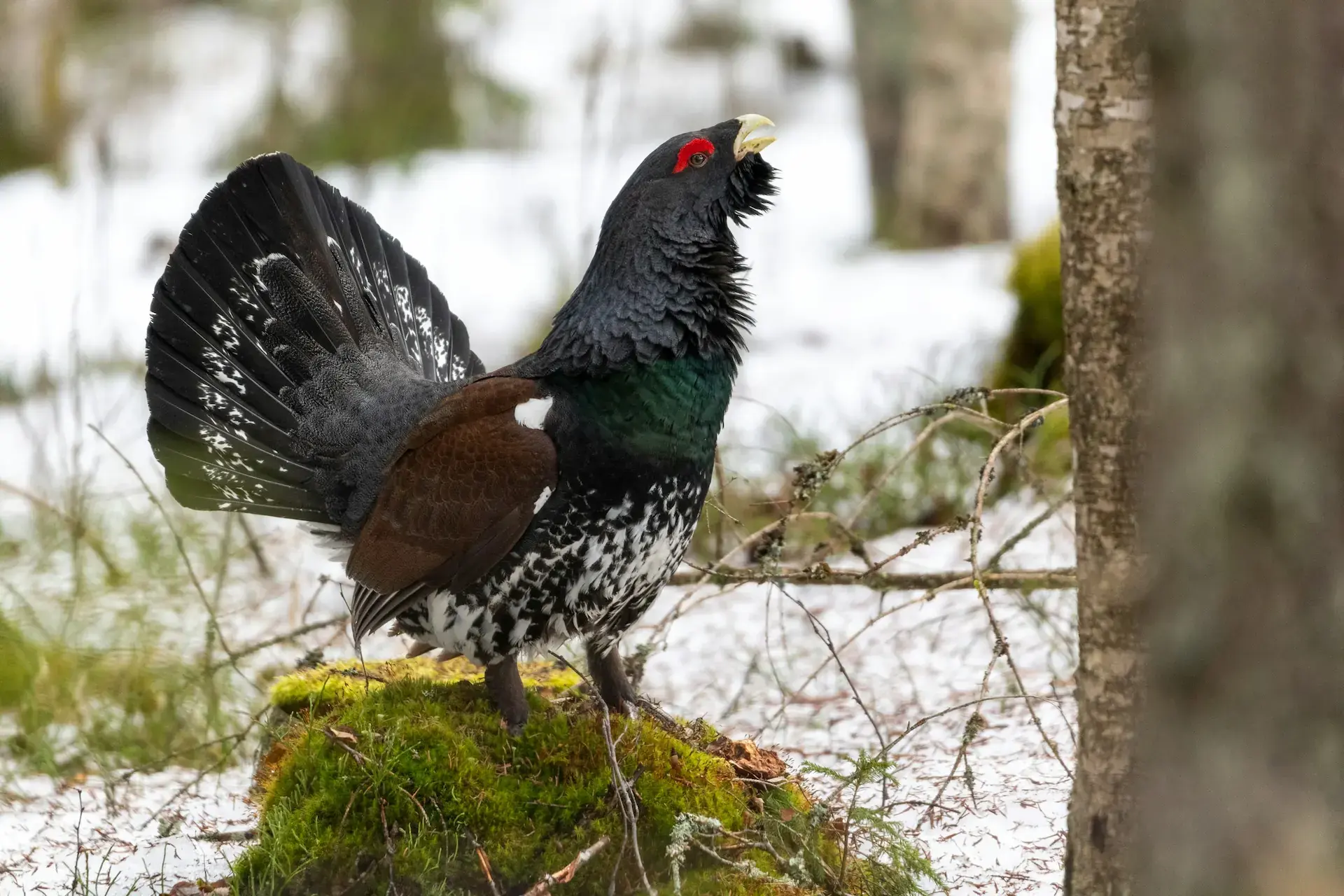
The capercaillie is one of those birds that seem to belong more to the silence of the forest than to the human gaze. Large, elusive and deeply linked to mountain forests, it occupies an almost mythical place within Iberian wildlife. Not only because it is difficult to see, but because in Spain it is in a very delicate conservation situation.
Unlike other birds that can be observed in wetlands, open plains or well-known birdwatching routes, the capercaillie is not a species to look for independently or to turn into a photographic target. Its low density, discreet behaviour, the sensitivity of its breeding areas and the state of its populations mean that, very often, the best way to approach it is to learn about it without trying to find it.
That is why talking about the capercaillie in Spain is not only talking about a spectacular species. It is talking about mature forests, lekking grounds, population isolation, extreme conservation and a very important idea: not all wildlife should become a direct observation experience.
What is the capercaillie?
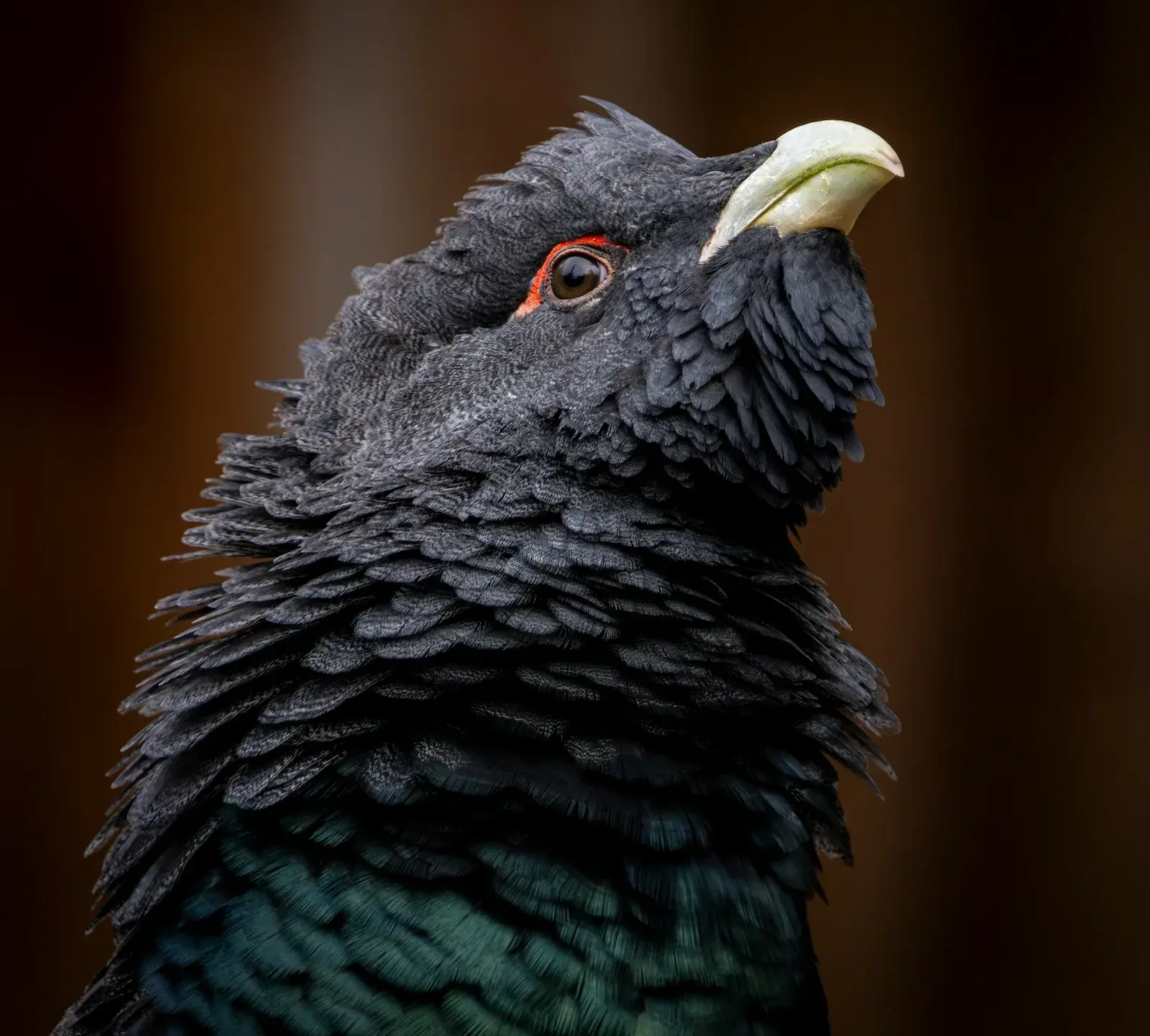
Western Capercaillie | Photo: Matthieu Rochette
The Western Capercaillie ‘Tetrao urogallus’, is a large forest bird from the family of pheasants, partridges and wildfowl. It is associated with mountain forests, especially in areas where it finds cover, food, tranquillity and a suitable vegetation structure to breed, shelter and move around.
It is a highly dimorphic species. Males are much larger and more striking, with dark plumage, greenish reflections on the chest, a broad tail and very visible red eyebrows during the breeding season. Females, on the other hand, have brown and cryptic tones that allow them to camouflage themselves better on the forest floor, especially during nesting.
In Spain, the capercaillie is represented by two geographically isolated populations: the Cantabrian Capercaillie ‘Tetrao urogallus cantabricus’, and the Pyrenean Capercaillie ‘Tetrao urogallus aquitanicus’. The former is distributed in the Cantabrian Mountains and is in an especially critical situation. The latter is present in the Pyrenean area, although it also shows a continuing decline.
The fact that there are two isolated populations already gives us an important clue: we are not talking about an abundant or easily observed species, but about a very localised bird with demanding ecological requirements and complex conservation needs.
Why the capercaillie is so difficult to observe
The capercaillie is difficult to observe for several reasons at once. The first is its low density. In Spain, it does not form abundant or easily detectable populations, and in the Cantabrian case the numbers are especially reduced. The second is its habitat: it lives in mountain forests, forest mosaics and areas where visibility is usually limited.
Its behaviour adds another layer of difficulty. Outside very specific moments of the year, the capercaillie is discreet, silent and not prone to exposing itself. It can move through vegetation, remain still for long periods or go unnoticed even when relatively close. In many cases, detecting signs of presence may be more realistic than observing the bird directly.
Its sensitivity also plays a role. Lekking grounds, breeding areas, resting places and feeding points are not spaces to visit out of curiosity. A disturbance at a delicate moment can have a very high cost, especially in small or fragmented populations.
That is why the capercaillie is a species that forces us to change the usual logic of birdwatching. It is not about looking for “the best place to see it”, but about understanding why we should not put pressure on it.
Cantabrian Capercaillie, a population in a critical situation
The Cantabrian Capercaillie is one of the most threatened birds in Iberian wildlife. Its population is isolated in the Cantabrian Mountains and has suffered a very sharp decline over recent decades.
The situation is so delicate that the Cantabrian population was declared to be in a critical situation. In the most recent population estimate, carried out using genetic individualisation techniques from non-invasive samples, 209 Cantabrian Capercaillies were estimated in 2024. Although the figure represents a slight increase compared with the previous estimate, it still points to an extremely small population.
In this context, every individual matters. Especially females, which play a key role in reproduction and demographic recovery. A population this small does not recover simply because a few individuals remain in the mountains. It needs reproductive success, connectivity, favourable habitat, low mortality and very careful long-term management.
That is why the Cantabrian Capercaillie should not be treated as a “rare” species that needs to be seen. It should be understood as a population on the edge, whose future depends on very precise conservation decisions and enormous social caution.
Pyrenean Capercaillie, more widespread but also vulnerable
The Pyrenean Capercaillie maintains a wider distribution than the Cantabrian population, but that does not mean its situation is comfortable. It is associated with mountain forests in the Pyrenean area and has also suffered a continuing decline over recent decades.
Its conservation depends on many factors: habitat quality, forest structure, food availability, tranquillity in sensitive areas, connectivity between nuclei and compatibility with human uses of the mountain. In species like this, presence in a territory does not necessarily mean that the population is stable or guaranteed.
The Pyrenees are an area with a great deal of use pressure in certain places and seasons. Hiking, skiing, recreational activities, forest tracks, forestry work and habitat changes can have different effects depending on the moment, intensity and location. In such a sensitive species, the problem is not always a single disturbance, but the accumulation of small pressures on critical areas.
That is why, when we talk about the Pyrenean Capercaillie, it is also worth avoiding the temptation to give specific points. The useful information is not “where to go to see it”, but what type of habitat it needs and why discretion is part of its conservation.
Song, lekking grounds and an especially sensitive period
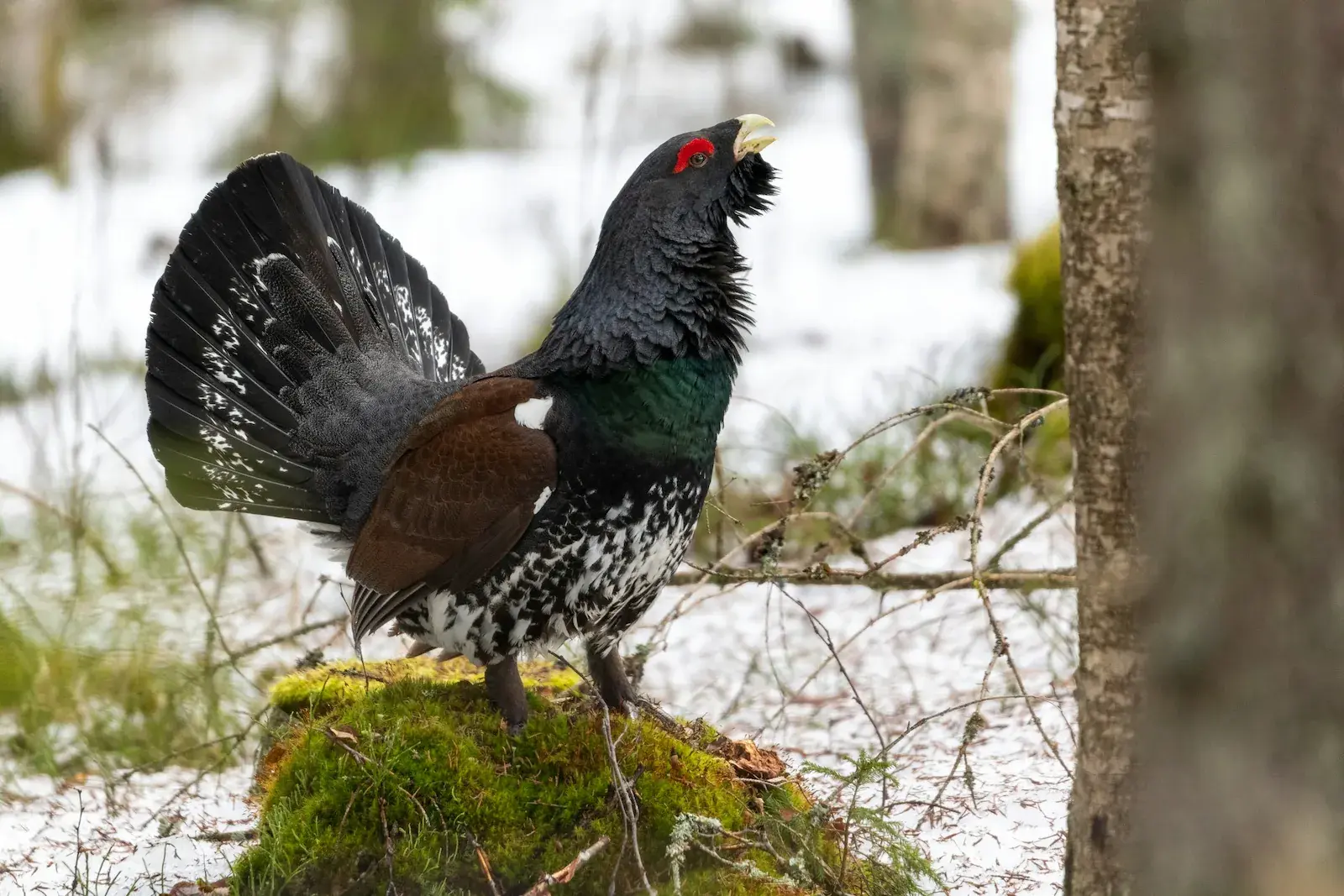
Western Capercaillie | Photo: Mathijs de Koning
One of the best-known behaviours of the capercaillie is the breeding display. During the breeding season, males attend traditional areas known as lekking grounds, where they perform displays and produce characteristic sounds to attract females and compete with other males.
From the outside, it may seem like one of the most attractive moments to observe the species. But precisely for that reason, it is also one of the most sensitive. Lekking grounds are not places to visit, search for, photograph or disclose. They are critical points for reproduction, and any alteration can affect male behaviour, the presence of females or the continued use of the area.
In addition, many lekking grounds have historical and ecological value. They are not simply places where a bird sings for one season. They can form part of a territorial structure used for years, and their abandonment may reflect much deeper problems in the population or habitat.
In threatened species, knowledge should not always translate into access. Knowing that lekking grounds exist should lead us to respect them more, not to try to find them.
What the capercaillie needs to live
The capercaillie needs much more than “forest”. It needs forests with a suitable structure, quiet areas, available food, cover, clearings, favourable undergrowth and connectivity between areas. In the Cantabrian case, plant species such as bilberry and holly are especially important within habitat improvement actions.
The project LIFE+ Cantabrian Capercaillie worked precisely on habitat restoration and improvement, favouring the regeneration of bilberry and holly, the creation of communication corridors between population nuclei and the correction of dangerous infrastructures for the subspecies.
This helps us understand something important: conserving the capercaillie is not only about protecting individuals. It is about restoring the ecological conditions that allow those individuals to live, reproduce and maintain viable populations.
A forest that is too closed, too fragmented, too altered or too pressured can stop working for the capercaillie even if it still looks like a forest from the outside. The species needs a very specific combination of structure, food, refuge and tranquillity.
Why it is disappearing
The decline of the capercaillie does not have a single cause. It is the result of several factors that accumulate and reinforce each other. Habitat loss and degradation, population fragmentation, low productivity, mortality, predation pressure in certain contexts, human disturbance, infrastructure and climate change are all part of a complex problem.
In small populations, every factor weighs more heavily. A poor breeding season, the loss of females, an altered breeding area, a dangerous infrastructure or a reduction in favourable habitat can have stronger consequences than they would in abundant species.
Climate change adds another difficulty. The capercaillie is linked to mountain environments and cool forests, so changes in temperature, snow, vegetation and food availability can alter the conditions it needs. It is not only about warmer temperatures, but about how the ecosystems it depends on are changing.
There is also a social component. The mountain is not an empty space: it has forestry, livestock, tourism, sporting and recreational uses. The challenge is to make those uses compatible with the conservation of a species that needs tranquillity in very specific moments and places.
Why you should not look for capercaillies independently
For many species, an observation guide can point to broad areas, seasons and habitats. With the capercaillie, much greater care is needed. It is not advisable to promote independent searches, visits to sensitive areas or attempts to observe it during the breeding season.
Looking for capercaillies without knowledge can mean entering critical areas, approaching lekking grounds, leaving routes, causing disturbance in breeding areas or disclosing information that increases pressure on an already vulnerable population. Even an apparently harmless observation can have effects if it is repeated, shared or attracts more people.
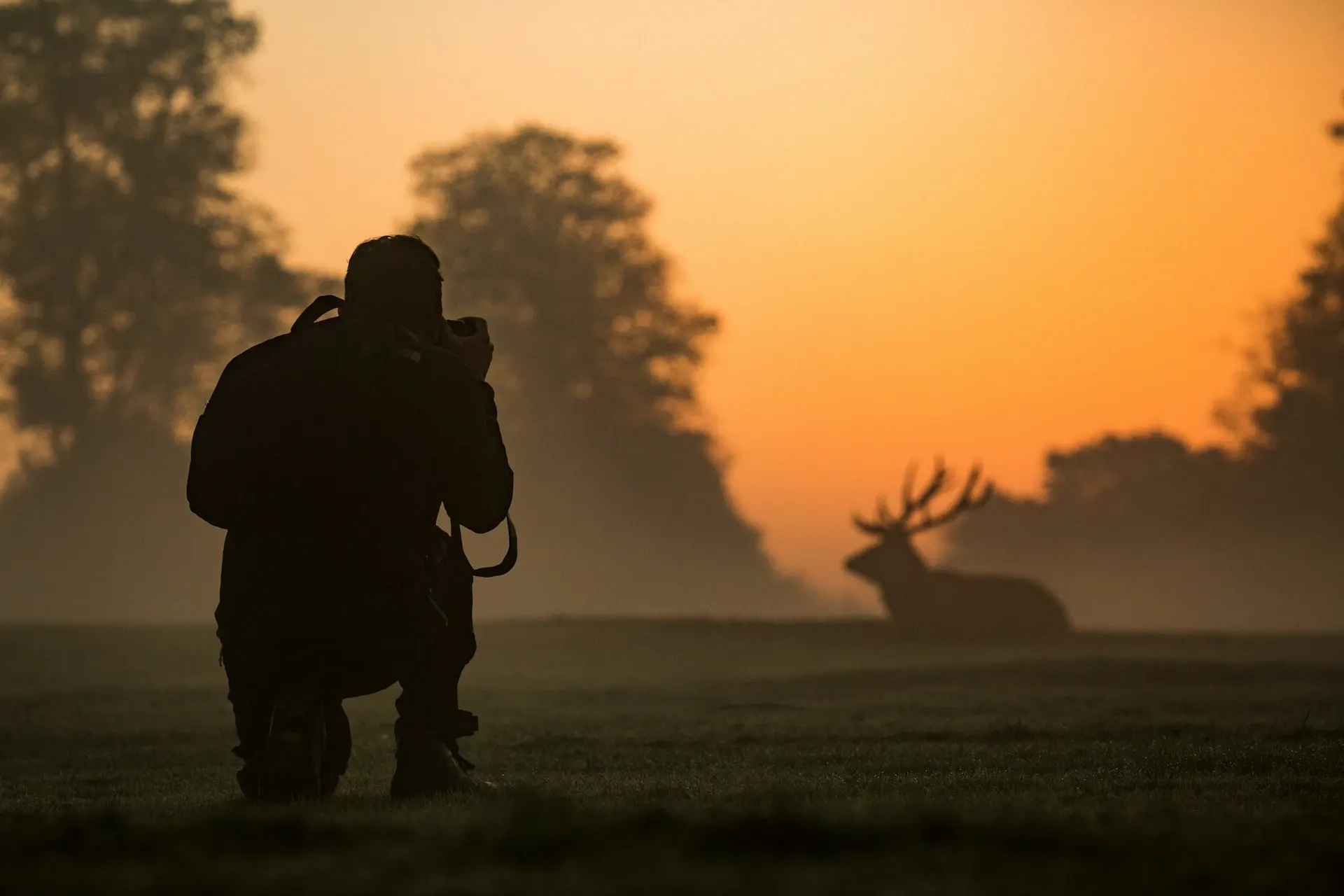
Photography is especially delicate. The capercaillie is not a species to chase with a telephoto lens or to approach deliberately. Calls, location information or any practice that alters its behaviour should not be used either. In this case, observation ethics are not an add-on: they are a minimum condition.
If you take part in activities in areas where the capercaillie lives, the responsible thing to do is to respect temporary closures, not leave authorised paths, avoid unnecessary noise, not search for lekking grounds and always follow the instructions of managers, specialised guides or environmental authorities.
How to talk about the capercaillie without putting it at risk
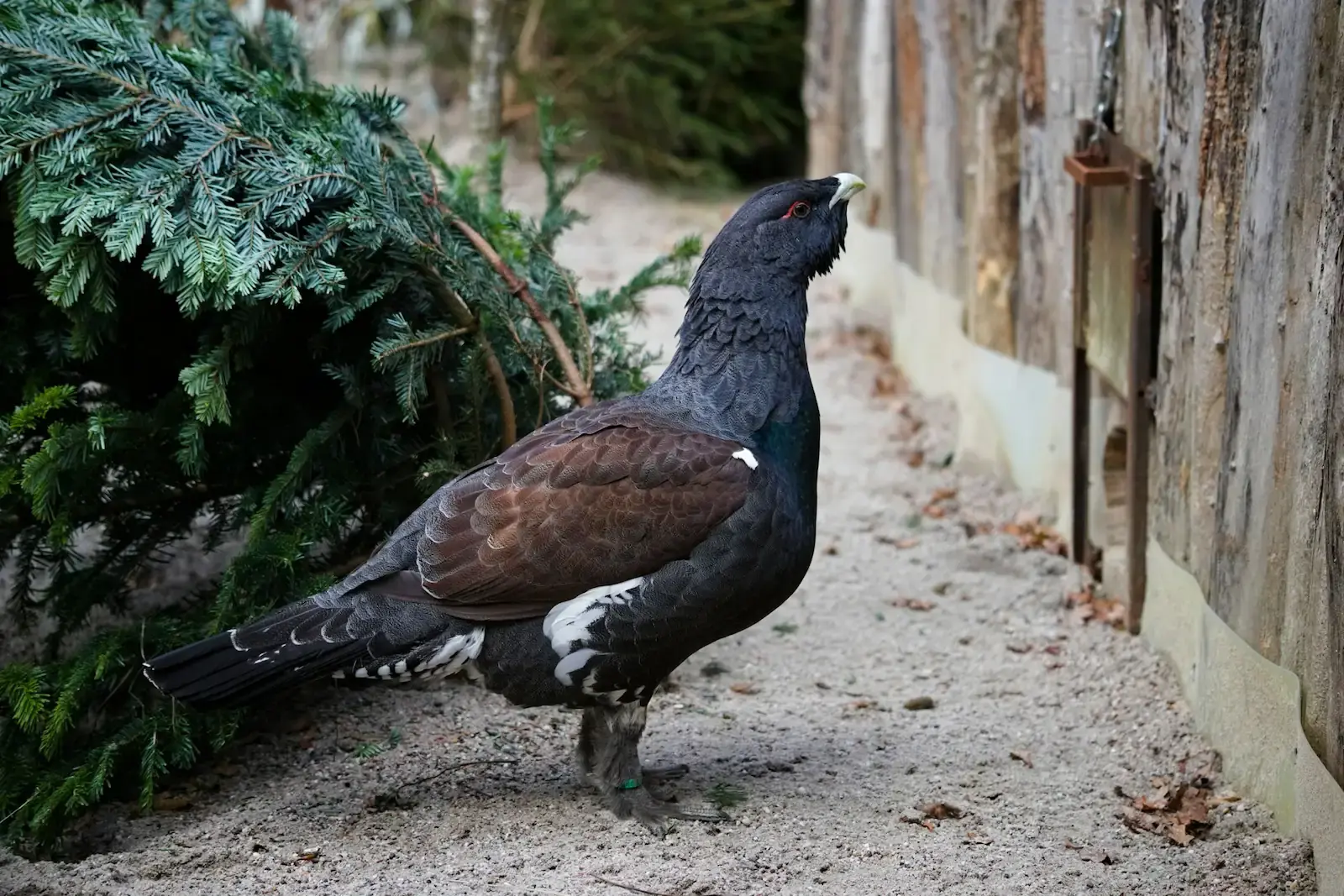
Western Capercaillie | Photo: Noureddine BOUABDALLAH
Communicating about sensitive species requires care. In the case of the capercaillie, there is no need to share locations, routes, forest tracks, lekking grounds or overly specific references in order to tell its story. In fact, avoiding those details is part of the responsibility.
It is possible to talk about the species through its ecology, conservation, behaviour, threats and symbolic value, without turning it into a direct observation goal. Its situation can also be explained with general data and official sources, without opening the door to pressure on critical areas.
This is especially important on social media, blogs, birdwatching forums and nature photography spaces. A publication with too much information can circulate far beyond the original intention. What for one person is simply an approximate location, for a sensitive species can become an accumulation of visits.
With the capercaillie, communicating well does not mean saying everything. It means saying what is necessary to generate respect, knowledge and caution.
A species that reminds us not everything has to be seen
The capercaillie has something that few species retain in a world that is increasingly photographed: distance. It is not easy to see, it should not be searched for without judgement and it does not need to become a spectacular image in order to have value.
Perhaps that is why it matters so much. It reminds us that there is wildlife that exists better far from us, in silent forests, in areas we do not enter, in lekking grounds we do not know and in mountains that still keep secrets.
At NatSnap, we believe that observing wildlife also means knowing when not to get close. There are species that can be part of a responsible nature experience, and others that, because of their situation, teach us something different: that conservation sometimes begins by accepting that not every encounter should happen.
The capercaillie is one of those birds. Difficult to observe, easy to admire and urgent to protect.
Frequently asked questions about the capercaillie in Spain
What is the capercaillie?
The Western Capercaillie, Tetrao urogallus, is a large mountain forest bird belonging to the family of pheasants, partridges and wildfowl. In Spain it is represented by Cantabrian and Pyrenean populations.
Where does the capercaillie live in Spain?
In Spain, there are two main areas of presence: the Cantabrian Mountains, where the Cantabrian Capercaillie lives, and the Pyrenees, where the Pyrenean Capercaillie lives. Specific locations should not be disclosed because of the sensitivity of the species.
What is the difference between the Cantabrian Capercaillie and the Pyrenean Capercaillie?
The Cantabrian Capercaillie, Tetrao urogallus cantabricus, is found in the Cantabrian Mountains and is in an especially critical situation. The Pyrenean Capercaillie, Tetrao urogallus aquitanicus, lives in the Pyrenean area and maintains a wider distribution, although it is also in decline.
Why is it so difficult to see a capercaillie?
It is difficult to observe because it has low density, lives in mountain forest habitats, is discreet outside very specific moments and occupies sensitive areas where disturbance should not be generated. In addition, its populations in Spain are small and threatened.
Can you go to see capercaillies in Spain?
It should not be approached as a species to look for independently. Because of its conservation status and the sensitivity of its breeding areas, the responsible approach is to avoid direct searching, not visit lekking grounds, not share locations and respect access restrictions.
What are capercaillie lekking grounds?
Lekking grounds are areas where males perform their displays during the breeding season. They are very sensitive points for reproduction and should not be visited, photographed or disclosed.
Why is the capercaillie threatened?
The capercaillie is threatened by habitat loss and degradation, population fragmentation, low productivity, human disturbance, some infrastructures, changes in forest use, predation in certain contexts and the effects of climate change.
How can you help conserve the capercaillie?
The best way to help is to respect restrictions in sensitive areas, not search for or disclose locations, support habitat conservation, get information from reliable sources and understand that, in this species, not seeing it can also be a way of protecting it.