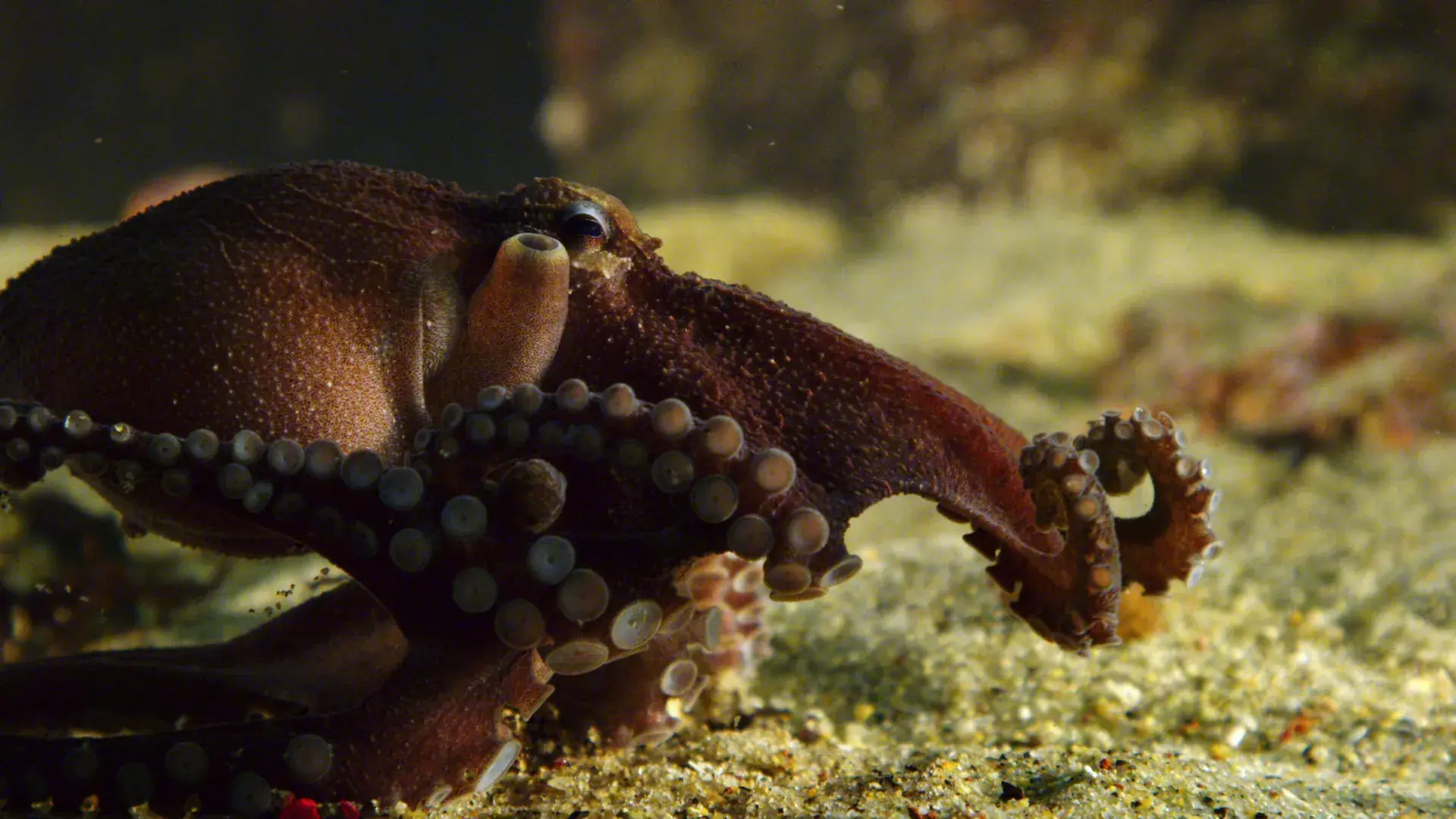
The octopus is one of those animals that seems to challenge almost everything we think we know about intelligence, the body and life in the ocean. It has eight arms packed with sensors, skin capable of changing colour and texture, three hearts, blue blood and a nervous system so different from ours that it is difficult to compare it with that of almost any other animal.
And no, it does not seem otherworldly simply because it is unusual. It seems that way because it has developed a completely different way of existing in the world: it processes information throughout its body, explores with its arms, camouflages itself in seconds and solves problems without a backbone, internal skeleton or the complex social life found in many mammals.
That is why few animals fit the NatSombrosos series as well as the octopus. Not because it is actually “alien”, but because it shows that intelligence can take very different forms from those we usually imagine. And the more science studies octopuses, the clearer it becomes that their unusual characteristics are not simply curiosities, but fascinating adaptations for surviving beneath the sea.
What kind of animal is an octopus?
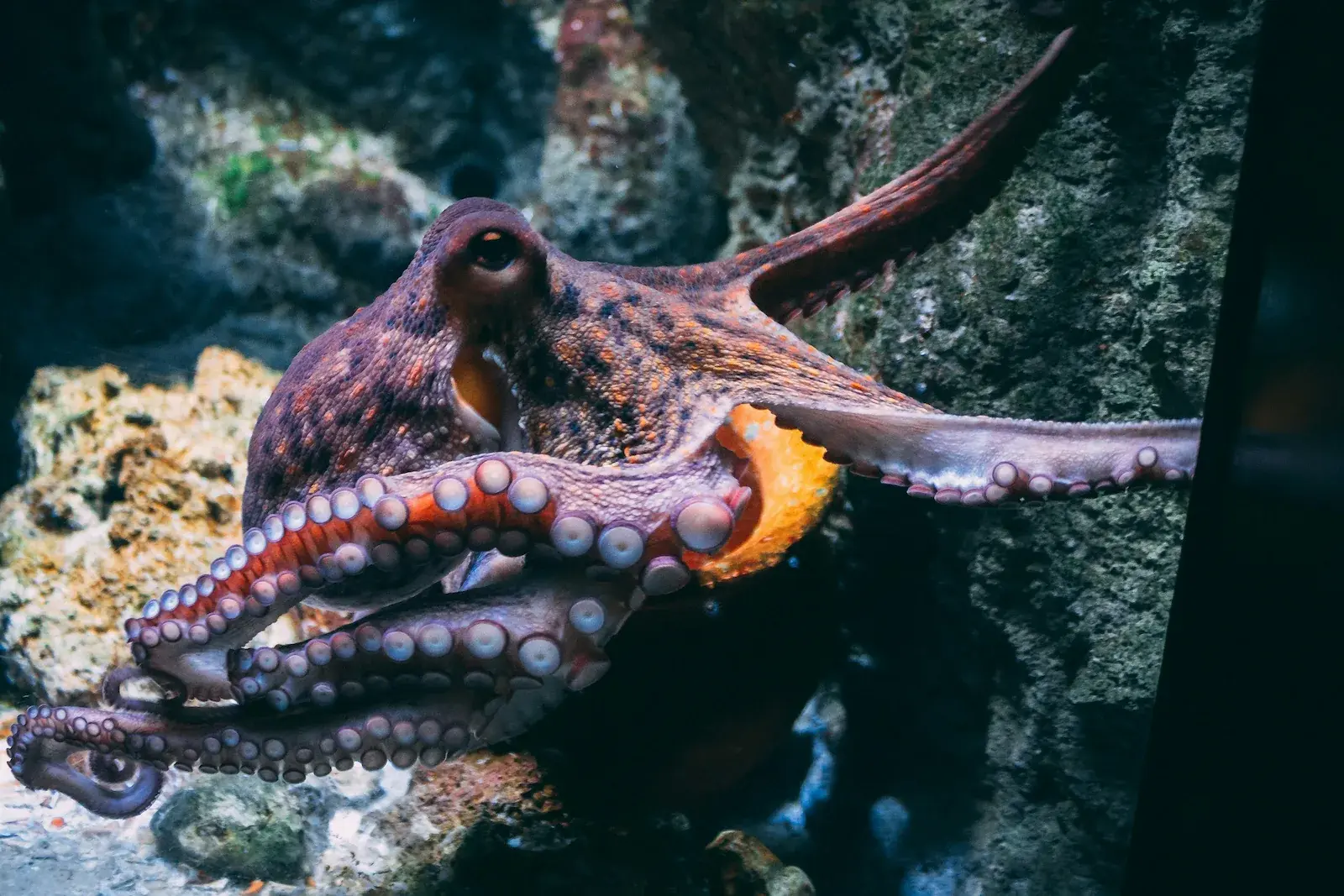
Octopus | Photo: Diane Picchiottino
Octopuses are cephalopod molluscs, part of the same broad group as squid, cuttlefish and nautiluses. In Spain, one of the best-known species is the common octopus, whose scientific name is Octopus vulgaris. Unlike many other molluscs, octopuses do not have an external shell to protect them, so their survival depends on other abilities: camouflage, flexibility, learning, strength in their arms, venom, ink and an extraordinary ability to explore their surroundings.
Their soft bodies allow them to squeeze into cracks, shelters and very narrow spaces, provided their beak can fit through, as this is one of the few hard parts of their body. This flexibility is not just an anatomical curiosity. It also helps explain why octopuses are so good at escaping, hiding and manipulating objects across rocky seabeds, reefs, seagrass meadows and sandy environments.
And although we often talk about “the octopus” as though it were a single species, there are actually many species of octopus, with different sizes, habitats and behaviours. Some of the curiosities we know about have therefore been studied in particular species, such as the common octopus, the California two-spot octopus or the mimic octopus, and they should not always be applied in exactly the same way to every octopus species on the planet.
Intelligence distributed throughout the body
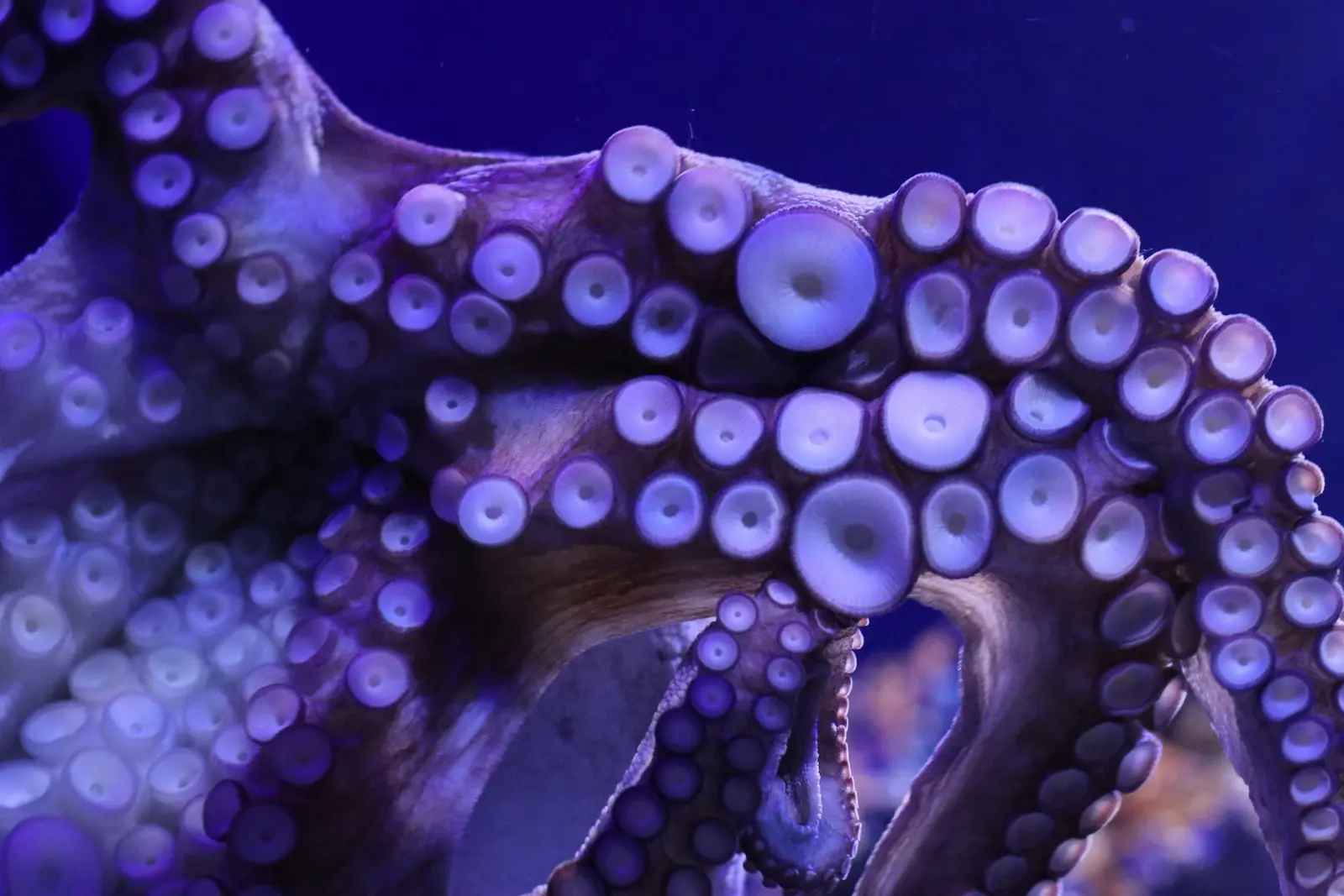
Octopus tentacles | Photo: Stephanie Harlacher
One of the most remarkable facts about octopuses is that their intelligence is not concentrated only in the head. The nervous system of the common octopus has been estimated at around 500 million neurons, with roughly two thirds located in the arms. This means that much of its sensory and motor processing happens outside the central brain.
This does not mean that each arm has its own independent mind, as though the octopus were made up of eight separate animals, but the arms do have a remarkable degree of autonomy. They can explore, touch, taste, react and coordinate movements without the central brain having to control every detail. Rather than functioning like a machine directed from a single centre, an octopus works more like a distributed network.
That organisation makes a lot of sense when we consider its body. An octopus has no bones or fixed joints, so each arm can bend, curl, stretch and move in many different directions. Controlling every point from a central brain would be an enormous task. Part of the octopus’s evolutionary solution appears to be allowing the arms themselves to take an active role in exploration and movement.
When an octopus puts an arm into a crevice, it is not simply “touching”. It is gathering chemical, tactile and spatial information. Its suckers can detect texture, shape and even chemical signals, allowing the animal to investigate a shelter, locate prey or recognise an object without relying only on sight.
Three hearts and blue blood
Another of the best-known octopus facts is that it has three hearts. Two pump blood towards the gills, where it is oxygenated, while the third pumps oxygen-rich blood around the rest of the body. The Smithsonian explains that cephalopods have three hearts and an oxygen transport system based on haemocyanin, a copper-containing protein that gives their blood a bluish colour.
This is not simply an aesthetic detail. While our blood uses haemoglobin, which contains iron, octopus blood uses haemocyanin, which contains copper. This molecule works differently and can be useful in marine environments where oxygen levels and temperature vary considerably.
The most curious part is that the octopus’s anatomy is closely linked to the way it moves. Many octopuses prefer walking along the seabed to swimming long distances, and there is a reason for this. BBC Earth notes that the systemic heart can stop beating while an octopus swims, helping to explain why jet-propelled swimming may be more energetically demanding than moving along using its arms.
Its three hearts, then, are not simply a biological oddity. They are part of the anatomy of an active, flexible predator with a large nervous system and a high dependence on oxygen.
Memory, learning and problem-solving
Octopuses have demonstrated learning abilities that were once associated almost exclusively with vertebrates. Laboratory studies have shown that they can learn to solve tasks, remember associations and improve through experience. In a classic experiment with common octopuses, the animals were able to open sealed transparent jars to reach prey, demonstrating trial-and-error learning.
Beyond the famous jar example, researchers have also studied visual discrimination, mazes, problem-solving and behavioural flexibility. In a study published in PLOS ONE, several octopuses solved a puzzle task in which they had to manipulate an object to reach food, which was interpreted as evidence of behavioural flexibility and problem-solving ability.
What makes this especially interesting is that their intelligence does not look quite like ours. Octopuses do not have hands, expressive faces, prolonged family lives or brains organised like those of mammals. Their intelligence emerged through a very different evolutionary pathway, shaped by the pressure of surviving as a soft-bodied and vulnerable animal without permanent protective armour.
That combination of vulnerability and exploratory ability may explain some of their behaviour. An octopus needs to hide, learn quickly, recognise shelters, manipulate prey, avoid predators and adapt to unfamiliar situations. Its intelligence therefore appears less like an isolated curiosity and more like a tool for survival.
Masters of camouflage
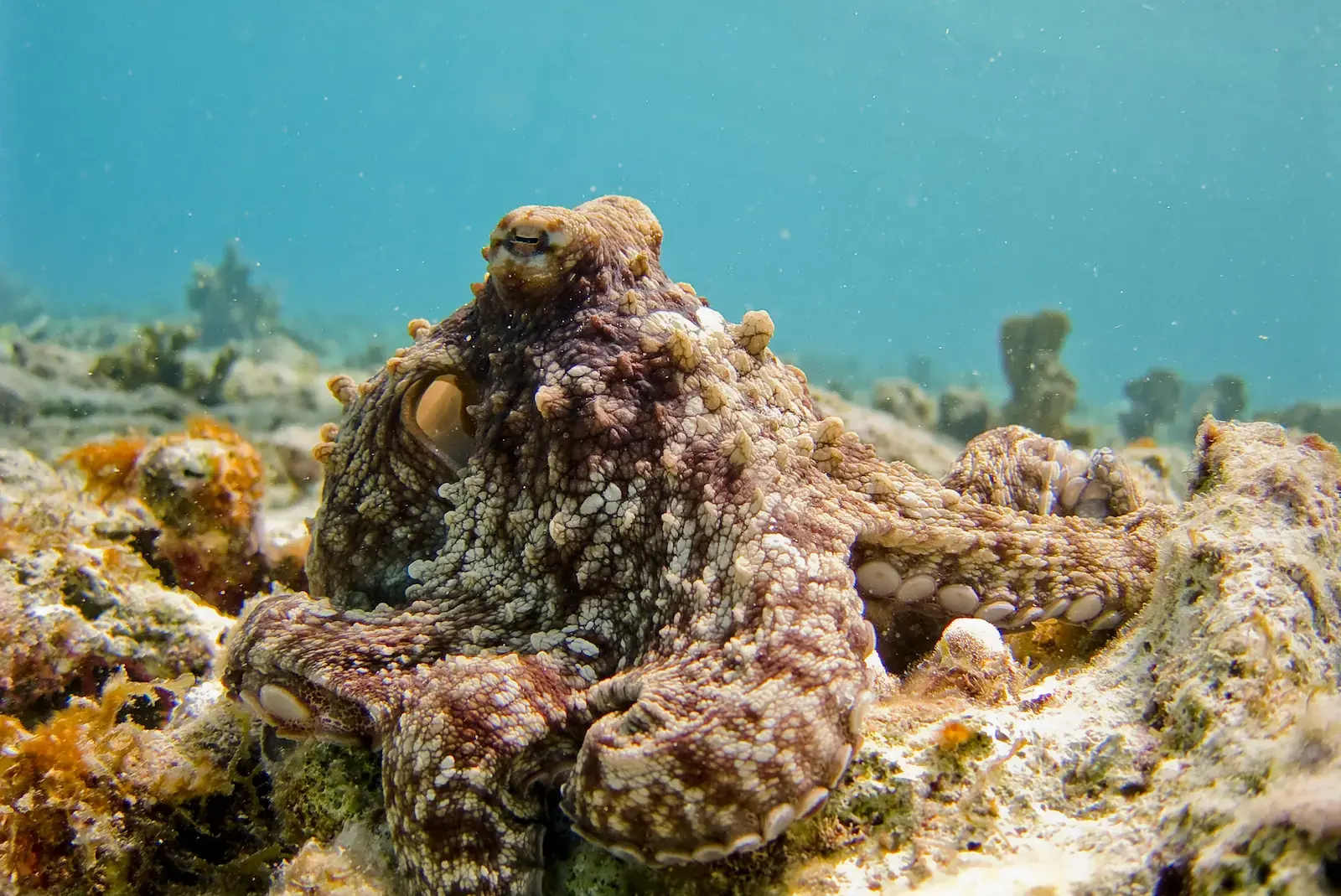
Camouflaged octopus | Photo: Vlad Tchompalov
Octopus camouflage is one of the great wonders of the marine world. Many species can change colour, pattern and even texture thanks to specialised structures in their skin, including chromatophores, iridophores, leucophores and papillae. Smithsonian Ocean explains that octopuses and other cephalopods can change not only the colour but also the texture of their skin, allowing them to resemble rocks, algae, sand or coral.
This camouflage does not work like a static disguise. It is dynamic, rapid and controlled by the nervous system. The animal can become lighter or darker, create spots, visually break up the outline of its body or raise small projections on its skin to imitate the texture of its surroundings.
Cephalopod skin is also used for more than simply hiding. Changes in colour and pattern can play a role in visual signals, threat responses and interactions with other animals. A review of dynamic patterns in cephalopods describes how their chromatophores can coordinate into complex visual signals, comparable to living pixels.
It is important, however, to distinguish between general camouflage and specialised mimicry. Many octopuses camouflage themselves, but not all imitate other animals. The most famous example is the mimic octopus, an Indo-Pacific species capable of changing its posture, shape and movement to resemble animals such as flatfish, lionfish or sea snakes. The American Museum of Natural History describes how the mimic octopus adjusts its posture and movement to imitate other species, which is much more specialised than simply changing colour.
Skin that can also detect light
One of the most surprising parts of an octopus is its skin. Scientists have long known that cephalopods change colour through neural signals linked to vision, but some studies have shown something even stranger: their skin can respond directly to light.
A study on the California two-spot octopus found that isolated skin could produce a response known as light-activated chromatophore expansion. Put more simply, certain cells in octopus skin can detect light and respond to it without the animal’s eyes being involved.
This does not mean that an octopus can “see” with its skin in the same way that it sees with its eyes. That would be an exaggeration. But it does suggest that its body has a much more complex relationship with light than we might imagine. Its skin is not simply a surface that changes colour, but an active sensory organ involved in how the animal perceives and adapts to its environment.
So when we say that an octopus seems to see with its whole body, it may be a poetic way of putting it, but there is an interesting biological basis behind the idea. Its skin detects, responds and participates in a constant relationship with the underwater landscape.
Editing RNA to adapt to the environment
Octopuses are not changing their DNA every time they adapt. Instead, some species can modify the information expressed through RNA.
RNA editing allows the same genetic information to be translated into slightly different proteins without altering the original DNA sequence. In 2023, a study published in Cell showed that the California two-spot octopus can extensively alter RNA editing in neural tissue when temperatures change, adjusting proteins related to nervous system function.
This is fascinating because it introduces another form of adaptation. Rather than relying only on genetic changes between generations, the animal can adjust part of its molecular functioning during its lifetime. It is neither magic nor science fiction, but it is a biological strategy that feels highly unintuitive if we are used to thinking of DNA as a fixed and untouchable instruction manual.
This kind of research also helps explain why cephalopods are so unusual. Their uniqueness is not limited to their arms or camouflage, but extends to internal mechanisms that influence how their nervous system functions.
They sleep in a way that resembles REM sleep
Another remarkable octopus fact has to do with sleep. During rest, some octopuses alternate between states of quiet sleep and active sleep. During these active periods, they may move their eyes, change their breathing and rapidly alter the colour and texture patterns of their skin.
A study published in iScience described a cyclical alternation between quiet sleep and active sleep in octopuses, accompanied by dynamic changes in colour and texture. Later, research published in Nature analysed neural activity and skin patterns during sleep and found that active sleep in octopuses resembles vertebrate REM sleep in some respects, including wake-like neural activity and small body movements.
We need to be careful with the language here. Saying that octopuses “dream” may be a beautiful way to describe it, but science cannot yet confirm that they dream as we do or consciously replay memories. What we do know is that their sleep is neither simple nor passive.
Watching an octopus change colour while asleep is almost hypnotic because it can look as though its body is displaying internal scenes. We may not know what it experiences, but its sleep does reveal a mental and bodily life far more complex than was once assumed for many invertebrates.
Sentient octopuses and a new way of looking at invertebrates
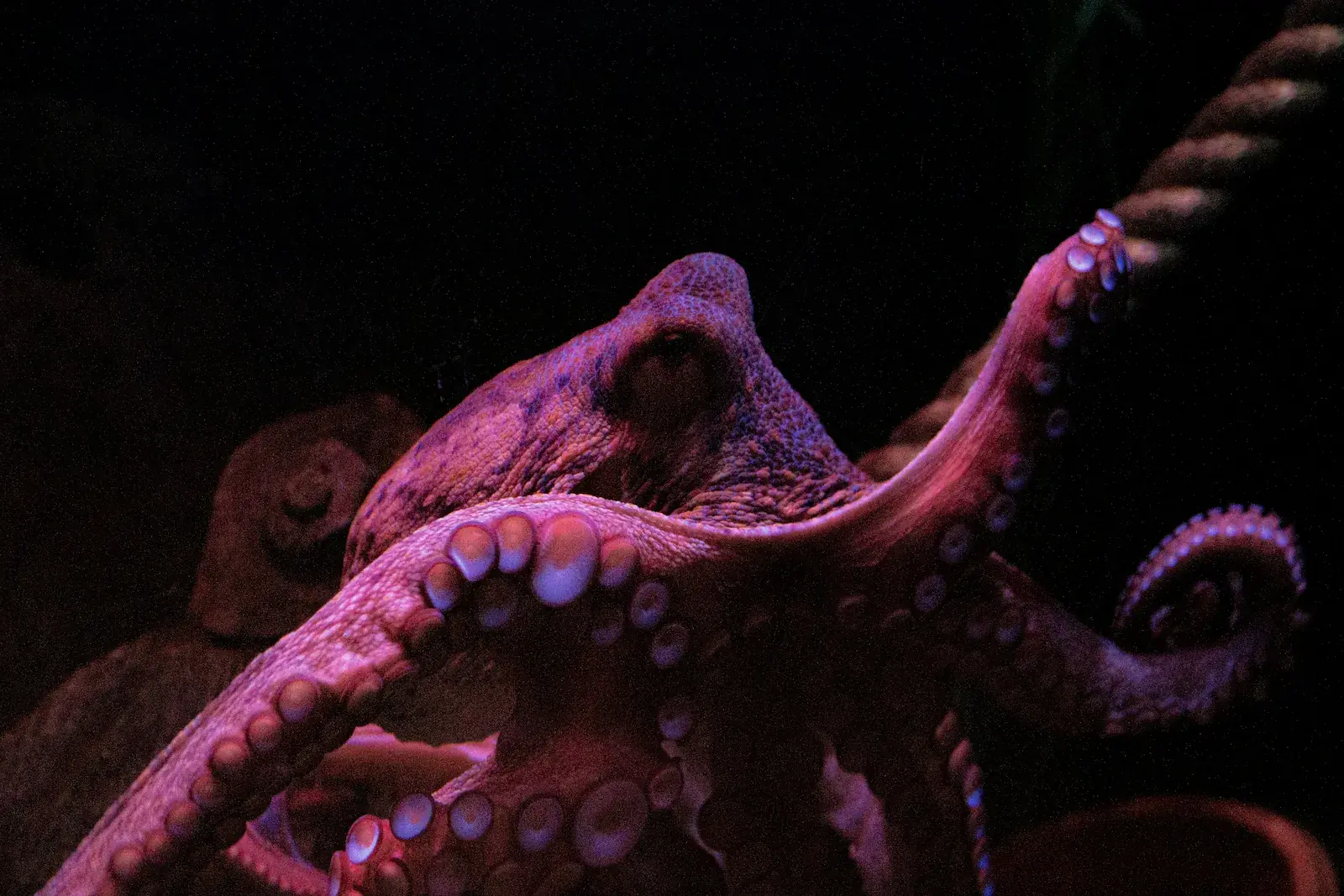
Octopus | Foto: Matteo Vella
For a long time, many invertebrates were treated as simple, almost automatic animals. Octopuses, however, have forced us to reconsider that view. Their behaviour, nervous system and learning abilities have led both science and legislation to take their welfare more seriously.
A review commissioned by the UK Government and carried out by the London School of Economics assessed more than 300 studies on cephalopods and decapod crustaceans, defining sentience as the capacity to experience states such as pain, pleasure, hunger, thirst, warmth, joy, comfort or excitement. Following evidence of this kind, UK animal sentience legislation includes cephalopod molluscs such as octopuses and squid within its definition of an animal.
This does not mean that we can know exactly what an octopus feels, nor that we should translate its experience directly into human emotions. But it does mean that it no longer makes sense to describe them as insensitive organisms driven purely by instinct.
Recognising their sentience changes the conversation. It makes us think about how we observe them, how we study them, how they are treated in aquariums or laboratories and even how we talk about them when sharing fascinating facts. Because the more we learn about octopuses, the less simple they appear.
What the octopus teaches us about animal intelligence
The octopus seems like it comes from another planet because it does not fit neatly into our usual categories. It has no bones, yet it can manipulate objects with precision. It does not have an expressive face like ours, yet it changes colour, texture and posture in response to its surroundings. It does not have a central brain comparable to that of a mammal, yet it learns, remembers and solves problems.
It also fascinates us because its intelligence evolved along such a different path. Humans, dolphins, primates and birds often dominate conversations about animal intelligence, but the octopus demonstrates that minds can emerge in radically different kinds of bodies.
Perhaps that is precisely why we find it so fascinating. An octopus looks nothing like us, yet it forces us to recognise something resembling curiosity, strategy, exploration and adaptation. It is living proof that nature does not have just one way of creating intelligence.
Observing octopuses also means learning how to look beneath the surface
Seeing an octopus in the wild is not always easy. They often remain hidden among rocks, crevices, seagrass meadows or seabeds where their camouflage makes them almost invisible. And that is part of their appeal: rather than searching for an obvious silhouette, you need to learn to notice details, textures, colour changes and tiny movements.
If you ever see an octopus while snorkelling, diving or exploring permitted intertidal areas, the important thing is to keep your distance and never touch, chase or remove it from the water, or try to provoke a reaction simply to make it change colour. Its camouflage, ink and movements are not there to entertain us, but to help it survive.
Observing an octopus responsibly means accepting that the encounter may be brief, discreet or may not happen at all. But it also means understanding that beneath the surface live animals with ways of life far more complex than we might imagine from above.
An impossible mind beneath the sea
The octopus is not simply a curious animal. It is one of the clearest examples of how intelligence, sensitivity and adaptation can emerge in bodies completely unlike our own.
Its arms explore almost as though they were thinking, its skin responds to its surroundings, its blue blood supports an unusual anatomy, its three hearts reveal another way of living underwater and its active sleep reminds us how little we still know about the mental lives of other animals.
That is why talking about octopus facts is not simply about collecting surprising details. It opens the door to a much bigger question: how many forms of intelligence exist in nature, and how many are still going unnoticed simply because they do not resemble our own?
At NatSnap, we continue creating guides to help you discover animals, destinations and nature experiences from a responsible perspective, without promising sightings and without putting the wildlife we want to observe at risk.
Frequently asked questions about octopuses
How many hearts does an octopus have?
An octopus has three hearts. Two pump blood towards the gills so it can be oxygenated, while the third pumps oxygen-rich blood around the rest of the body.
Why is octopus blood blue?
Octopus blood is blue because it uses haemocyanin, a copper-based protein, to transport oxygen. Human blood, by contrast, uses haemoglobin, which is based on iron.
Do octopuses have nine brains?
Not exactly. It is common to hear that octopuses have “nine brains”, but this is an oversimplification. More accurately, they have a highly distributed nervous system, with one central brain and a large number of neurons located in their arms.
Are octopuses intelligent?
Yes. Octopuses have demonstrated learning, memory, exploration and problem-solving abilities. They can manipulate objects, learn through experience and adapt to new situations.
Can octopuses change colour?
Yes. Many octopuses can change colour, pattern and even texture thanks to specialised structures in their skin. This ability helps them camouflage themselves, respond to threats and communicate visually in certain contexts.
Do octopuses dream?
Scientists cannot yet say that octopuses dream in the same way humans do. What has been observed is that some octopuses alternate between quiet and active sleep, with movements and colour changes that share certain similarities with REM sleep in vertebrates.
Do octopuses feel pain?
Scientific evidence suggests that octopuses can experience pain and other states associated with sentience. This is why some legal frameworks, including that of the United Kingdom, now include cephalopods within animal sentience legislation.