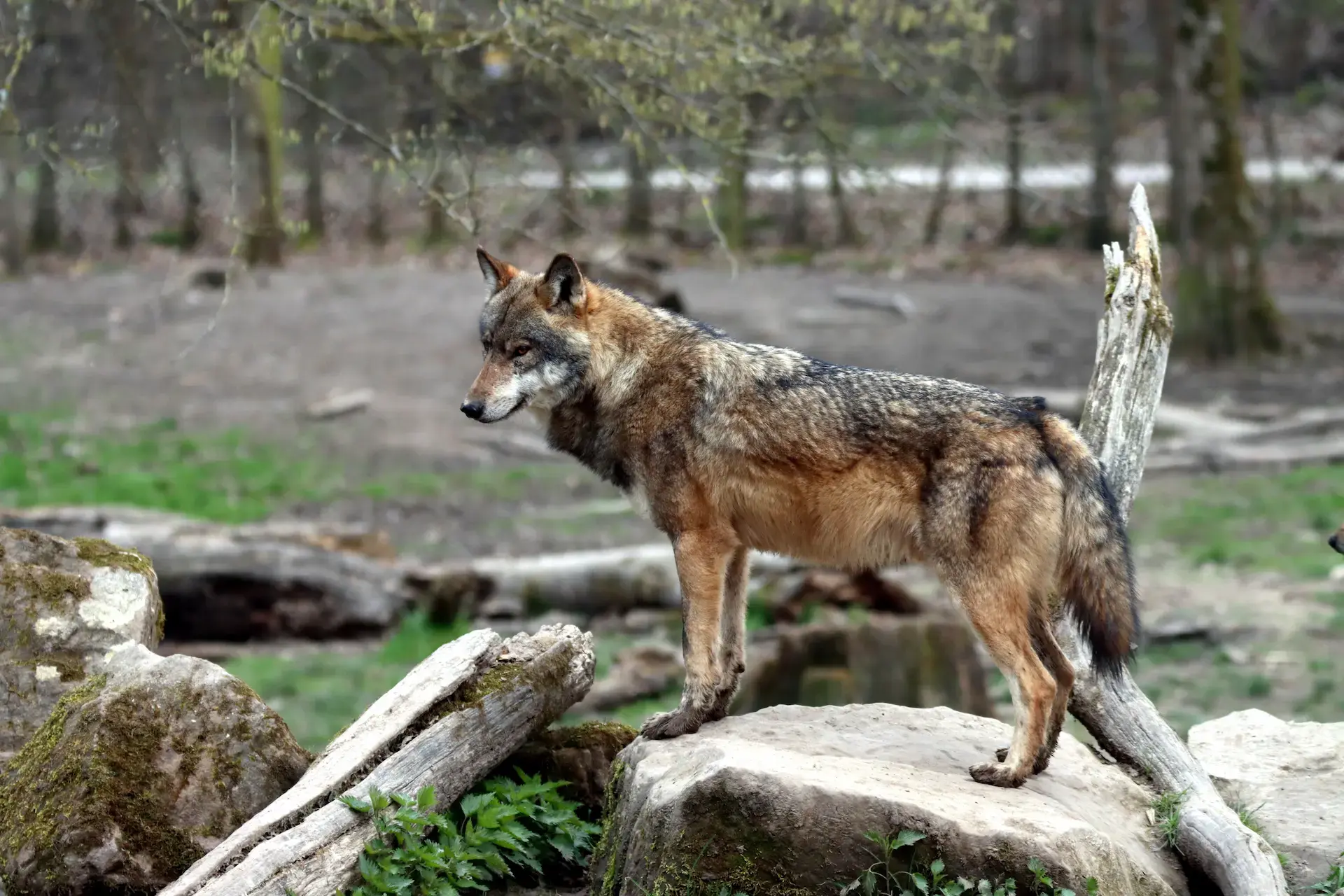
If you are wondering where to see the Iberian wolf in Spain, the answer begins in the north-west of the Iberian Peninsula. Castilla y León, Galicia, Asturias and Cantabria are home to most of its packs, although there are also areas where its presence is more limited or expanding, such as the Basque Country, Madrid, Castilla-La Mancha, La Rioja and Extremadura.
In this blog, we will explore the areas most closely associated with Iberian wolf watching, the landscapes it inhabits and the current context surrounding a species that is as admired as it is debated. Because observing a wolf is not simply a matter of reaching a location and waiting for a sighting. It is also about understanding how wolves move, how their packs are organised and why their presence is so important to the balance of ecosystems.
How the Iberian wolf lives in Spain
The Iberian wolf, whose scientific name is Canis lupus signatus, is a subspecies of wolf found on the Iberian Peninsula. Its life is closely linked to mountain ranges, woodland, scrubland, livestock areas, open landscapes and territories where it still has enough space to move, hunt and maintain the structure of its packs.
Unlike other species that are easier to observe, wolves move discreetly and usually avoid direct contact with people. They can travel considerable distances within their territory and use different areas depending on the time of year, food availability, the presence of the pack or the level of human pressure in the area. This is why spotting one does not simply depend on being somewhere where wolves are present, but also on understanding how they use the landscape and why certain habitats are more suitable than others.
Where the Iberian wolf lives
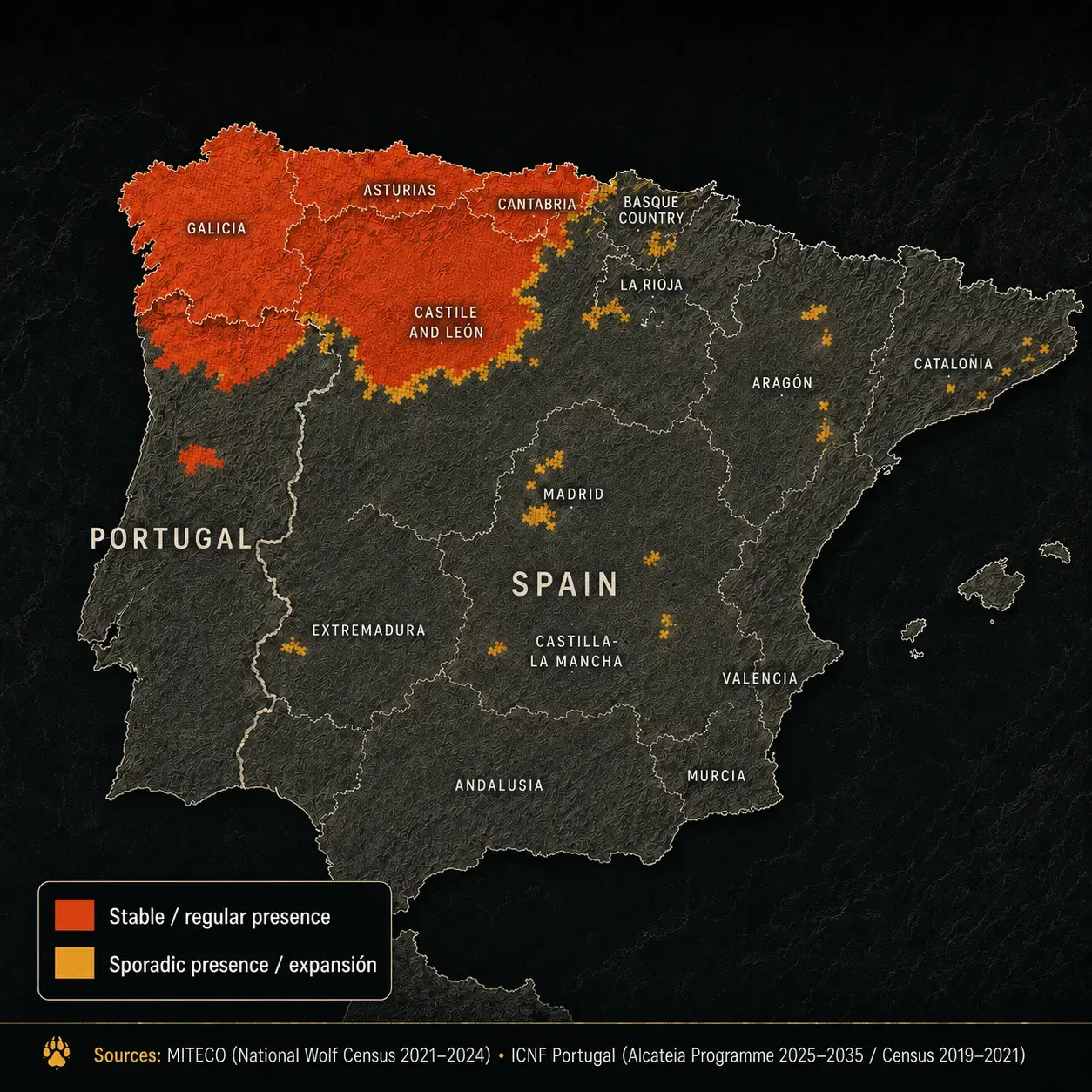
Iberian wolf expansion | Source: MITECO
The Iberian wolf lives mainly in north-western Spain. The 2021–2024 national census recorded 333 wolf packs in Spain, with most of the population concentrated in Castilla y León, Galicia, Asturias and Cantabria.
Within this wider wolf range, Castilla y León is one of the areas most closely associated with Iberian wolf watching. The Sierra de la Culebra, in Zamora, is probably one of the best-known locations, not because seeing wolves there is easy, but because over the years it has become a reference point for wolf-watching tourism.
The Cantabrian Mountains are also part of the Iberian wolf's major landscapes. In areas of Asturias, Cantabria, León and Palencia, the species shares its environment with mountains, valleys, villages, livestock farms and areas of high natural value. In these territories, the wolf cannot be understood simply as an isolated animal, because it forms part of a network involving prey, scavengers, vegetation, livestock, roads and human activity.
Galicia is another important region for the species, particularly in woodland, mountain ranges and landscapes where forest, scrub and livestock farming coexist. There are also territories where its presence is more limited or expanding, such as the Basque Country, Madrid, Castilla-La Mancha, La Rioja and Extremadura, although greater caution is needed when discussing these areas because they may involve recently established packs, dispersing individuals or populations that are still very small.
How to observe the Iberian wolf in wolf territories
Once you know where the Iberian wolf lives, the next step is understanding how wolf-watching experiences are usually approached. In areas such as the Sierra de la Culebra, the Cantabrian Mountains and parts of Galicia, observation generally takes place from open viewpoints using binoculars or spotting scopes, often accompanied by people who understand the species' behaviour and how it uses its territory.
It is not simply a matter of waiting for a wolf to appear, but of learning how to read the landscape. Tracks, crossing points, changes in light, the activity of other species and the structure of the terrain itself can all help explain why a pack might move through a particular area, cross a hillside or remain out of sight for hours.
The best times for wildlife watching are often around dawn and dusk, when many animals are more active and the light makes long-distance observation easier. Even so, sightings are never guaranteed, even in areas well known for their wolf populations, and that uncertainty is part of what makes these experiences so special.
Why the Iberian wolf is back at the centre of the debate in Spain
The Iberian wolf is back at the centre of the debate because its level of protection has changed. In 2025, Law 1/2025 amended Royal Decree 139/2011 so that only wolf populations south of the River Duero remained included in the List of Wild Species under Special Protection. Following this change, wolf hunting north of the Duero once again became a possibility in several autonomous communities.
The problem is that this decision does not simply affect a supposedly “problematic” species or a figure in a population census. It affects a social predator that plays an important role in the landscape, because its presence influences how prey species move, where they feed, how the remains of dead animals are used and the balance maintained between different wildlife species.
For this reason, when the conversation turns to killing wolves again, it should not stop at whether there are more or fewer individuals. We also need to ask what happens when a predator that lives in packs is removed; one that can influence the pressure herbivores and wild boar place on the landscape, provide food for scavengers and, in some contexts, help reduce the transmission of disease within ungulate populations.
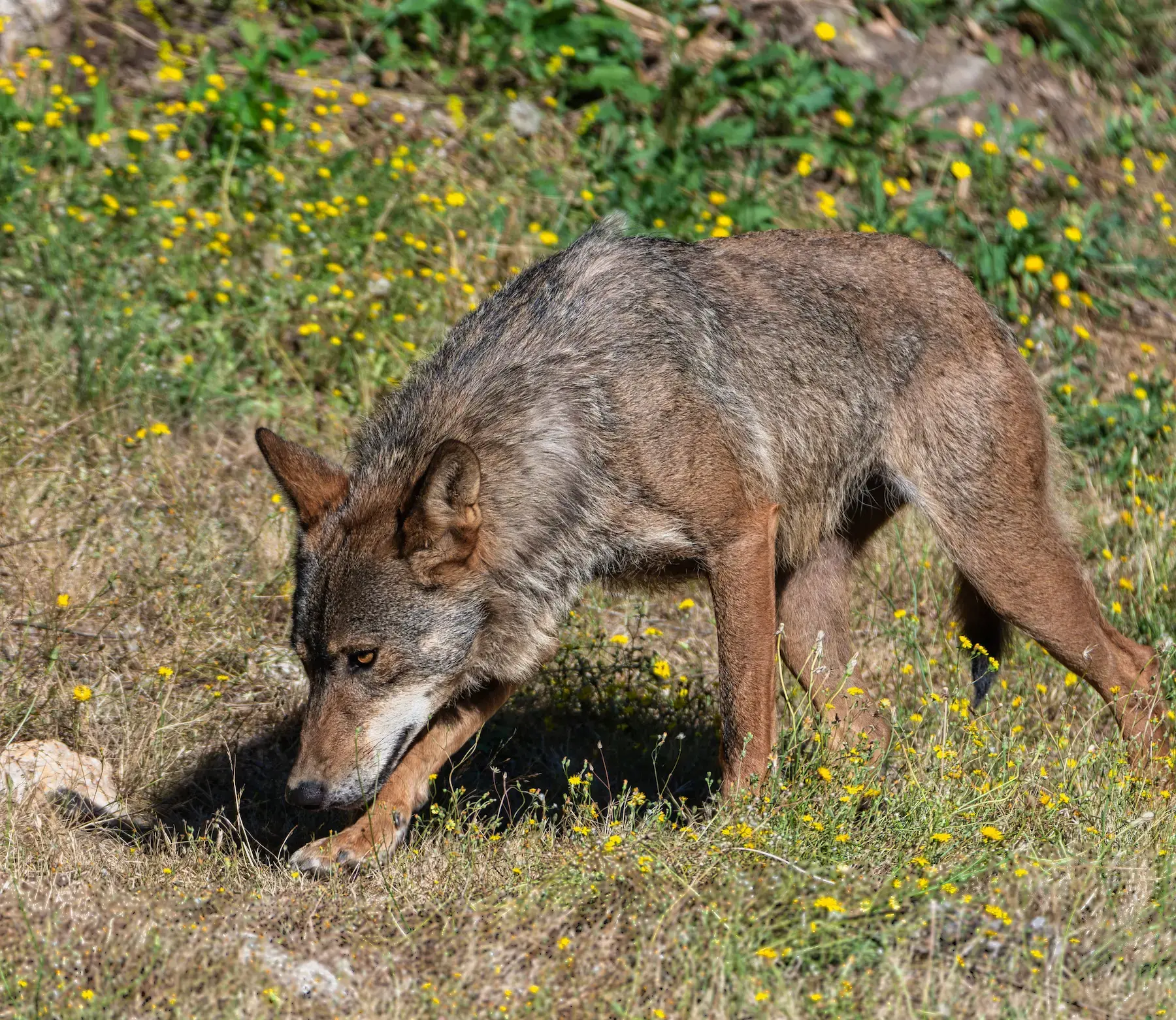
Iberian wolf following a scent trail | Photo: Jesús Esteban San José
The role of the Iberian wolf in the ecosystem
The Iberian wolf is a large predator, but its importance lies in far more than what it hunts. It also lies in everything that changes around its presence.
When wolves inhabit a territory, red deer, roe deer, wild boar and other ungulates do not use the landscape in the same way. The risk of predation can make them move more cautiously, avoid certain areas or alter their schedules and routes. This matters because the pressure exerted by herbivores and wild boar is not distributed evenly across the landscape. When they become too concentrated in one area, they can increase pressure on vegetation, disrupt the regeneration of young plants, disturb the soil or contribute to imbalances that are not always immediately visible.
The wolf cannot solve all these processes by itself, but it forms part of an ecological network that prevents landscapes from functioning as though large predators did not exist. Its presence introduces movement, risk, natural selection and limits within the ecosystem.
It also performs a less visible but very important role. Large predators often find it easier to catch vulnerable, sick, young, old or weaker animals. In Asturias, a study examining wolves, wild boar and tuberculosis found that the presence of wolves may help reduce the prevalence of tuberculosis in wild boar, a species that acts as a reservoir for the disease. Put simply, in some contexts wolves do not only hunt; they may also help reduce the circulation of certain diseases within ecosystems.
There is another effect that is often overlooked. When a wolf makes a kill, not everything ends up being consumed by the wolf. The remains of its prey can provide food for scavenging birds, corvids, foxes, mustelids, insects and many other animals that make use of this organic matter. A single animal killed by wolves can become a food source for numerous other species while returning nutrients to the ecosystem.
The wolf is therefore much more than an animal that generates debate. It is an ecological component connecting prey, scavengers, vegetation, disease, wildlife movement and the wider balance of the landscape.
What can happen when wolves disappear from an area
When a wolf is removed, the impact is not always immediately visible. The landscape may appear unchanged, prey species may still be present and other wolves may remain in the area. However, in social and territorial species, the consequences can emerge in more complex ways.
If mortality increases, some packs can become smaller, reproduce less successfully or find it more difficult to occupy large territories. A study led by the Doñana Biological Station–CSIC concluded that reducing mortality among Iberian wolves living in family groups by 10% could result in larger groups, greater reproductive success and longer dispersal distances.
This is important because dispersal does not simply mean moving from one place to another. It means colonising new territories, connecting populations and preventing the species from becoming confined to isolated areas. In fact, the same study links mortality to the fact that the Iberian wolf's distribution range has barely increased over recent decades, despite the existence of suitable habitats into which the species could expand.
A law that makes it easier to kill wolves across part of their range is therefore not simply a hunting management decision. It can also affect the species' ability to recover, disperse and maintain connected populations over the long term.
Why killing one wolf can affect the entire pack
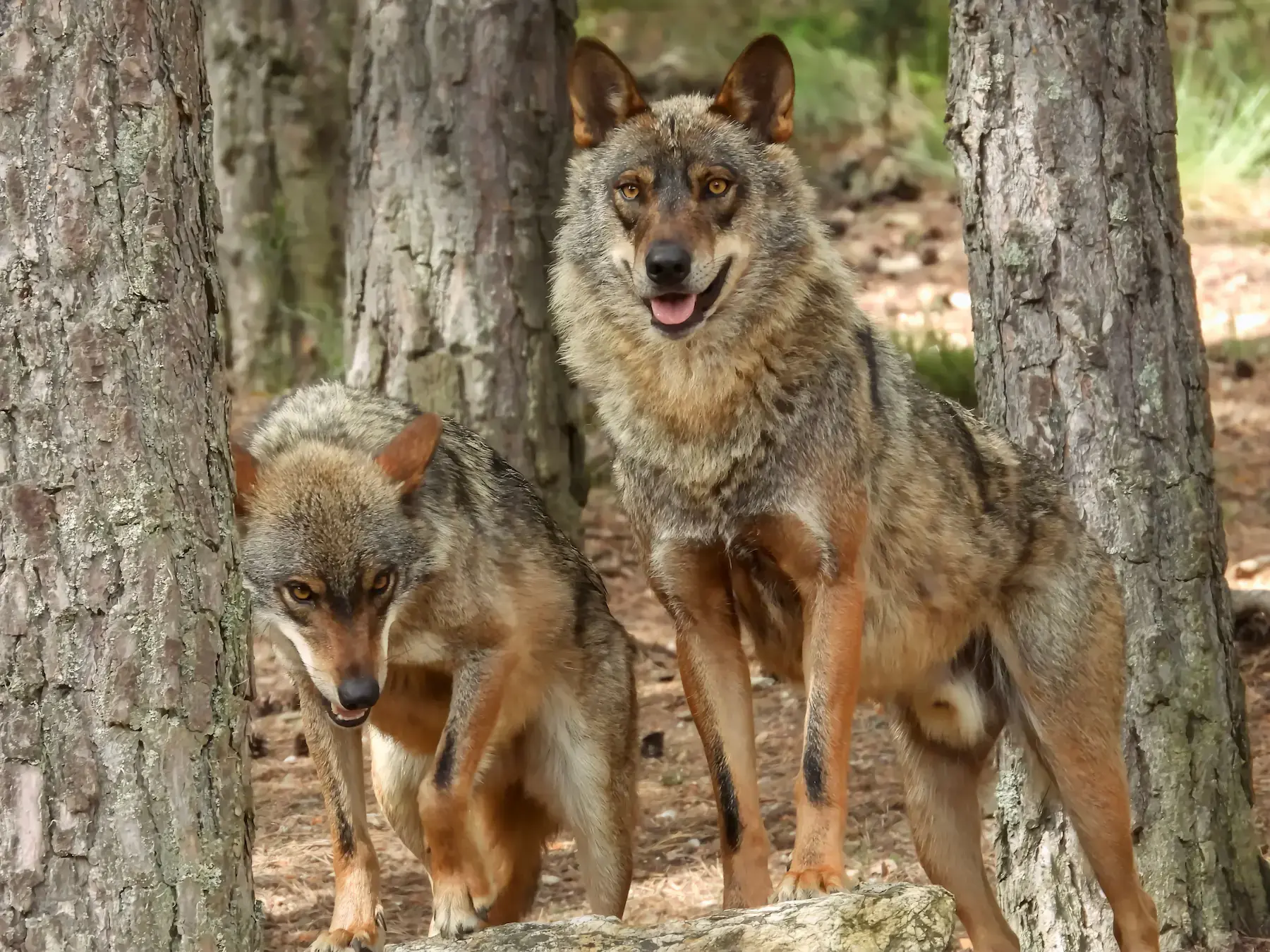
A pair of Iberian wolves | Photo: Manuel from Pexels
A wolf pack is not simply a group of animals travelling together. It is a social structure, normally a family unit, in which certain individuals play key roles in reproduction, group cohesion, territorial defence and the learning of younger animals.
This is why killing one wolf does not always simply mean “one fewer individual”. If a young dispersing wolf dies, the impact may be very different from the death of a breeding wolf within a small pack. In the latter case, the loss can alter the organisation of the group, affect reproduction, change how the territory is used or increase the risk of the pack becoming destabilised.
A 26-year study of grey wolves found that the loss of breeding individuals preceded 77% of recorded pack dissolution events, particularly when a female or both breeding individuals were lost and the group was small. This does not mean that every pack disappears when a wolf dies, but it does help illustrate an important point: in a social species, the life of one individual can support far more than its own survival.
When a pack breaks apart, it is not simply the group itself that is lost. Its routes, hunting behaviour, reproduction and use of the territory can also change. Instability may even increase within an area if dispersing, young or less experienced individuals are left attempting to reorganise themselves.
This is why a management system based solely on quotas or population figures can fall short. With wolves, how many individuals there are matters, but so does which wolf dies, when it dies and what role it played within the pack.
Changes to wolf protection and the risk of seeing the species only as a problem
The new legal situation is concerning because it risks returning the debate to an overly simplistic view: if wolves cause problems, reduce their numbers. But the wolf is neither a pest nor a species that does not belong in the landscape. It is a native predator that forms part of Iberian wildlife, and its presence has effects that go far beyond immediate conflict.
When the conversation focuses exclusively on damage to livestock, everything the wolf contributes to the ecosystem can become invisible. Attacks are discussed, but there is not always the same attention given to how wolves regulate wild populations, alter the behaviour of their prey, may help control disease in wild boar or provide carcasses that feed scavengers and other animals.
This does not mean denying that conflicts exist, but rather ensuring that conflict does not become the only way in which the species is understood. If a law makes it easier to kill wolves without considering pack structure, population connectivity and their ecological role, there is a risk of making decisions based on the most visible part of the problem while ignoring everything happening beneath the surface.
Wolves inhabited these territories long before many landscapes were fragmented by roads, fences, intensive farming and other human land uses. Talking about coexistence should therefore not mean expecting wildlife to adapt continually to our conditions, but recognising that some species need space, continuity and management approaches that do not reduce them simply to a source of inconvenience.
Observing wolves also means understanding why they matter
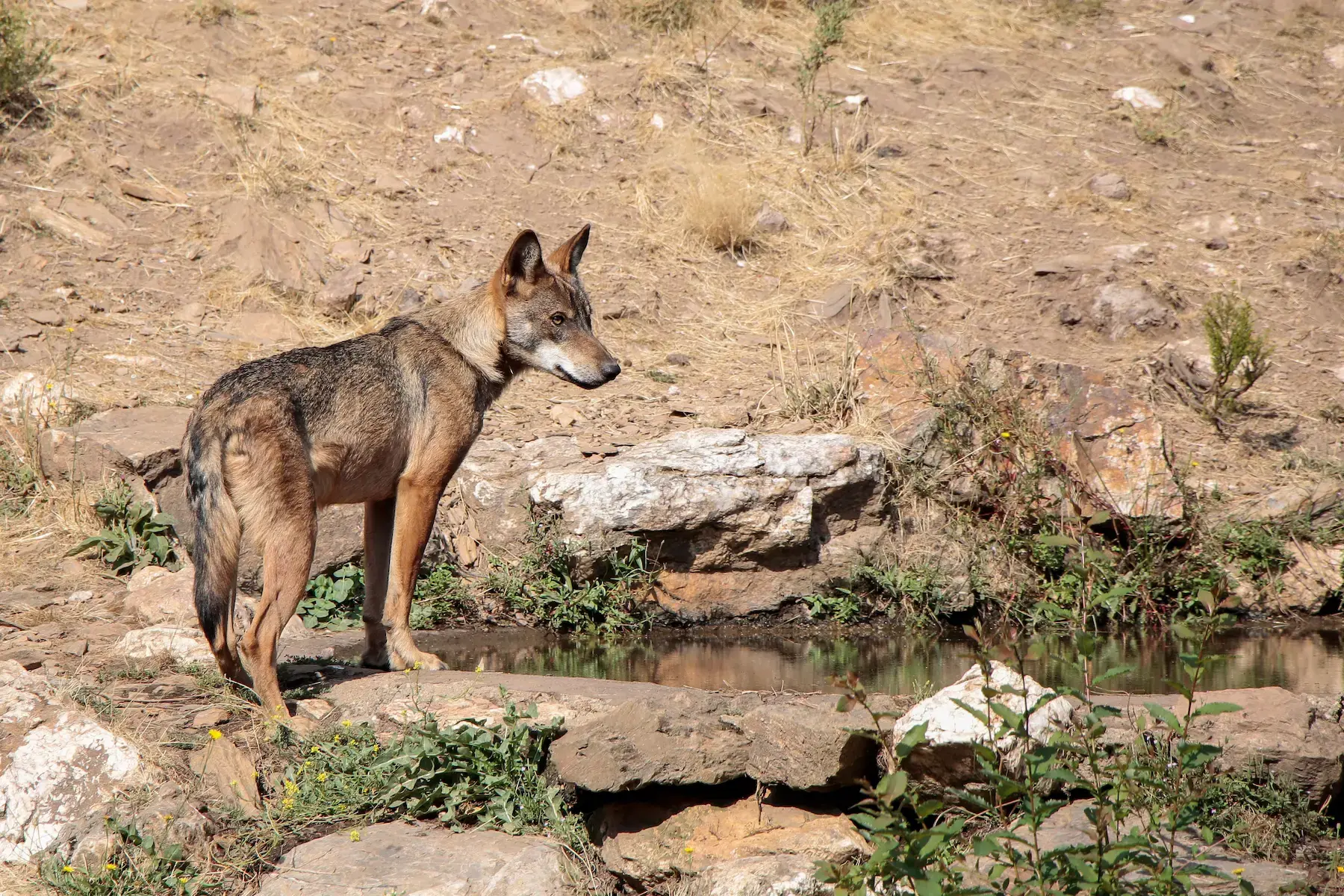
Iberian wolf by the lake | Photo: Natalia García Prieto
Seeing a wolf can be exciting, but understanding one may be even more important. A wildlife-watching trip should not focus solely on achieving a sighting, but also on reading the landscape that allows the species to remain there.
In wolf territories, every track, valley, crossing point and pack is part of a much wider story. The wolf tells us about connected ecosystems, wild prey, the limits of human activity and the need to accept that nature does not exist simply to adapt to us.
Observing the Iberian wolf is therefore not simply about staring at a point in the landscape and waiting for one to appear. It is about understanding that behind its presence lies a network of relationships between wildlife, the landscape and conservation. And the more we understand that network, the clearer it becomes that killing wolves should never be an easy or automatic response.
What the Iberian wolf teaches us about wildlife
The Iberian wolf reminds us that wildlife cannot be measured solely by the number of individuals remaining within a territory. In social species, packs, relationships, learning, reproduction and the ability to move between different areas are also essential to maintaining healthy populations.
It also reminds us that an ecosystem does not function in the same way with large predators as it does without them. Their presence can influence prey, scavengers, disease, movement patterns, territories and balances that are not always visible at first glance.
For this reason, the debate surrounding the wolf should not simply come down to whether it can be hunted. The deeper question is what kind of relationship we want to have with wildlife: one in which anything that causes inconvenience is eliminated, or one in which we learn to leave space for species that play an essential role even when they do not always fit neatly with our interests.
At NatSnap, we continue to create guides to help you discover animals, destinations and nature experiences from a responsible perspective, without promising sightings or putting at risk the wildlife we want to observe.
And if, after learning more about its role in the ecosystem, you would like to support its conservation, you can join WWF's Yo defiendo al lobo initiative.
Frequently asked questions about the Iberian wolf
Where can you see the Iberian wolf in Spain?
The Iberian wolf can mainly be observed in north-western Spain, particularly in parts of Castilla y León, Galicia, Asturias and Cantabria. The Sierra de la Culebra and certain areas of the Cantabrian Mountains are strongly associated with wolf watching, although sightings are never guaranteed.
What is the scientific name of the Iberian wolf?
The scientific name of the Iberian wolf is Canis lupus signatus. It is a subspecies of wolf found on the Iberian Peninsula.
What is the best time of year to see the Iberian wolf?
There is no particular time of year that guarantees a wolf sighting. In general, wildlife-watching trips tend to take place around dawn or dusk, when wildlife is more active and the light makes it easier to observe animals from a distance without disturbing them.
What happens if a wolf from a pack is killed?
It depends on which individual dies, the size of the pack and the time of year. If a breeding individual dies within a small pack, its social structure may be affected, potentially influencing reproduction, group cohesion or even the survival of the pack itself.
Is it advisable to share wolf locations on social media?
No. Sharing exact locations can increase pressure on the species, attract unprepared visitors and cause disturbance both to the wolves and to the rural environments in which they live.
How can you observe the Iberian wolf responsibly?
The most responsible approach is to observe wolves from a distance using binoculars or a spotting scope, without using calls or food, while respecting the rules of the natural area and, whenever possible, accompanied by guides or specialist professionals.