The Iberian lynx is one of the most recognisable animals in Iberian wildlife, but its importance goes far beyond its appearance. As a feline endemic to the Iberian Peninsula, its life is closely linked to the Mediterranean scrubland that provides shelter, the European rabbit it feeds on, and a conservation story shaped by habitat loss and the gradual recovery of its populations.
Talking about interesting facts about the Iberian lynx does not simply mean focusing on its appearance or on how difficult it can be to see one in the wild. It also means understanding how it lives, why it depends so heavily on its habitat, and what it can teach us about the way we should observe wildlife.
A unique feline of the Iberian Peninsula
The Iberian lynx, whose scientific name is Lynx pardinus, is a wild feline whose natural history is closely tied to the landscapes of Spain and Portugal, particularly areas of Mediterranean scrubland where it can find shelter, food and tranquillity.
For decades, it was one of the most threatened feline species in the world, with very small and fragmented populations. However, conservation programmes involving reintroduction, scientific monitoring and habitat restoration have enabled a remarkable recovery. Despite this improvement, it remains a sensitive species because its survival depends on very specific factors, including the presence of European rabbits, habitat quality, connectivity between populations, a reduction in road casualties, and the protection of the areas where it breeds, rests and moves.
The main historical causes of its decline include unnatural mortality, the decline of European rabbit populations and the destruction, fragmentation and alteration of its habitat. Protecting the lynx, therefore, has never simply meant protecting one animal, but also looking after the entire ecosystem that makes its survival possible.
For the Iberian lynx, the European rabbit is far from being a minor detail. Much of its life depends on this prey species, as rabbit availability influences where lynx can establish territories, how much space they require, how successfully they breed and how likely a population is to recover. When rabbit numbers decline because of disease, habitat loss or changes in the landscape, the lynx is also affected, even when the surrounding environment may appear natural at first glance.
To live and reproduce successfully, seemingly natural landscapes are not enough. The Iberian lynx requires healthy rabbit densities, dense vegetation for resting and breeding, and minimal human disturbance. Understanding the species therefore also means understanding the landscape that supports it.
7 Iberian lynx facts that explain why this species is unique
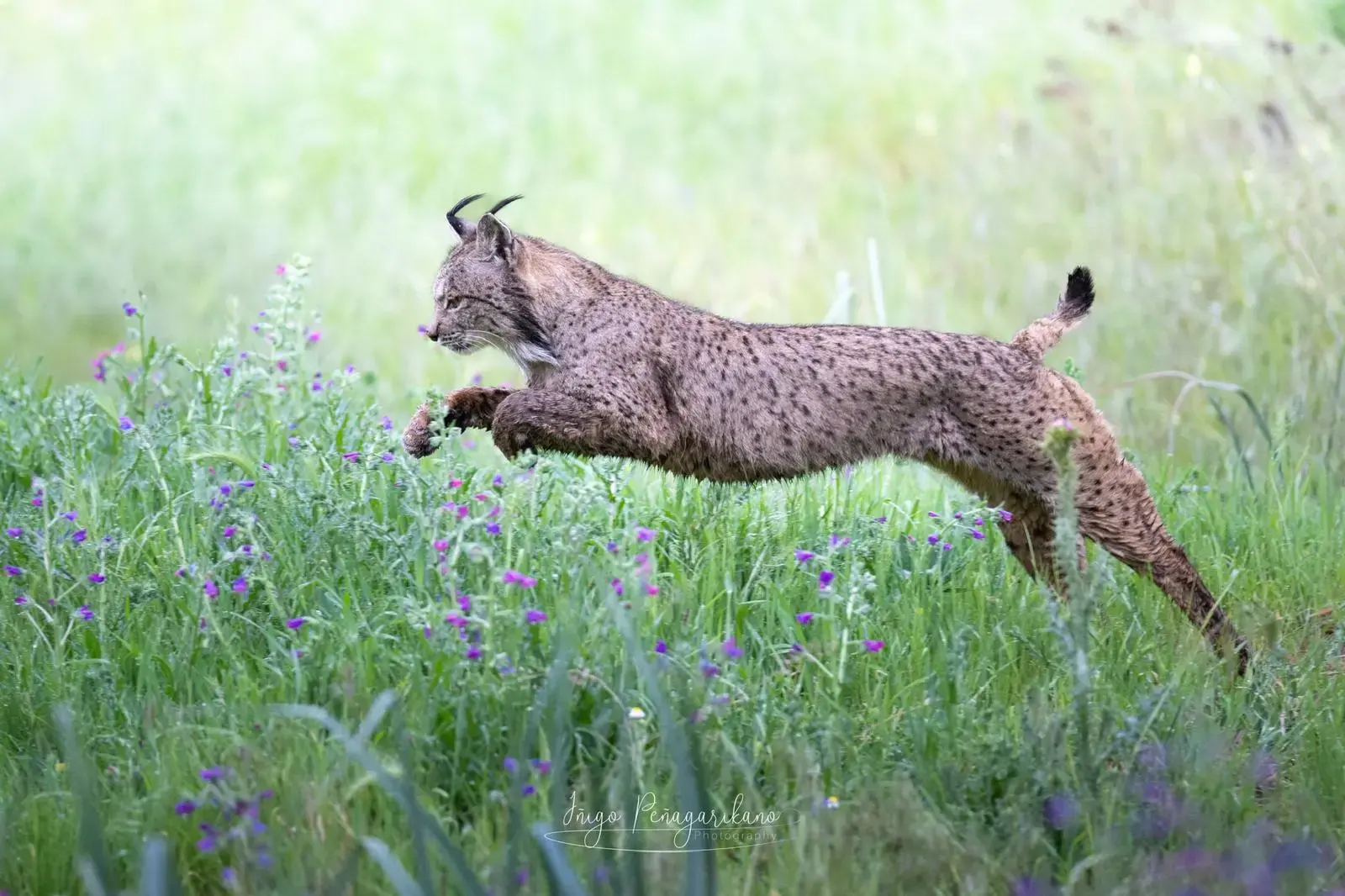
Iberian lynx jumping | Photo: Iñigo Peñagarikano
1. It is a feline found exclusively on the Iberian Peninsula
One of the most remarkable facts about the Iberian lynx is that its natural distribution is extremely limited. This means its conservation depends on well-connected landscapes with sufficient shelter, prey and natural corridors that allow animals to move between territories and maintain healthy populations.
This makes it an especially important species within Iberian wildlife, not simply because it is an attractive wild feline or difficult to see, but because it forms part of a very specific ecosystem, with the prey, shelter, breeding areas and territories it needs in order to survive.
Talking about the lynx therefore also means talking about Mediterranean scrubland, landscape conservation, ecological connectivity and natural balance.
2. Every lynx has a different pattern of spots
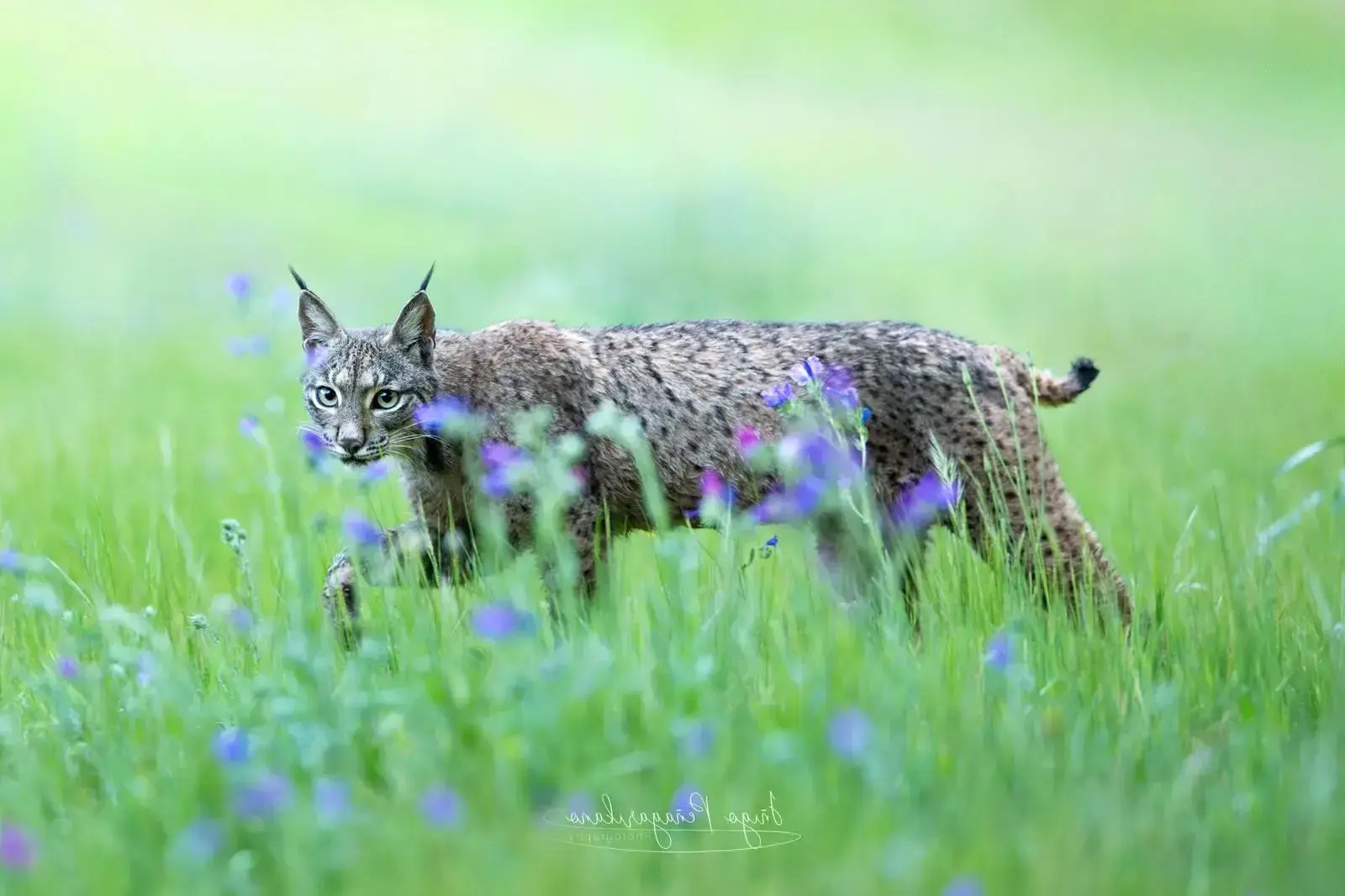
The Iberian lynx's coat is covered in dark spots that are among its most recognisable features and can vary considerably between individuals. In fact, today's subpopulations contain lynx with a wide variety of coat patterns, ranging from large spots to very fine speckles.
This pattern not only makes the Iberian lynx visually distinctive, but also reminds us that every animal is an individual rather than simply a generic example of the species. During monitoring programmes, these differences can be used alongside camera traps and non-invasive genetic analysis, which are valuable tools for identifying individuals, understanding lineages, recording reproduction and monitoring genetic diversity without having to capture the animals.
For anyone observing wildlife, this detail completely changes the way you look at the animal, because you are not simply seeing “a lynx”, but an individual with its own coat pattern, territory and history.
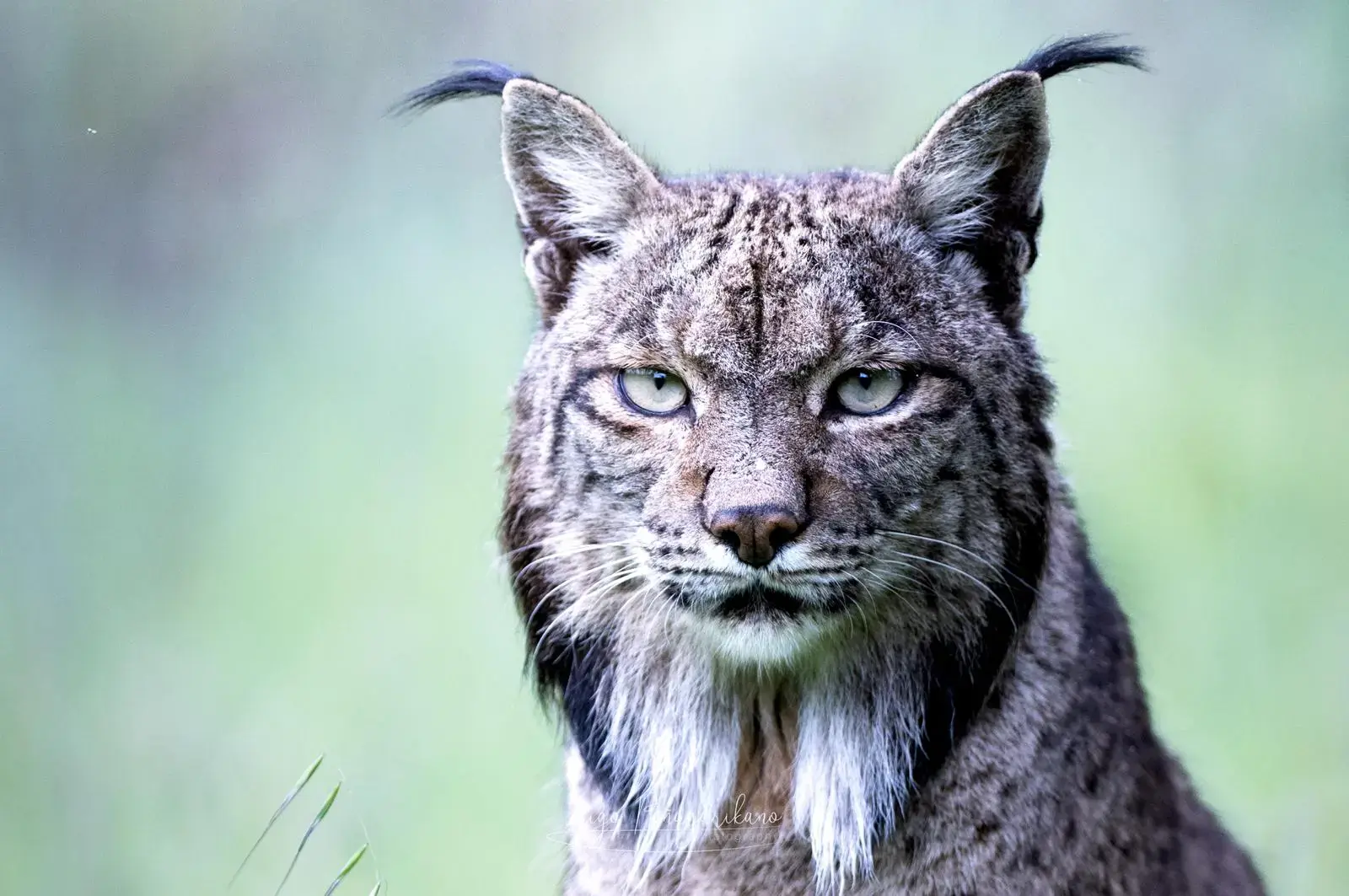
Iberian lynx face | Photo: Iñigo Peñagarikano
3. Its tufted ears are one of its defining features
If there is one feature that makes the Iberian lynx instantly recognisable, it is its pointed ears topped with black tufts, although its long facial ruff also contributes to the distinctive appearance that sets it apart from other wild felines.
Its silhouette combines several recognisable characteristics, including a compact body, short tail, spotted coat, long facial ruff and black ear tufts. Even when seen from a distance, it has a very distinctive presence within the landscape.
Although our attention is often drawn first to its gaze or its spots, its visual identity comes from the overall combination of its ears, tufts, facial ruff, low-set body and discreet movements through the scrub.
4. It depends heavily on the European rabbit
The Iberian lynx is a highly specialised predator, to the point that the European rabbit can account for around 90% of its diet. This dependence explains why changes in rabbit populations have such a major impact on the species. A decline not only reduces the amount of available food but can also influence how lynx use their territory, how they breed and which areas they need in order to survive.
Conserving the Iberian lynx therefore cannot focus solely on the lynx itself. The ecosystem that supports it must also be protected, from Mediterranean scrubland and areas of shelter to connectivity between territories and healthy rabbit populations.
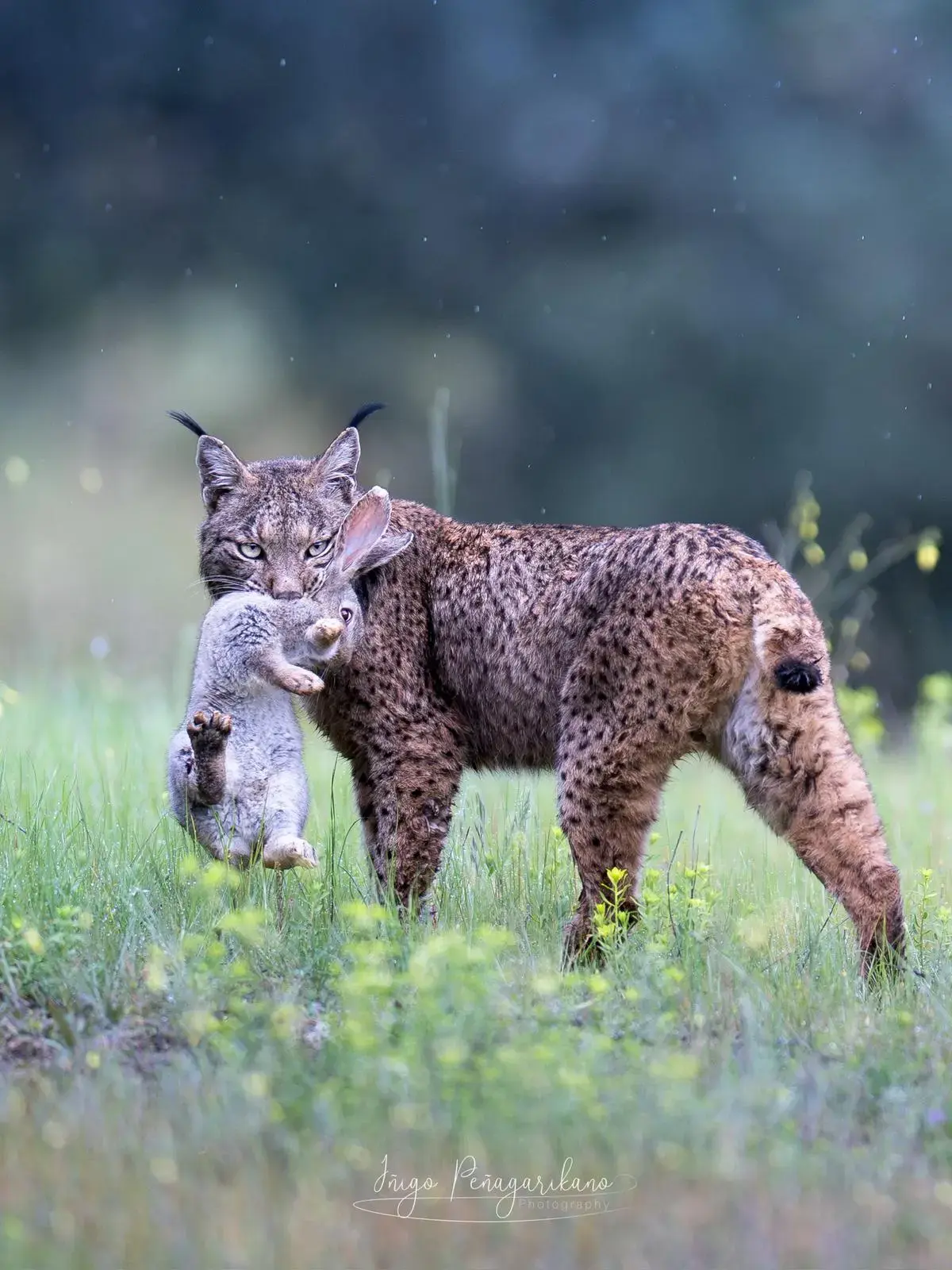
Iberian lynx with a rabbit | Photo: Iñigo Peñagarikano
5. It cannot live in just any forest because it needs well-preserved Mediterranean scrubland
Another important fact about the Iberian lynx is that not every natural landscape provides what it needs. It requires areas with shelter, scrub vegetation, tranquillity and enough food to establish a territory.
Its typical habitat is associated with Mediterranean scrubland, a landscape combining open spaces for hunting with denser vegetation for resting, hiding and breeding. This balance between clearings, scrub and prey availability is essential for the species.
Protecting the Iberian lynx therefore also means protecting a particular type of landscape. When suitable habitat, connectivity and prey are available, the chances of lynx successfully living in an area increase, whereas highly fragmented or heavily altered territory can significantly limit their recovery.
6. Its recovery is one of Europe's great conservation success stories
The Iberian lynx remained in an extremely vulnerable situation for many years, but conservation programmes have succeeded in reversing part of that decline through a combination of scientific monitoring, captive breeding, reintroduction, habitat restoration and collaboration between different stakeholders across the landscape.
In 2024, the Iberian lynx was reclassified from “Endangered” to “Vulnerable” on the IUCN Red List, an important improvement demonstrating the impact of decades of conservation work, although this does not mean the species no longer requires protection.
The latest figures also show a remarkable recovery. In 2025, the recorded population reached 2,663 individuals, the highest number recorded since coordinated monitoring began.
However, this story should not be regarded as a completed happy ending. An improvement in conservation status does not mean that the species can stop being protected. The lynx still depends on responsible decisions, including conserving habitats, reducing road casualties, maintaining healthy rabbit populations and preventing disturbance in sensitive areas.
7. Seeing one in the wild requires respect, patience and plenty of distance
The Iberian lynx attracts enormous interest, and for many wildlife enthusiasts, seeing one in the wild can be an exciting experience. Precisely for that reason, however, it is important to remember that the desire to see wildlife does not justify every type of behaviour.
Because it is a sensitive species, lynx should never be chased, lured, cornered or deliberately sought out in sensitive areas. Exact locations should also not be shared, particularly when doing so could increase pressure on the animal or its habitat.
Although its situation has improved, the species still faces threats such as road casualties, habitat loss and alteration, poaching and fluctuations in rabbit populations, all of which are listed among the risks that continue to affect its conservation in the latest IUCN assessment.
Responsible wildlife watching is not about getting as close as possible, but about understanding that the animal is not there for us.
Why the Iberian lynx matters for understanding wildlife
The Iberian lynx is much more than an iconic species. It also provides an excellent way to understand how conservation works in practice.
Its story reminds us that an animal does not live in isolation, but depends on its food, its habitat, the tranquillity of its surroundings, connections between territories and its coexistence with people. It also demonstrates that conservation can work when supported by science, coordination and long-term commitment.
The case of the Iberian lynx is particularly interesting because it brings together many of the major issues affecting wildlife, from habitat loss and prey recovery to reintroduction, scientific monitoring, genetic diversity, environmental education and responsible nature tourism.
Learning more about the Iberian lynx helps us look at wildlife with greater understanding, because instead of simply seeing an attractive animal, we begin to recognise the complex relationship between behaviour, landscape, diet and conservation.

Responsible wildlife watching | Photo: Annie Spratt
How to observe the Iberian lynx responsibly
If you ever have the opportunity to observe an Iberian lynx in the wild, the most important thing is to do so without altering its behaviour.
You should always keep a generous distance and use binoculars or telephoto lenses rather than attempting to get closer. It is also important to stay on permitted paths and within authorised areas, avoid sharing exact locations on social media, and never use calls, food or sounds to attract wildlife.
You should also avoid breeding areas, dens and other sensitive locations, and always respect the rules of the protected area. If you do not know the area well, the most responsible option is to choose professional guides or specialist organisations.
Wildlife watching should leave no trace on the animal. If it changes its behaviour because of our presence, we are already too close.
What the Iberian lynx teaches us about wildlife
The Iberian lynx is one of the most fascinating species in Iberian wildlife, not only because of its appearance but because of everything it represents.
Its spots, ear tufts, dependence on rabbits and remarkable recovery all tell us something much bigger: the relationship between animals, landscapes and people.
Learning more about the species should not encourage us to place greater pressure on it, but rather to observe nature with more patience and respect. Sometimes, a genuine connection with wildlife begins long before we actually see an animal, at the moment we start to understand how it lives.
Learning more about the Iberian lynx is one way to approach Iberian wildlife with greater respect. At NatSnap, we continue to create guides to help you discover animals, destinations and nature experiences responsibly.
Frequently asked questions about the Iberian lynx
What is the scientific name of the Iberian lynx?
The scientific name of the Iberian lynx is Lynx pardinus. It is a carnivorous mammal belonging to the cat family and a species endemic to the Iberian Peninsula.
What does the Iberian lynx eat?
The Iberian lynx feeds mainly on European rabbits, a prey species that can account for around 90% of its diet and is essential to its survival.
Where does the Iberian lynx live?
The Iberian lynx lives in areas of the Iberian Peninsula with suitable habitat, particularly Mediterranean scrubland with sufficient cover, shelter and healthy populations of European rabbits.
Is the Iberian lynx still endangered?
Its situation has improved considerably thanks to conservation programmes, and since 2024 it has been classified as Vulnerable on the IUCN Red List. However, it remains a protected and sensitive species.
Can you photograph Iberian lynx in the wild?
Yes, but it should always be done responsibly, from a distance and without altering the animal's behaviour. For sensitive species such as the Iberian lynx, it is advisable not to share exact locations and to prioritise experiences led by specialist guides or wildlife professionals.
To complement this guide, you can also visit the Iberian lynx species page on NatSnap, designed as a quick reference for learning more about the species, its habitat and nature experiences related to responsible wildlife watching.