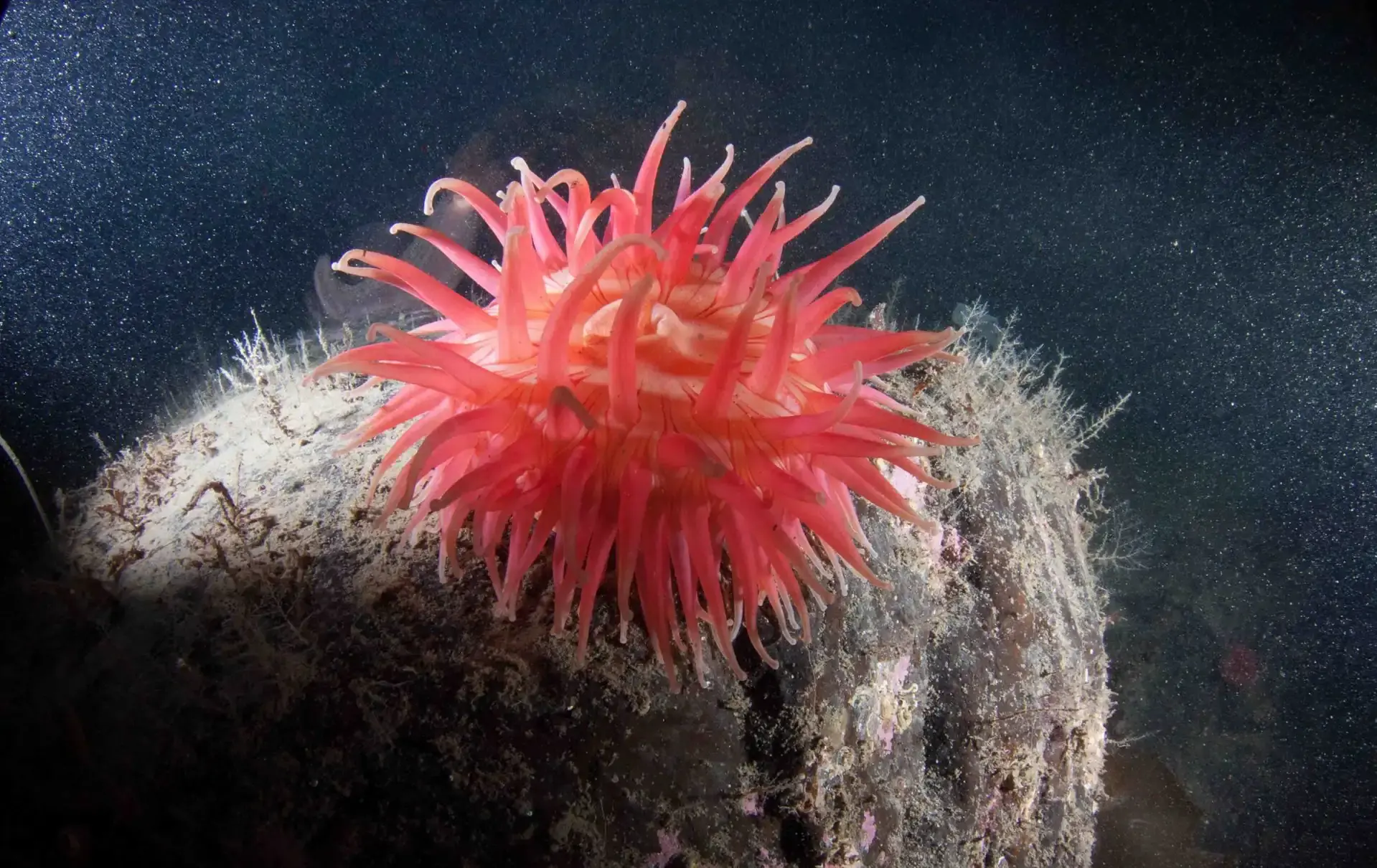
When the tide goes out, the sea reveals a landscape that is normally hidden beneath the water. Small pools appear among the rocks, providing a home for tiny fish, crabs, sea anemones, sea urchins and other animals that seem to inhabit a completely different world from our own.
At first glance, many of these rock pools look like simple collections of water. However, spending just a few minutes observing them can reveal a surprising diversity of marine life.
A small fish may remain motionless on a rock, almost invisible thanks to its colouring. Just a few centimetres away, a sea anemone spreads its tentacles while a transparent prawn moves among the seaweed. And just outside the water, a limpet clings so tightly to the rock that it is difficult to imagine it can move at all.
But living in these small refuges is not easy. Their inhabitants must cope with temperature changes, variations in salinity, periods of isolation and, in some cases, the possibility of being completely exposed to the air.
What makes this particularly interesting is that many of these animals live along Spain's coasts, and we can observe them without needing to dive, provided we know where to look and respect their environment.
What are rock pools and why are they full of life?
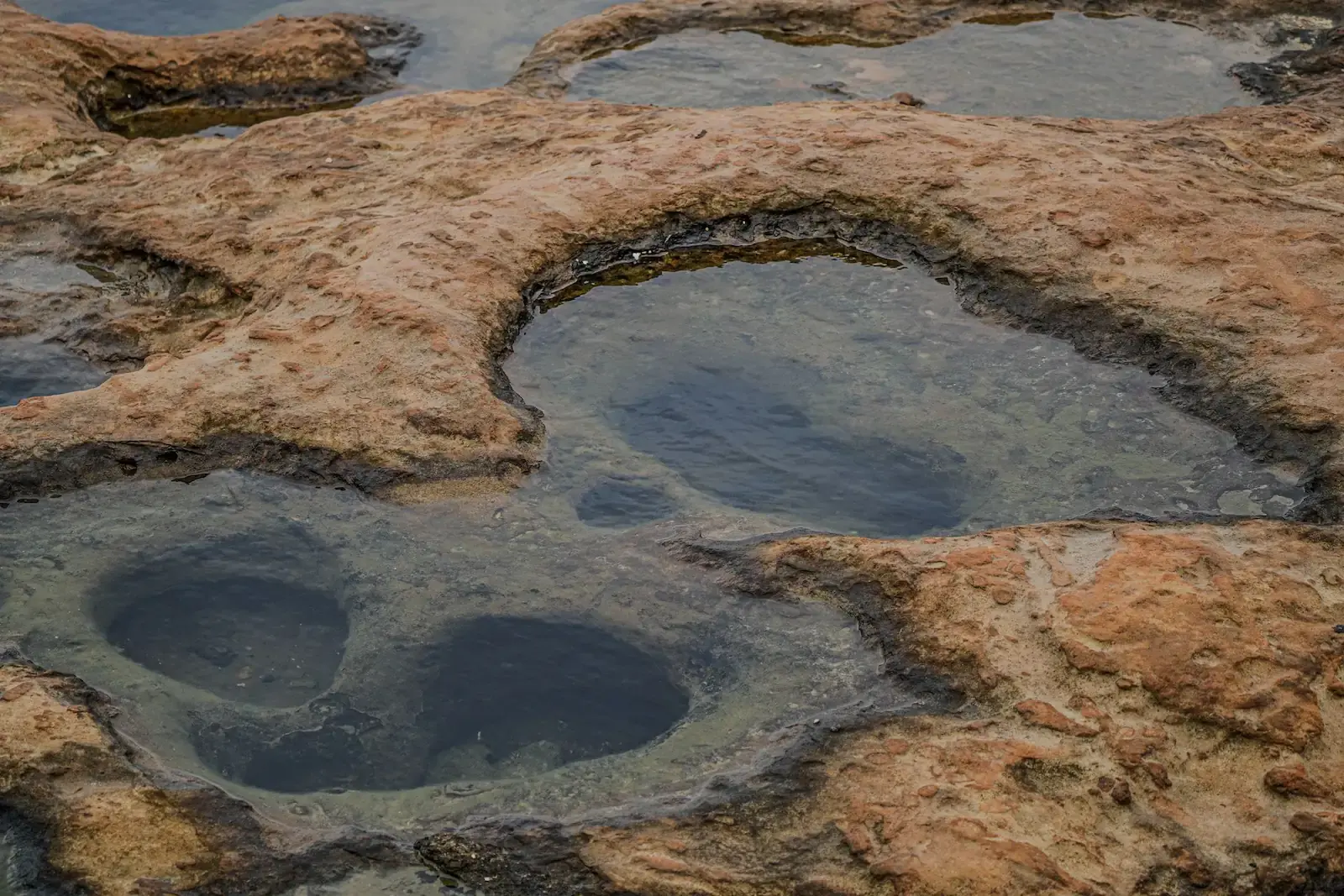
Rock pools | Photo: William Chen
Rock pools, also known as intertidal pools, are small bodies of seawater that remain trapped among rocks when the sea level falls.
They form mainly in the intertidal zone, the stretch of coastline that is covered during high tide and exposed during low tide. In these environments, water regularly flows in and out, while depressions in the rocks can retain small amounts of water when the sea retreats.
Although they may look like peaceful pools from the outside, they are particularly demanding ecosystems.
When a rock pool becomes isolated from the sea, it no longer receives the constant exchange of water that normally helps stabilise its conditions. In strong sunshine, temperatures can rise quickly and evaporation can concentrate salts. Heavy rain, meanwhile, can reduce salinity, while the activity of algae and animals changes the amount of oxygen available.
As a result, temperature, salinity and oxygen levels can vary considerably between rock pools, even when they are only a few metres apart.
Furthermore, not all pools are equally deep or remain isolated for the same amount of time. Those located higher up the shore may spend more hours without receiving fresh seawater, while those closer to the lower tidal limit are generally reconnected to the sea more frequently.
These differences explain why some rock pools are mainly home to small molluscs and algae, while others can provide shelter for fish, anemones, sea urchins and various crustaceans.
But which animals actually live in them?
1. Beadlet anemones look like little red fruits, but they are predators
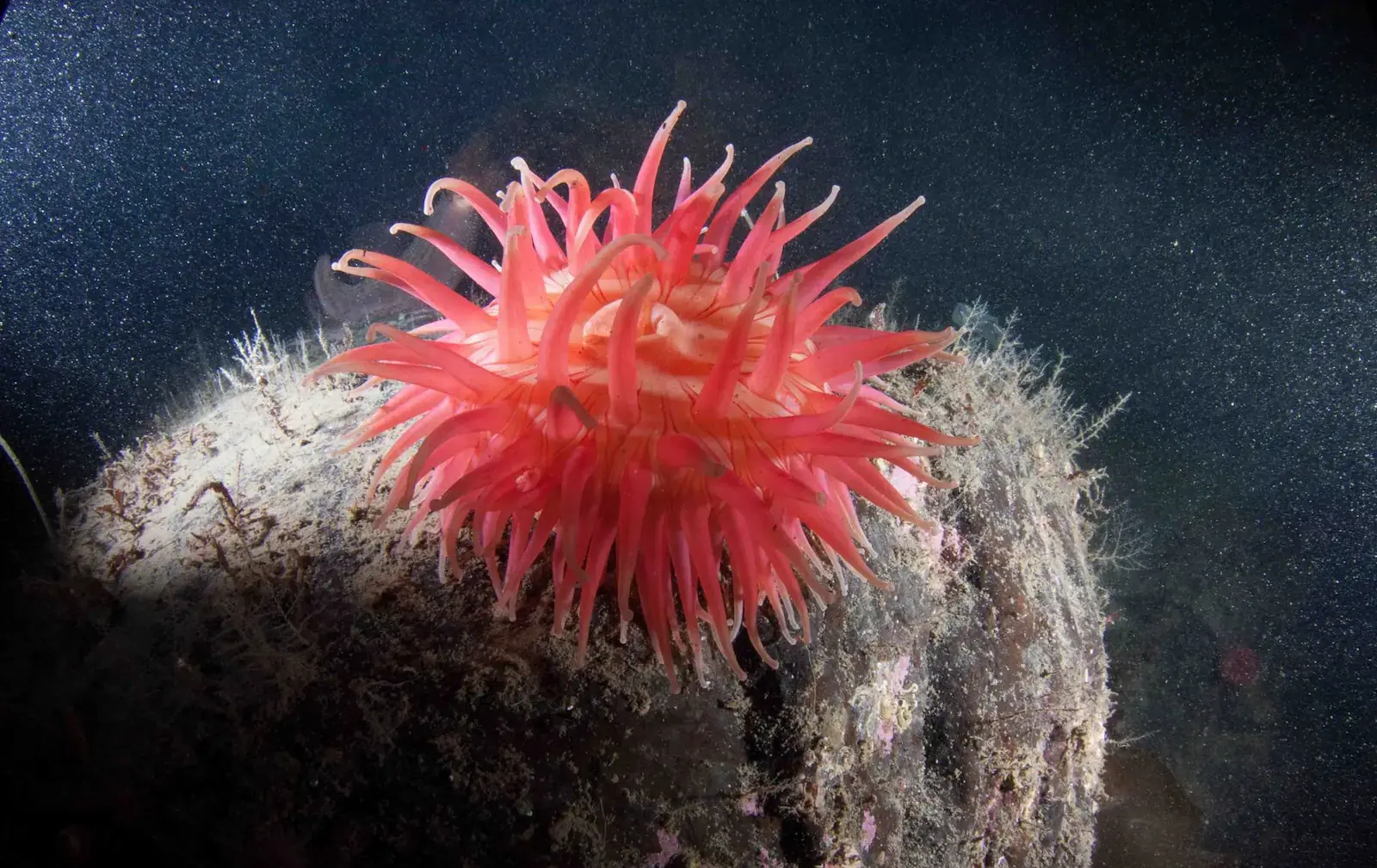
Beadlet anemone 'Actinia equina' | Photo: Andreas Berget
Among the most striking animals found on rocky shores is the beadlet anemone ‘Actinia equina’, also known as the sea tomato because of its rounded appearance and characteristic red colour.
When exposed to the air or contracted, it can look like a small gelatinous lump attached to a rock. However, when submerged and conditions are favourable, it opens its body and extends numerous tentacles around a central opening.
And here comes the first surprise. Although it may look like a plant or a harmless organism at first glance, the beadlet anemone is a carnivorous animal.
It belongs to the cnidarian group, alongside jellyfish and corals, and uses specialised cells located on its tentacles to capture small prey.
These structures contain stinging substances that allow it to immobilise tiny organisms, such as small crustaceans and marine larvae, which it then moves towards its mouth.
But how does it survive when the tide goes out?
The beadlet anemone can retract its tentacles and keep its body closed when exposed to the air, helping to reduce water loss while it waits for the sea to cover it again.
It also tends to settle on rocky surfaces, in small crevices and in places that retain moisture, where it remains firmly attached by a disc at the base of its body.
Along the coasts of northern Spain, particularly in rocky areas of Galicia, Asturias and Cantabria, it can be found both inside rock pools and on nearby damp surfaces.
Interestingly, an animal that looks like a simple red sphere can transform completely once it is submerged again.
2. Snakelocks anemones can have hundreds of tentacles
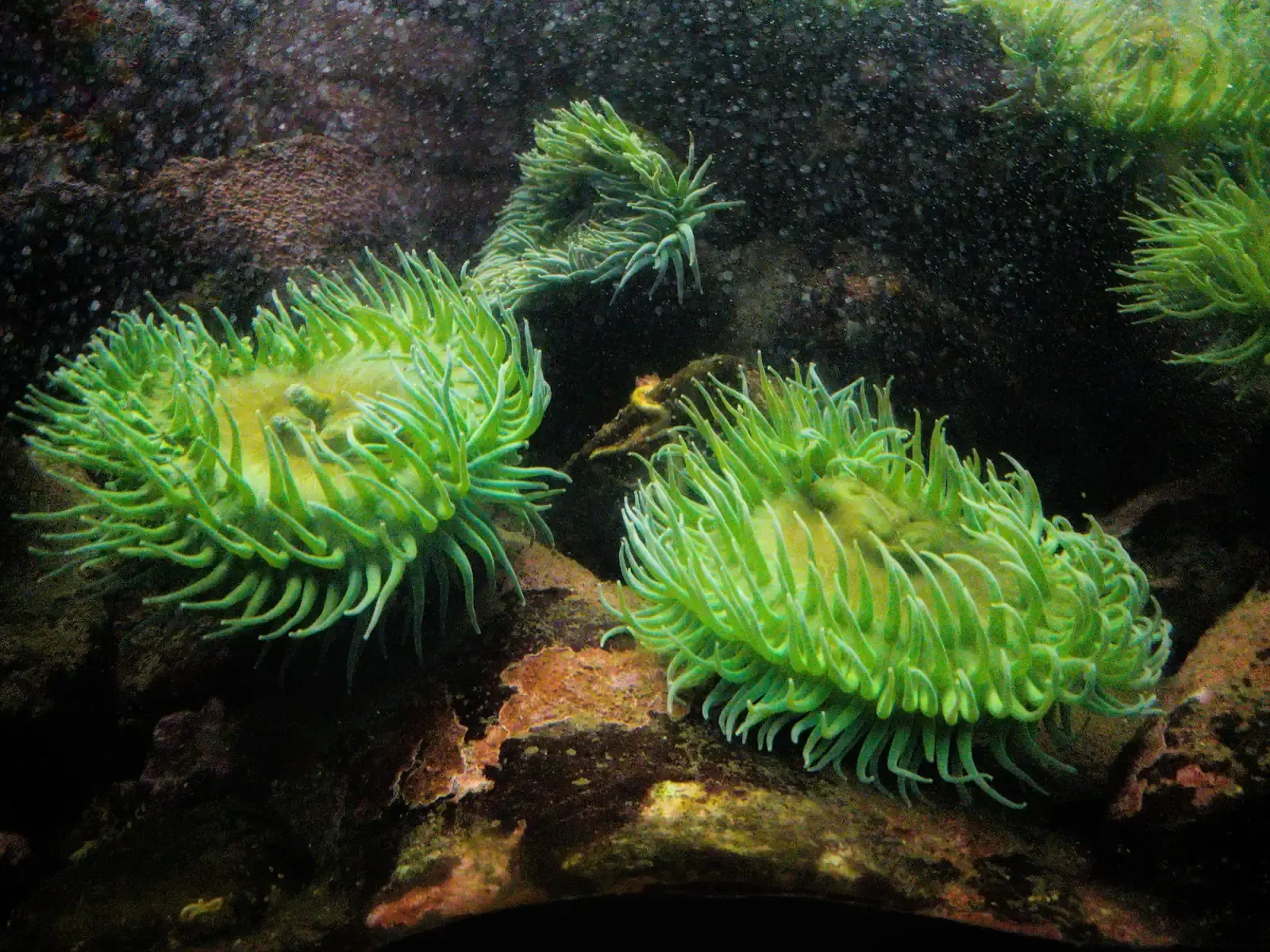
Snakelocks anemone 'Anemonia viridis' | Photo: Coral Grandbois
Although the beadlet anemone is one of the most recognisable sea anemones, it is not the only one we can find in Spain's intertidal pools.
Another particularly striking species is the snakelocks anemone ‘Anemonia viridis’, known for its long tentacles, which can display green, brown or greyish tones, often with violet tips.
Unlike the beadlet anemone, whose tentacles can retract until they are almost completely hidden, this species usually keeps them extended, forming a flexible crown that moves with the water.
Some individuals may have around 200 tentacles, allowing them to cover a considerable area in relation to their body size.
However, these tentacles are not merely decorative. Like other anemones, it uses them to capture small prey that come into contact with its stinging cells.
The species can be found in rock pools and other shallow rocky habitats, particularly in areas where enough water remains and suitable surfaces are available for attachment.
Its colouring is also partly related to the presence of photosynthetic organisms living in association with its tissues, a relationship that can provide nutritional benefits to the animal.
This means that a sea anemone can obtain nutrients both by capturing prey and through this biological association, although the importance of each source varies according to environmental conditions.
If you ever find a snakelocks anemone in a rock pool, the best approach is to observe its movements without touching it. Its tentacles contain stinging cells and, although some species do not usually pose a significant danger to people, contact can cause irritation and disturb the animal.
3. Limpets appear motionless, but they emerge to feed when the water returns
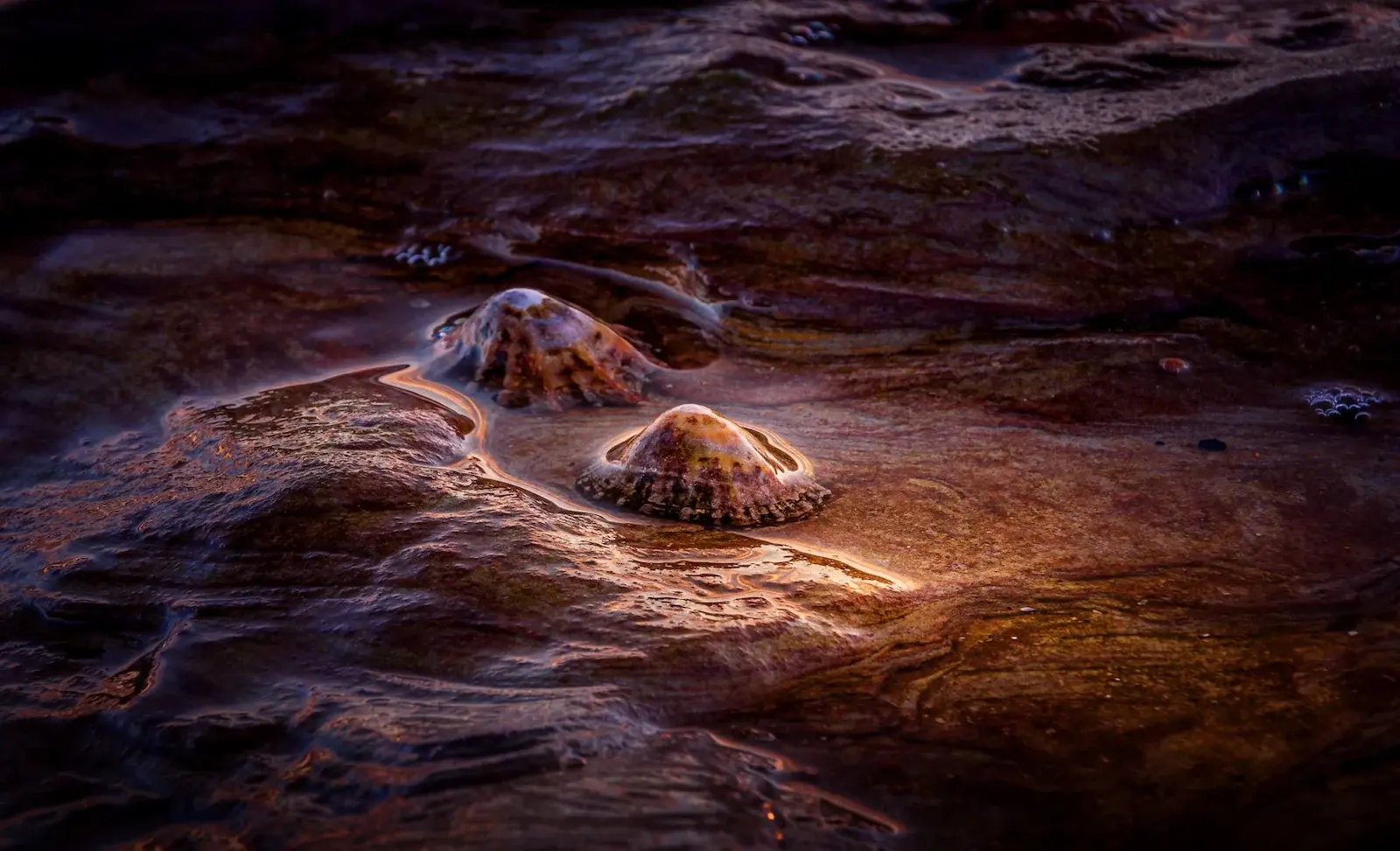
Common limpet 'Patella vulgata' | Photo: Ray Bilcliff
If we look at the rocks surrounding a rock pool, we will probably find small animals covered by cone-shaped shells, firmly attached to the surface.
These are limpets, gastropod molluscs that are particularly well adapted to life in the intertidal zone.
One of the species found along Spain's Atlantic coast is the common limpet ‘Patella vulgata’, although other species from the same group occur in the Mediterranean and the Canary Islands.
Their appearance might make us think they remain motionless throughout their lives, but they are actually capable of moving across rocks using a muscular foot beneath their shell.
When conditions are favourable, particularly when submerged or in sufficiently humid environments, limpets venture out to feed by scraping small algae and microorganisms from rocky surfaces.
To do this, they use a structure called a radula, a ribbon-like organ covered in tiny teeth that allows them to scrape food from surfaces.
However, when the tide goes out, they return to places where they can remain protected from drying out.
Most surprisingly, some limpets repeatedly return to the same spot on a rock after feeding.
Over time, the shape of their shell can fit into a small depression in the rock, known as a home scar, helping to improve the seal and reduce moisture loss.
So, although they may appear never to move, some limpets make short journeys to feed before returning to their usual spot.
In fact, their ability to cling to rocks is one of the adaptations that allows them to survive waves and periods of exposure to the air.
4. Rock crabs use every crevice as a hiding place
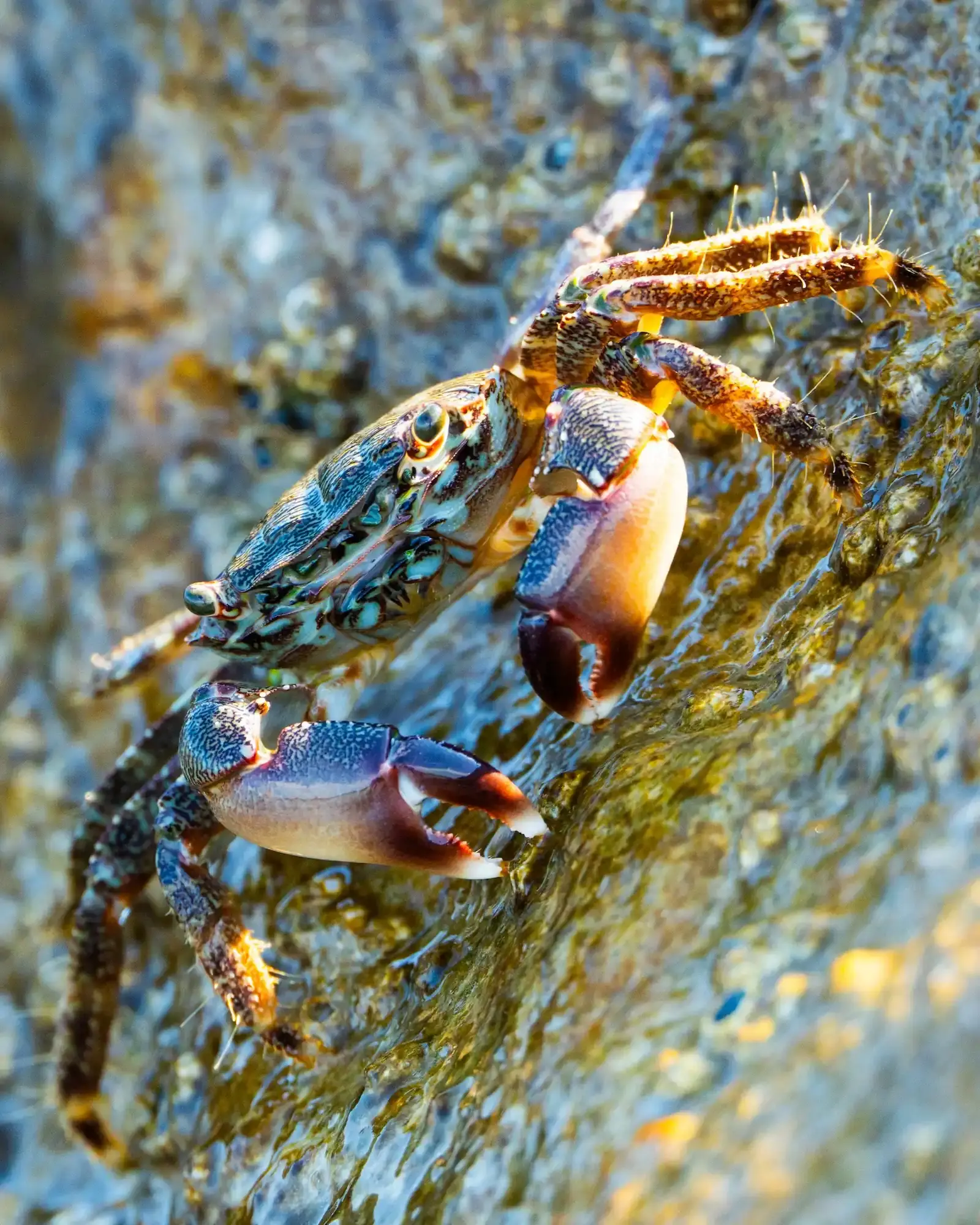
Rock crab 'Pachygrapsus marmoratus' | Photo: Lorenzo Manera
Few sights are as common on a rocky shore as a small crab quickly disappearing between stones when someone approaches.
Along Spain's coasts, we find several species adapted to these environments, including the marbled rock crab ‘Pachygrapsus marmoratus’, recognisable by its relatively square carapace and dark colouring with marbled patterns.
This crustacean can move quickly across rocky surfaces, crevices and areas close to the water, allowing it to take advantage of different resources within the intertidal zone.
Although it can be found beside rock pools, it does not need to remain inside them continuously. It uses damp refuges and can move across exposed areas during low tide, provided conditions are suitable.
We can also find other species, such as the shore crab (Carcinus maenas), which is particularly associated with different environments in the north-eastern Atlantic, including estuaries, rocky shores and shallow waters.
Contrary to what we might expect, the green shore crab is not always green. Its colouring can range from greenish and brown tones to orange and red, depending on various factors related to its development and environmental conditions.
Its diet is also varied, as it can eat small molluscs, crustaceans, organic remains and other available food sources.
But why are these crabs so difficult to observe?
Apart from their speed, many species use crevices, ledges and gaps between rocks as refuges from predators and unfavourable environmental conditions.
As a result, a seemingly empty rock pool may contain several individuals that remain hidden when they detect movement or shadows on the surface.
Rather than moving stones to find them, it is better to remain still for a few minutes and watch whether any emerge from their hiding places.
5. The almost transparent prawns that hide among seaweed
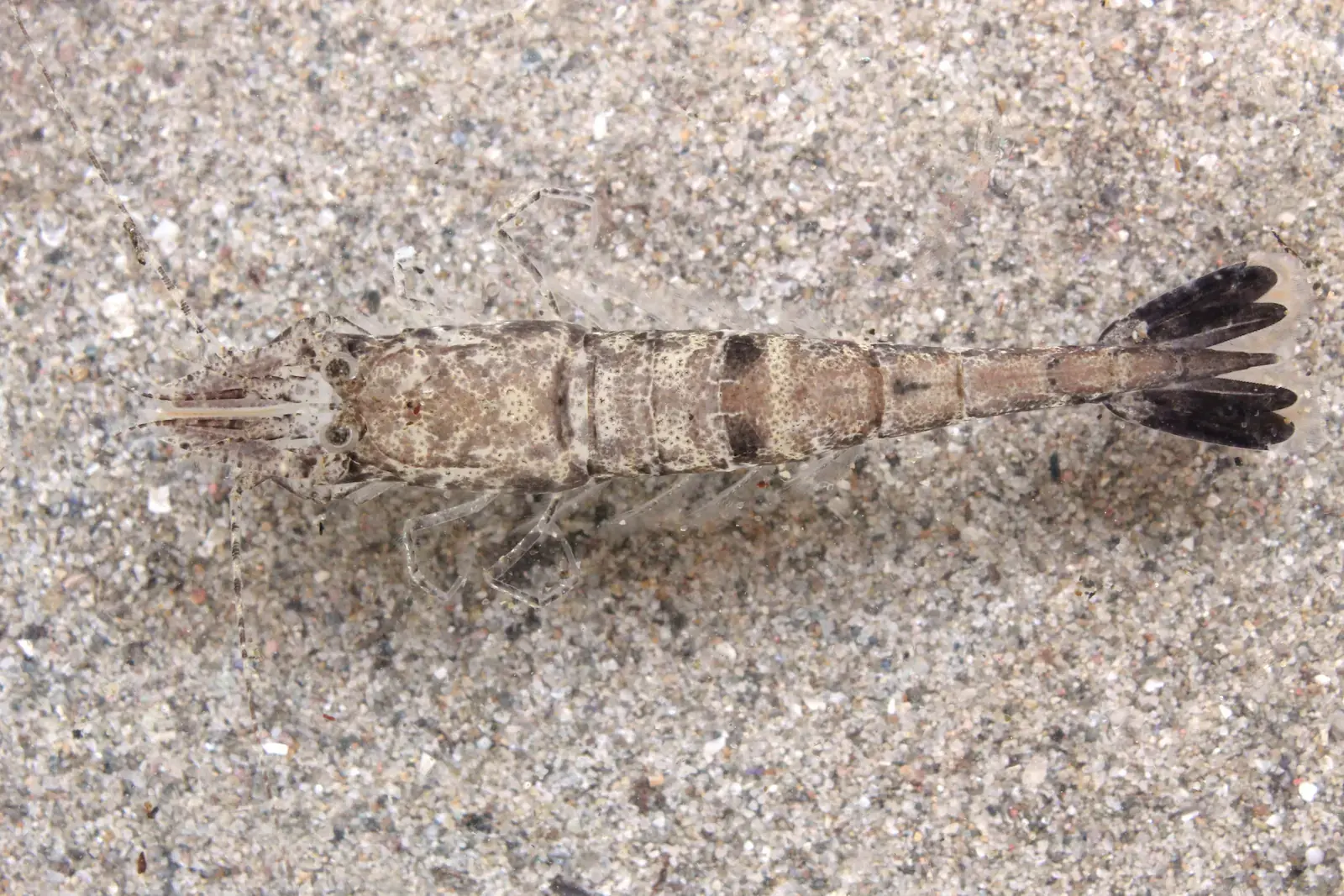
Rockpool prawn 'Palaemon elegans' | Photo: Holger Krisp - CC BY 3.0
Among the most discreet species found in rock pools are small prawns that can be difficult to distinguish even when swimming right in front of us.
One of them is the rockpool prawn ‘Palaemon elegans’, a crustacean with an elongated, partially transparent body marked with small reddish or brownish patterns.
Its appearance helps it blend in among rocks, seaweed and reflections in the water, especially when it remains still.
However, observing a rock pool for just a few minutes reveals that these animals can move remarkably quickly.
They use their appendages to move along the bottom and swim, while their long antennae help them detect information about their surroundings.
They can also take advantage of different food sources, including small organisms and organic matter.
The rockpool prawn inhabits rocky intertidal areas and pools that become isolated during low tide, with a distribution that includes the Mediterranean and various parts of the Atlantic.
It can grow to several centimetres in length, although its transparency and the movement of the water often make it appear much smaller.
Interestingly, not all the prawns we observe in these environments belong to the same species. There are different representatives of the genus Palaemon and other similar-looking crustaceans, so identifying them from a photograph alone can be difficult.
And there is something worth remembering. Although they are small and may seem abundant, we do not need to catch them to observe them. Remaining still and watching for movement among the seaweed can be enough to discover their presence.
6. Gobies and blennies, fish that seem to disappear among the rocks
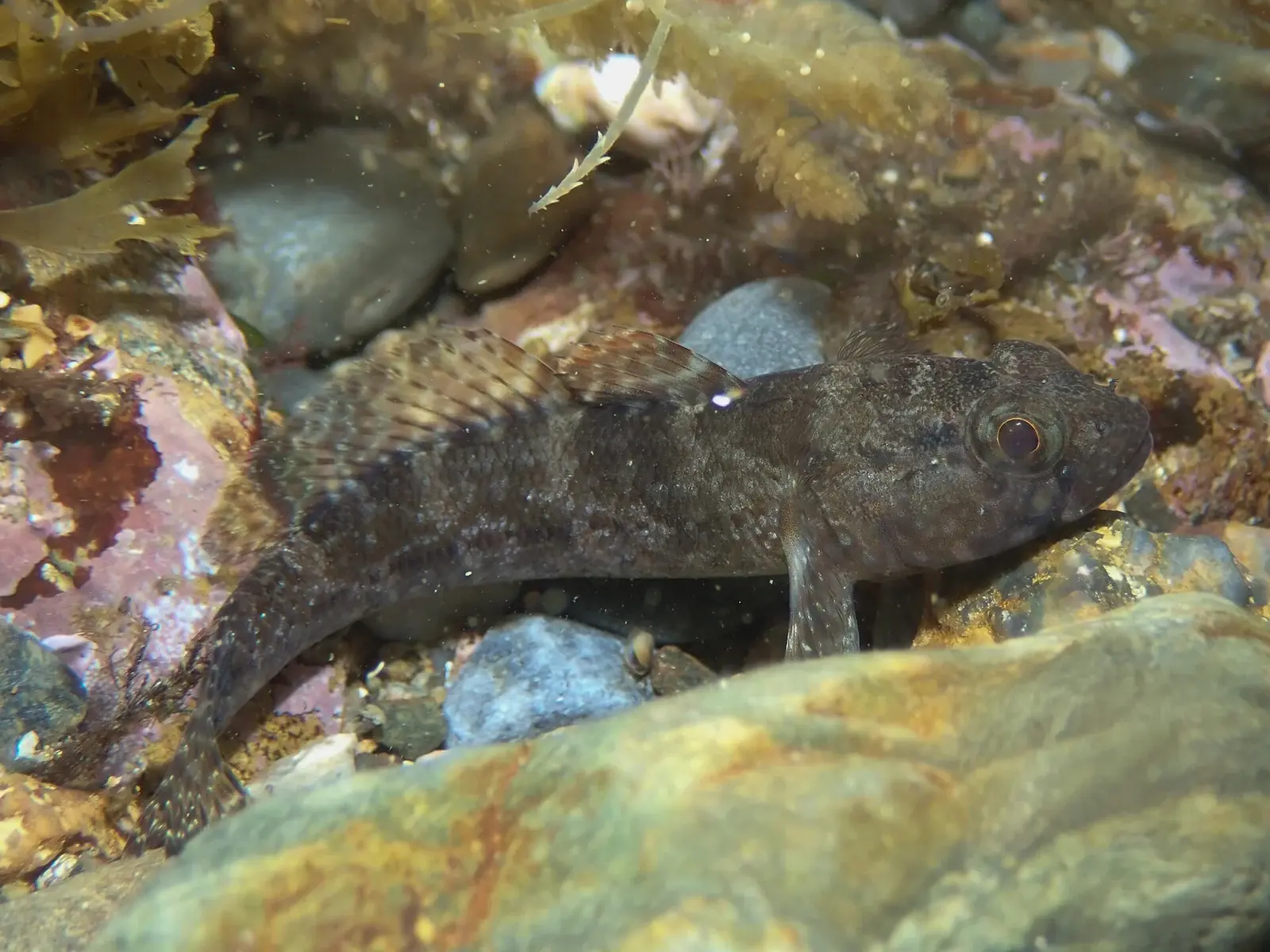
Rock goby 'Gobius paganellus' | Photo: jujurenoult - CC BY 4.0
When we think of marine fish, we often imagine animals swimming freely in open water. However, some of the fish that inhabit rock pools have a very different relationship with their surroundings.
Gobies and blennies are two particularly interesting groups because many of their species use rocky bottoms, crevices and small cavities as places to shelter.
One example is the rock goby ‘Gobius paganellus’, a fish with an elongated body and variable colouring, usually brown or mottled, which allows it to blend in with the rocks and seabed.
It can live in intertidal areas and take shelter inside rock pools or beneath seaweed, where it remains alert for the small invertebrates that form part of its diet.
Blennies also display interesting adaptations. Some species, such as Lipophrys pholis, have elongated bodies, eyes positioned relatively high on their heads and colouring that helps them camouflage themselves.
The latter is particularly well known for its ability to use rock pools and damp refuges among the rocks, even when the sea has retreated.
But how do they survive in pools that may remain isolated for several hours?
Besides seeking sheltered hiding places, these species are adapted to environments where conditions change frequently. However, that does not mean they can withstand any temperature or prolonged drying out.
Deeper pools and those that maintain relatively stable conditions offer better chances of survival than extremely small, exposed pools.
Interestingly, some of these fish can go completely unnoticed until they make a sudden movement.
So, if you look at the bottom of a rock pool and get the impression that nothing is there, it may be worth waiting a few moments. A small shadow among the stones could turn out to be a perfectly camouflaged fish.
7. Sea urchins can also live in small rock pools
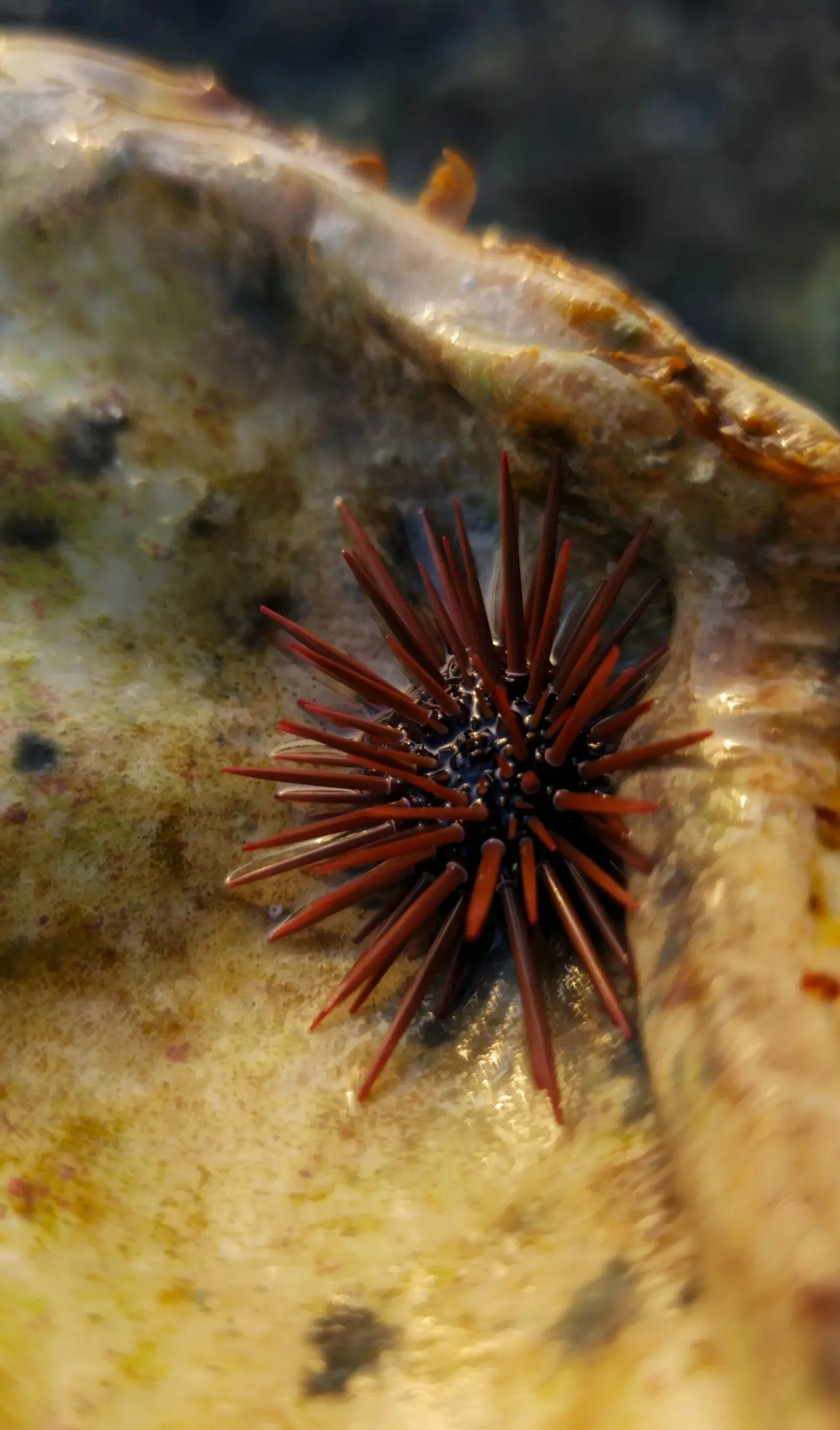
Common sea urchin 'Paracentrotus lividus' | Photo: ULTRA_IMAGE
Sea urchins are among the best-known animals of rocky seabeds, but we do not always need to go underwater to find them.
Some species can live in intertidal pools, particularly in lower areas of the shore where the pools retain sufficient depth and are frequently reconnected to the sea.
The common sea urchin ‘Paracentrotus lividus’ is one of the species we can find in these environments, as well as on other shallow rocky seabeds.
Its body is protected by a calcareous skeleton made up of plates and covered with movable spines that serve defensive purposes and also help with movement.
But beneath those spines lies another surprising feature.
Sea urchins have small tube feet, flexible structures that they use to attach themselves, move around and interact with their surroundings.
They can also feed by scraping algae and other materials from surfaces using a complex mouthpart known as Aristotle's lantern.
Some individuals may also occupy small cavities or depressions in rocks, where they find some protection from waves and exposure during low tide.
In certain rock pools, sea urchins can influence the amount of algae present, as their feeding activity changes the vegetation growing on rocky surfaces.
However, not all pools contain sea urchins. Their presence depends on factors such as depth, wave exposure, rock type and environmental conditions.
And although it may be tempting to touch them or lift them to examine their underside, it is best to leave them where they are. Their spines can cause minor injuries, and handling them can disturb their position and behaviour.
8. Hermit crabs use abandoned shells to protect themselves
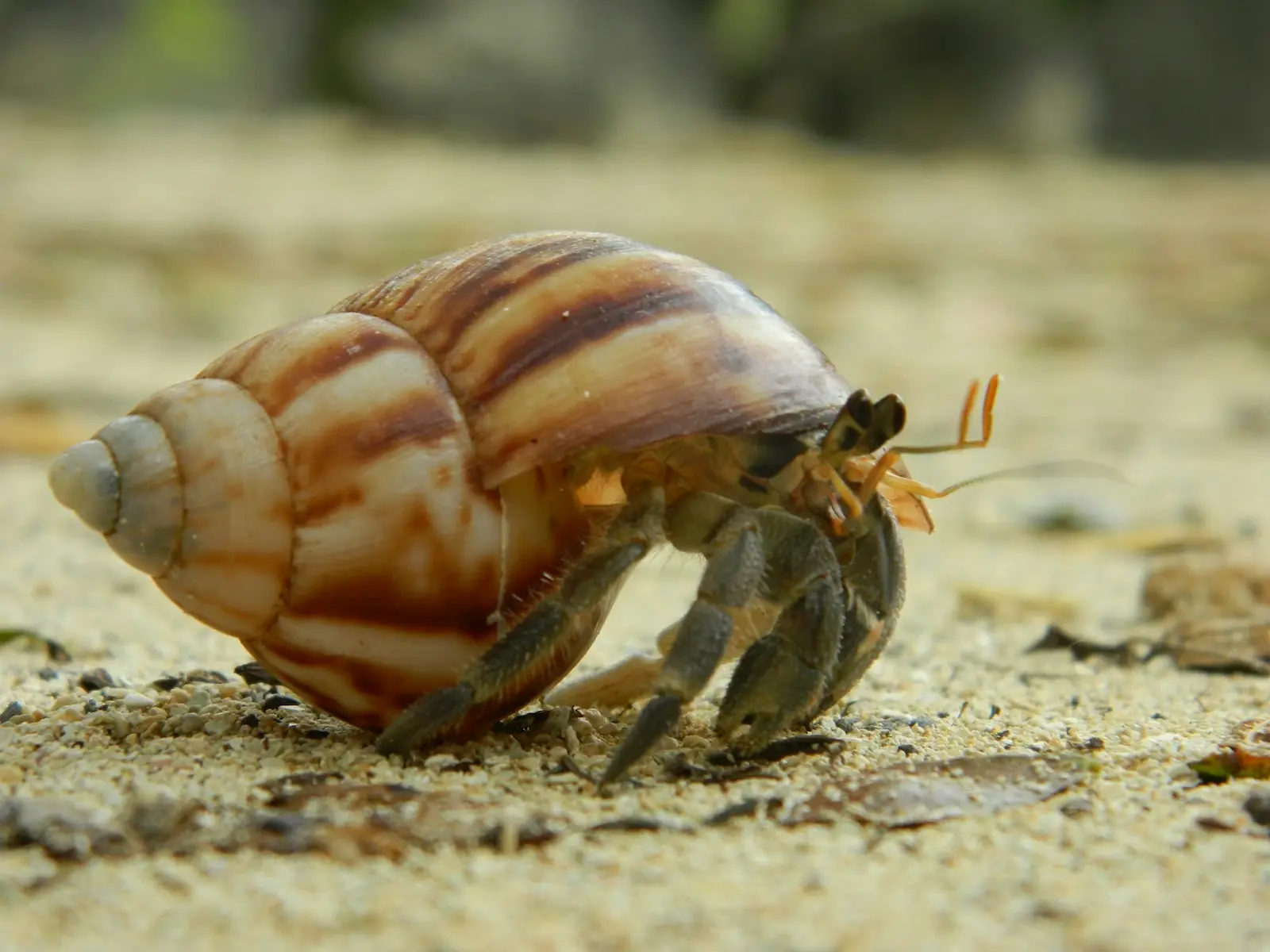
Common hermit crab 'Pagurus bernhardus' | Photo: Anna Mcphee
Among the most curious animals we can find in some rock pools are hermit crabs.
Unlike crabs with a hard carapace protecting much of their body, many hermit crabs have a soft, vulnerable abdomen that needs to remain sheltered.
To solve this problem, they use empty marine snail shells for protection.
One example is the common hermit crab ‘Pagurus bernhardus’, found in different environments throughout the north-eastern Atlantic, including some rocky shores and intertidal pools.
What makes this fascinating is that the shell is not actually part of the crab's body.
As the animal grows and its current shell becomes too small, it can search for a larger one and move into a new shelter.
The availability of suitable shells can influence its survival, because not all shells offer the same level of protection or allow the animal to continue growing comfortably.
In deeper rock pools and among rocks, hermit crabs can be found alongside other small crustaceans, although the species present vary according to the region and characteristics of the habitat.
One particularly curious sight is a hermit crab walking along the bottom, dragging a shell that seems to be moving on its own.
If you ever find a seemingly empty shell in a rock pool, it is worth observing it before assuming there is no animal inside.
And, of course, we should never collect occupied shells or remove hermit crabs from their shelters to photograph them.
9. Barnacles look like tiny stones, but they are crustaceans
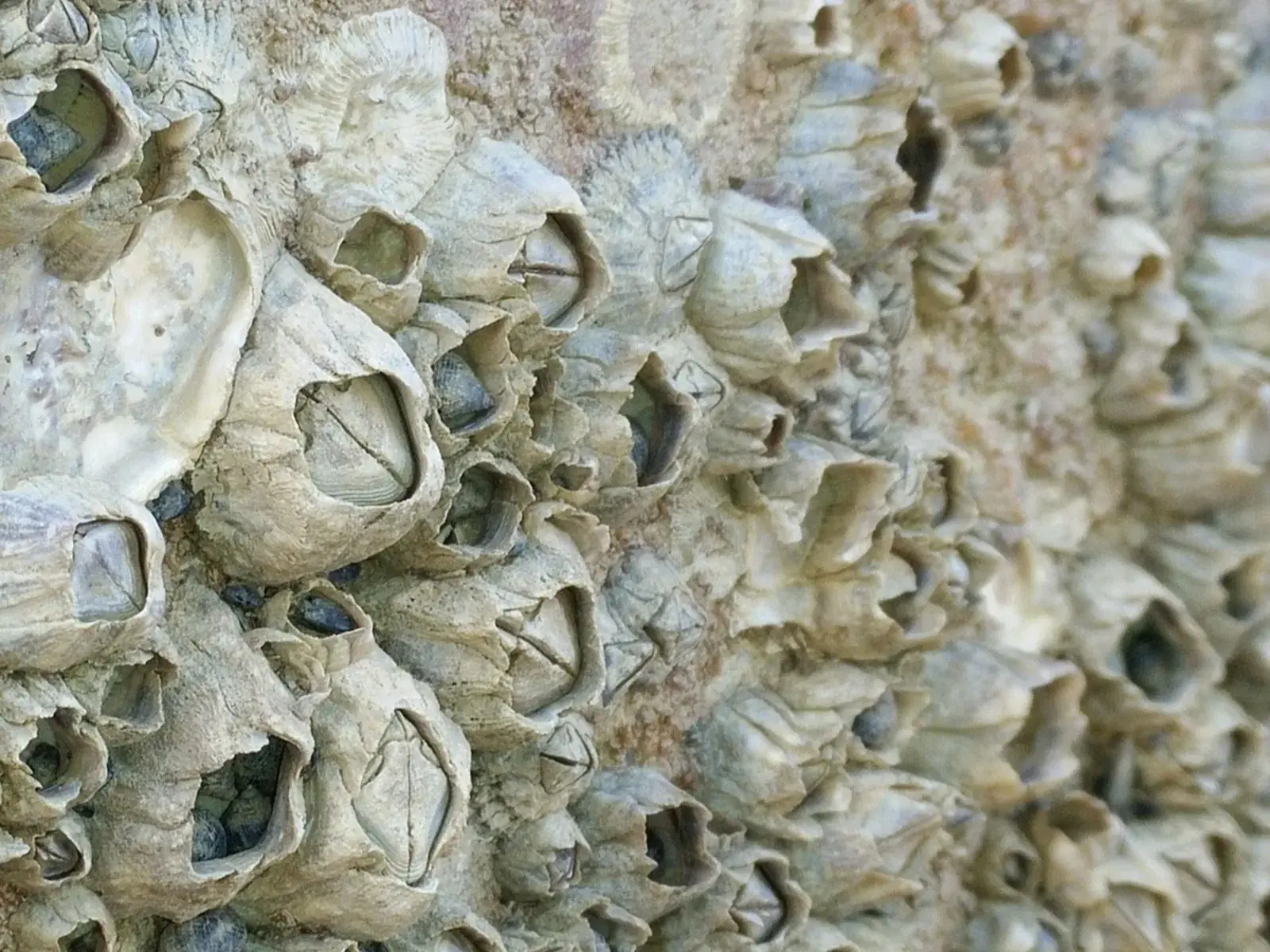
Barnacles | Photo: Saiful Zaree Johar
On the rocky surfaces surrounding rock pools, we can find small whitish organisms attached to the stone, often gathered in large numbers.
At first glance, they look like tiny volcanoes or fragments of rock, but they are actually animals.
Known as acorn barnacles, they belong to the crustacean group, meaning they are related, albeit distantly, to animals such as crabs and prawns.
Among the species found along Spain's coasts are different representatives of the genus Chthamalus, which are particularly common in rocky intertidal areas.
Their lives are very different from those of other crustaceans.
After passing through free-swimming larval stages in the water, individuals attach themselves to a surface and develop a calcareous structure that protects them for the rest of their lives.
When covered by the sea, they can open small plates and extend specialised appendages to capture food particles suspended in the water.
But when the tide goes out, they close these plates to reduce moisture loss.
Therefore, although they appear motionless, acorn barnacles carry out feeding activities that we cannot normally observe when they are out of the water.
They are part of the characteristic diversity of Spain's rocky intertidal shores, where they coexist with limpets, mussels and other organisms attached to rocks.
And perhaps the most curious thing is that such a small animal can spend practically its entire life in the same place, depending on the movement of the sea to bring it food.
Where to find rock pools in Spain
Intertidal pools can be found along different parts of Spain's coastline, but they do not form or function in exactly the same way everywhere.
The tidal range, shape of the coastline, rock type and exposure to waves directly influence their size, how long they last and the animals that can live in them.
Galicia and the Cantabrian coast
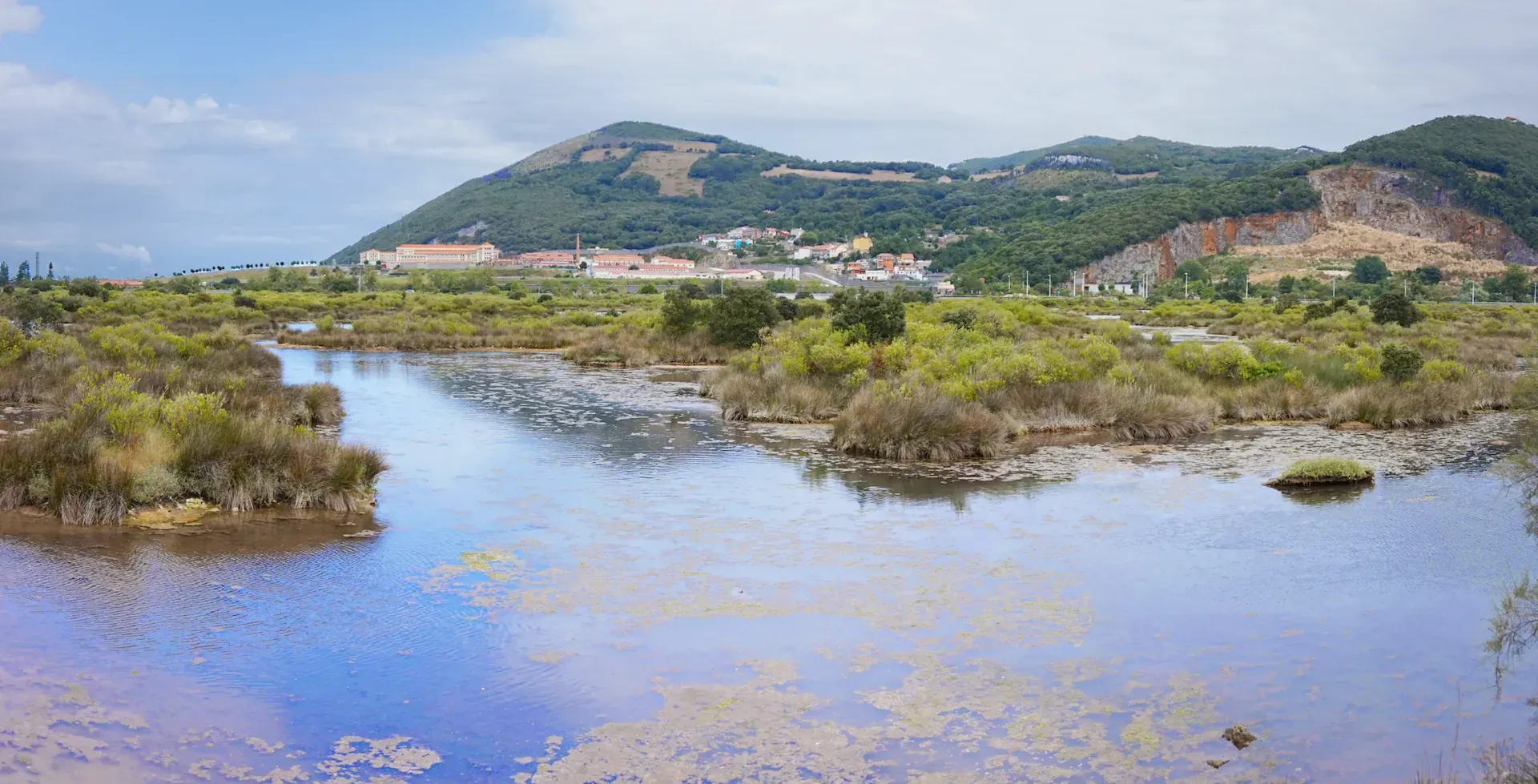
The Atlantic coast of Galicia and the Cantabrian coastline offer some of the best opportunities to observe intertidal pools, as the difference between high and low tide exposes relatively extensive rocky surfaces.
In Galicia, different stretches of the Rías Baixas, Rías Altas and Costa da Morte have rocky areas where small pools can form, although access depends on the configuration of each stretch of coastline and sea conditions.
The same applies to Asturias, Cantabria and the Basque Country, where rocky platforms, cliffs and small coves support diverse intertidal communities.
In these environments, we may find limpets, anemones, crabs, small fish and various invertebrates, although not all of them are present in every pool.
In fact, the marine communities of the Atlantic Islands of Galicia display a great diversity of organisms adapted to rocky coastal conditions, particularly in areas where water and waves create a variety of small habitats.
However, it is essential to respect access restrictions in protected areas and avoid entering designated reserve zones.
The Mediterranean, where tides are much less pronounced
Along Spain's Mediterranean coast, conditions are quite different.
The tidal range is much smaller than in the Atlantic and Cantabrian Sea, meaning the intertidal zone is generally narrower and less visible.
This does not mean that rocky pools do not exist, but rather that many also depend on the shape of the coastline, natural depressions and wave action.
In places such as the Costa Brava, certain rocky stretches of the Balearic Islands and parts of the Murcia and Almería coastlines, small pools and animal communities adapted to these environments can be found.
Their inhabitants may include anemones, marine snails, small crustaceans and other organisms characteristic of Mediterranean coasts.
However, we should bear in mind that rock pools in the Mediterranean do not necessarily follow the same pattern of emptying and refilling as those in the Atlantic, due to differences in tidal range.
As a result, a small pool that appears stable may experience changes caused by wind, waves and evaporation, as well as variations in sea level.
The Canary Islands and their intertidal pools
In the Canary Islands, volcanic coastlines provide particularly interesting landscapes for the formation of pools among rocks.
The structure of the terrain, with solidified lava surfaces, crevices and small depressions, can allow seawater to remain trapped after low tide.
These areas support communities that differ from those found along mainland Spain's coasts, influenced by the archipelago's geographical position, temperatures and the characteristics of the Atlantic Ocean.
The islands have natural rock pools and intertidal environments associated with volcanic platforms, where small crustaceans, molluscs, algae and various organisms adapted to changes in sea level can be found.
However, not all pools are safe or accessible, and some are located within specially protected areas, so it is important to check visiting conditions before approaching them.
Why two nearby rock pools can contain completely different animals
One of the most interesting characteristics of these small ecosystems is that two pools separated by just a few metres can support quite different communities.
The explanation lies in the combination of environmental factors affecting each one.
A deep pool located close to the lower tidal limit may maintain relatively stable temperatures and receive fresh seawater frequently. In contrast, a small, shallow pool can heat up much more during sunny periods.
Shade, the presence of algae, available crevices and the amount of time a pool remains isolated from the sea also make a difference.
Salinity and oxygen levels can also change throughout the day. When evaporation is intense, the water becomes more saline, while rainfall can have the opposite effect.
Photosynthetic organisms also contribute to changes in oxygen concentration and the chemical conditions of the water, particularly in pools that remain isolated for longer periods.
These differences can determine which species manage to establish themselves and which find the conditions too demanding.
That is why observing several pools during the same walk can be far more interesting than stopping only at the largest one.
When is the best time to observe rock pools?
When observing wildlife in intertidal pools, one of the most important factors is choosing the right time to visit.
Along the Atlantic and Cantabrian coasts, low tide reveals areas that remain underwater during high tide, although this does not mean they are always safe to approach.
Spring tides, which occur around the full moon and new moon, can expose more extensive areas, but they also create greater differences between high and low water levels.
That is why it is essential to check tide forecasts and sea conditions before setting out.
Official sea-level and wave forecasts allow us to find out when the next low tides will occur and assess the general conditions in the area.
However, we should also pay attention to weather warnings, wave height and the possibility of the sea reaching areas that appear sheltered.
In the Mediterranean, where tidal fluctuations are smaller, wave conditions and the overall state of the sea may be more important in practical terms when observing these communities.
As for the time of year, rock pools can support life throughout the year, although some species change their activity according to temperature, breeding cycles and other seasonal conditions.
There is therefore no single season that guarantees sightings of all the animals we have mentioned.
How to observe and photograph rock pool wildlife without disturbing it
Rock pools offer an extraordinary opportunity to discover marine wildlife without needing to go underwater, but they are also delicate environments where small disturbances can affect numerous organisms.
That is why the best approach to observing them is usually quite simple: approach carefully, remain still for a few minutes and pay attention to movement in the water.
Many animals hide when they detect vibrations or shadows, so waiting can reveal more activity than trying to move stones or push seaweed aside.
It is also advisable to avoid putting our hands into the pools, lifting organisms attached to rocks or removing animals to photograph them. Anemones can be sensitive to contact, sea urchins have spines that can cause injuries, and numerous invertebrates need to remain firmly attached to their substrate.
Rocks can also support tiny organisms that go completely unnoticed, meaning that moving or stepping on them can cause damage that is not always immediately obvious.
To photograph these environments, a camera capable of close focusing or a macro lens can help capture interesting details from outside the water.
If conditions allow the use of an underwater camera, photographs can also be taken without handling animals, provided access is permitted and the activity does not disturb the environment.
But there is an even more important precaution: safety.
Rocky surfaces can be extremely slippery, and some areas can quickly become cut off as the tide rises. For this reason, we should never venture onto platforms exposed to waves or approach pools in places where a wave could reach us.
Responsible wildlife observation also means recognising when conditions make it unsafe to approach and enjoying the landscape from a secure location instead.
The small marine ecosystems that have always been there
When we think about observing marine wildlife, we often imagine large cetaceans, turtles, sharks or colourful fish swimming among reefs.
However, some of the sea's most interesting ecological relationships take place just centimetres from the surface, inside small pools that appear and disappear with the tides.
These are places where animals spend much of their lives attached to rocks, fish camouflage themselves among stones, crustaceans use abandoned shells and tiny predators capture food with their tentacles.
Each has developed different strategies to survive in an environment where conditions can change dramatically within a matter of hours.
And perhaps that is what makes rock pools so interesting. We do not need to encounter an enormous animal or venture far out to sea to discover surprising behaviours.
Sometimes, all it takes is stopping beside a rock and carefully observing a small space we would normally have overlooked.
Frequently asked questions about rock pools and their animals
What animals live in rock pools?
Rock pools can be home to anemones, prawns, small crabs, gobies, blennies, sea urchins and various molluscs. Limpets, acorn barnacles and other organisms adapted to changing sea levels also live on nearby rocks. The species present depend on the coastline, depth and characteristics of each pool.
Where can you find rock pools in Spain?
They are particularly visible in rocky areas of Galicia and the Cantabrian coast, although similar environments also exist in the Canary Islands and certain parts of the Mediterranean. Their formation depends on the tidal range, rock type and shape of the coastline.
How can animals survive in a rock pool when the tide goes out?
Species living in these environments have adaptations that allow them to tolerate changes in temperature, salinity and oxygen levels. Some seek shelter beneath rocks, others remain attached to protected surfaces, and certain species can withstand limited periods of exposure to the air.
Are rock pools filled with fresh water or salt water?
They normally contain seawater that remains trapped when the sea level falls. However, salinity can change due to evaporation, rainfall and how frequently the pool reconnects with the ocean.
What is the best time to observe animals in rock pools?
Along coasts with a pronounced tidal range, low tide usually offers good opportunities to observe these ecosystems. However, it is essential to check sea conditions beforehand and avoid areas exposed to waves or dangerous access routes.
Can you touch animals in rock pools?
The best approach is to observe them without touching or moving them. Many organisms are delicate, some remain firmly attached to rocks, and others may have spines or stinging cells. Handling them can also alter their behaviour and cause unnecessary harm.
Do rock pools contain the same animals in the Atlantic and Mediterranean?
Not necessarily. Although some animal groups occur in both environments, the species present can vary depending on the region, water temperature, tidal range and characteristics of each coastline.