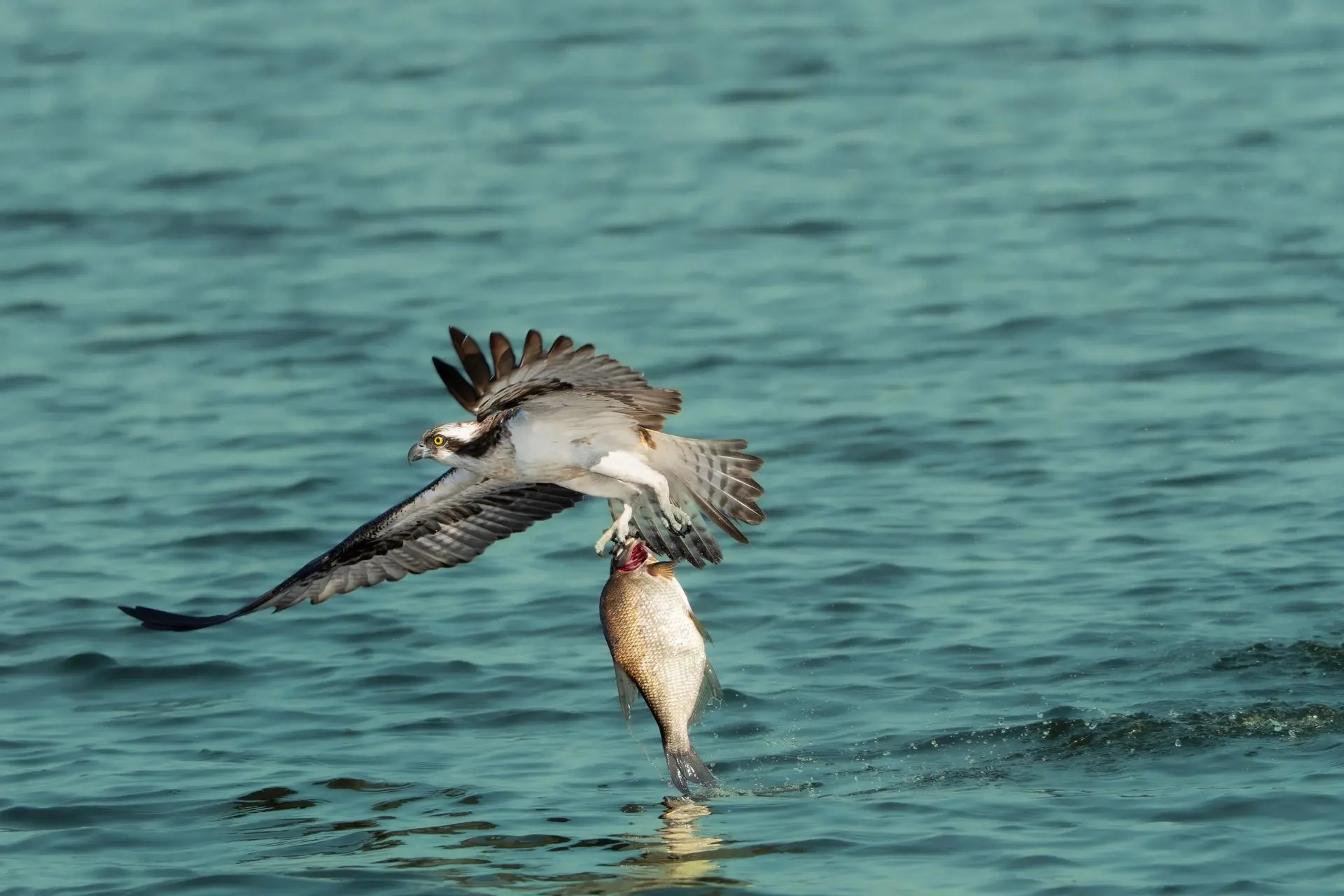
If you want to see an osprey 'Pandion haliaetus' in Huelva, a good place to start is the Isla de Enmedio viewpoint, at the end of the Calatilla de Bacuta trail. From here you can see the Mojarrera channel. Follow the water with your eye. Among the gulls, you might pick out a long-winged bird with a white belly. It hovers, looks down and plunges feet first.
You might also spend a good while scanning the sky, only to discover that an osprey has been perched on the far bank all along. Choose a spot with a clear view of both the water and the perches opposite. Winter is a good time to try. In January 2026, 18 ospreys were counted in the Odiel Marshes, as many as in the whole of the Doñana Natural Area during the same count.
Where to start looking for ospreys in Huelva
An osprey catches a fish in flight | Photo: Tina Nord
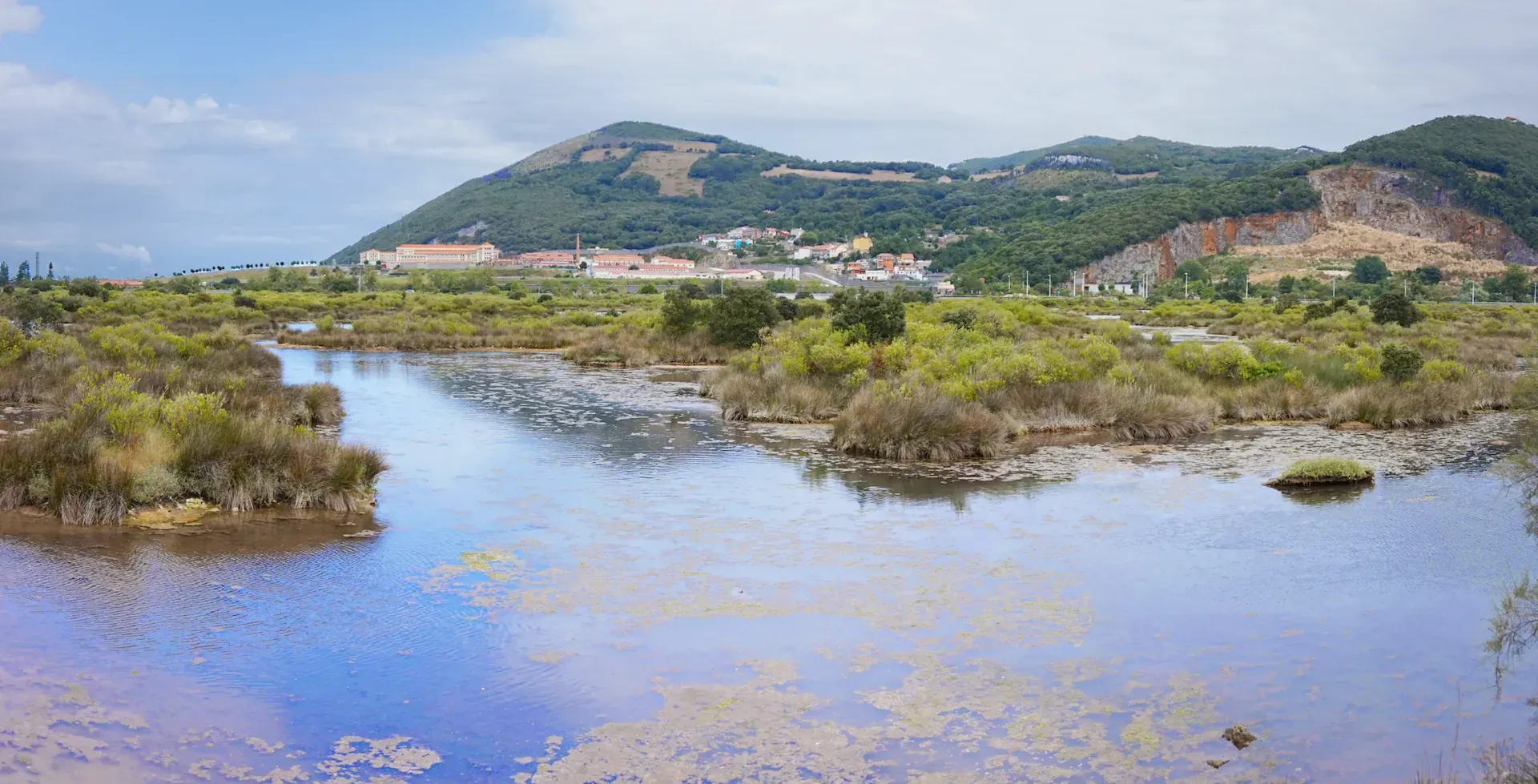
The Odiel Marshes, signposted as Marismas del Odiel, lie beside the city of Huelva, where the Tinto and Odiel rivers meet the sea. Calatilla is a good starting point for a first visit. From here you can look out over a tidal channel, scan the edge of a protected island and walk through traditional salt pans. If time is short, I would give the channel and the Isla de Enmedio viewpoint priority.
Calatilla de Bacuta and the Isla de Enmedio viewpoint
Head for the Anastasio Senra visitor centre. From the A-497 between Huelva and Punta Umbría, take the turning signposted for the nature reserve and follow the Dique Juan Carlos I road to Calatilla. Take a moment to get your bearings by the centre. Two trails here have very similar names. For the Isla de Enmedio viewpoint, look for the Calatilla de Bacuta sign before the bridge to the island of Bacuta.
The Calatilla de Bacuta trail is an easy linear walk of 820 metres each way. It follows the embankment between the industrial salt pans and the Calatilla channel, giving you two different habitats to watch from the same path. On one side, you can pause to watch birds on the salt ponds. On the other, follow the bend in the channel and look for a bird of prey flying along the bank or crossing towards the pans.
The trail ends at the Isla de Enmedio viewpoint. You are still in Calatilla, looking across at the island reserve. This is where I would spend the most time. There is room to follow a bird in flight and pick it up again if it briefly disappears behind a bank. From here you may see an osprey flying over the Mojarrera channel.
When you arrive, look around before raising your binoculars. Find the mouth of the channel, the edge of the island and a post or branch that stands out. These landmarks will help if someone spots a bird. ‘Just right of the post, above the water’ is much easier to follow than ‘over there’. Then scan the far bank with binoculars, pausing over any pale shape that stands out on a perch.
Another view of the estuary from Salinas de Bacuta
If you have more time, head back towards the centre and cross the bridge. On the right you will find the start of the Salinas de Bacuta trail, an easy 1.68-kilometre circular walk. The trail takes you into the traditional salt pans. One of its viewpoints looks out across the estuary, with Huelva and the old Muelle del Tinto pier in the background.
The Salinas de Bacuta viewpoint is about 300 metres from the start of the trail. It makes a good second stop if you want to compare watching a relatively narrow channel with scanning open water. Against the sky, the shape of an osprey’s wings may be the first thing you notice. A bird flying against the city skyline is easier to follow if you have already picked it out over the water.
Between the two viewpoints you may come across birds that feed in quite different ways. Pause if you spot a Eurasian spoonbill 'Platalea leucorodia' wading with its bill in the water, sweeping it from side to side. You can make out that movement even at a distance. To look for an osprey, lift your gaze to the stretch of sky just above the bank. From the same spot, you can watch one bird feel for food below the surface and another look for it from the air.
Why winter is a good time to see ospreys in the Odiel Marshes
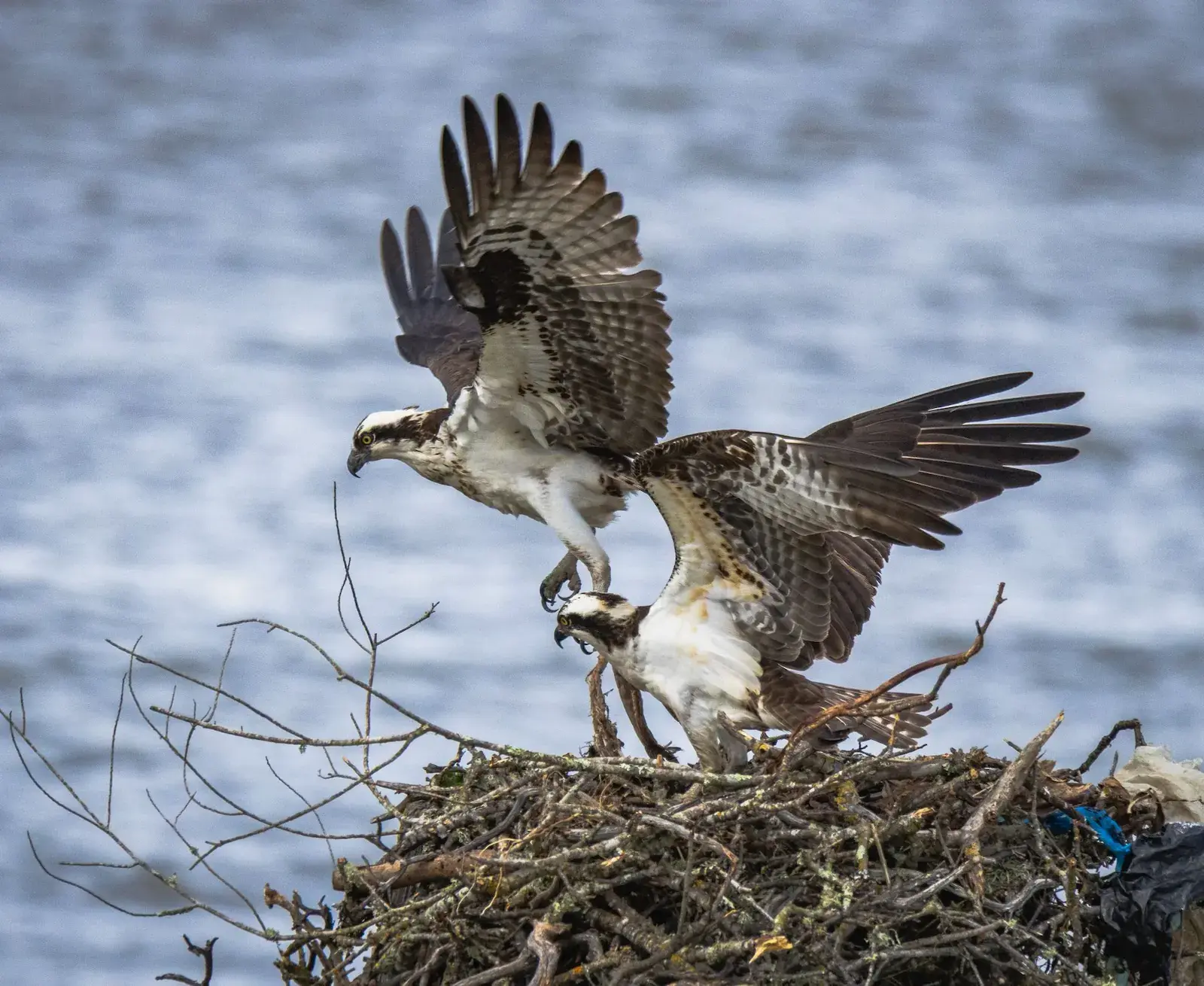
Two ospreys in their nest | Photo: Robert So
An osprey spending December in Huelva may have hatched thousands of kilometres away or much closer to home. Birds from central and northern Europe come to Spain in the colder months, and Huelva’s marshes also have a breeding population. You can therefore see ospreys on a winter visit as well as during the breeding season. What you can tell about the birds depends partly on when you visit.
What the 18 birds in the January count tell us
Waterbirds are counted across Andalusia’s wetlands in mid-January, when wintering populations are relatively settled. In January 2026, 107 ospreys were recorded across 18 Andalusian wetlands. Of these, 31 were in the Bay of Cádiz, 18 in Doñana and another 18 in the Odiel Marshes.
If you are planning a visit, it helps to put those figures in perspective. The 18 birds were counted across the marshes as a whole. From the viewpoint you can see part of a channel, a stretch of bank and a patch of sky. Even at a wetland where ospreys are regularly recorded, you could spend a morning without spotting one. Equally, two sightings half an hour apart could be of the same bird.
November is a good time to start planning visits for the months ahead. The January count gives you an idea of how many ospreys use the marshes in winter. It tells you little about which of two November weekends to choose or which month is best for a sighting. To pick a day, consider which paths are open, how much daylight you will have and whether any birds have been seen in the past few days.
Are all the ospreys seen here in winter migrants?
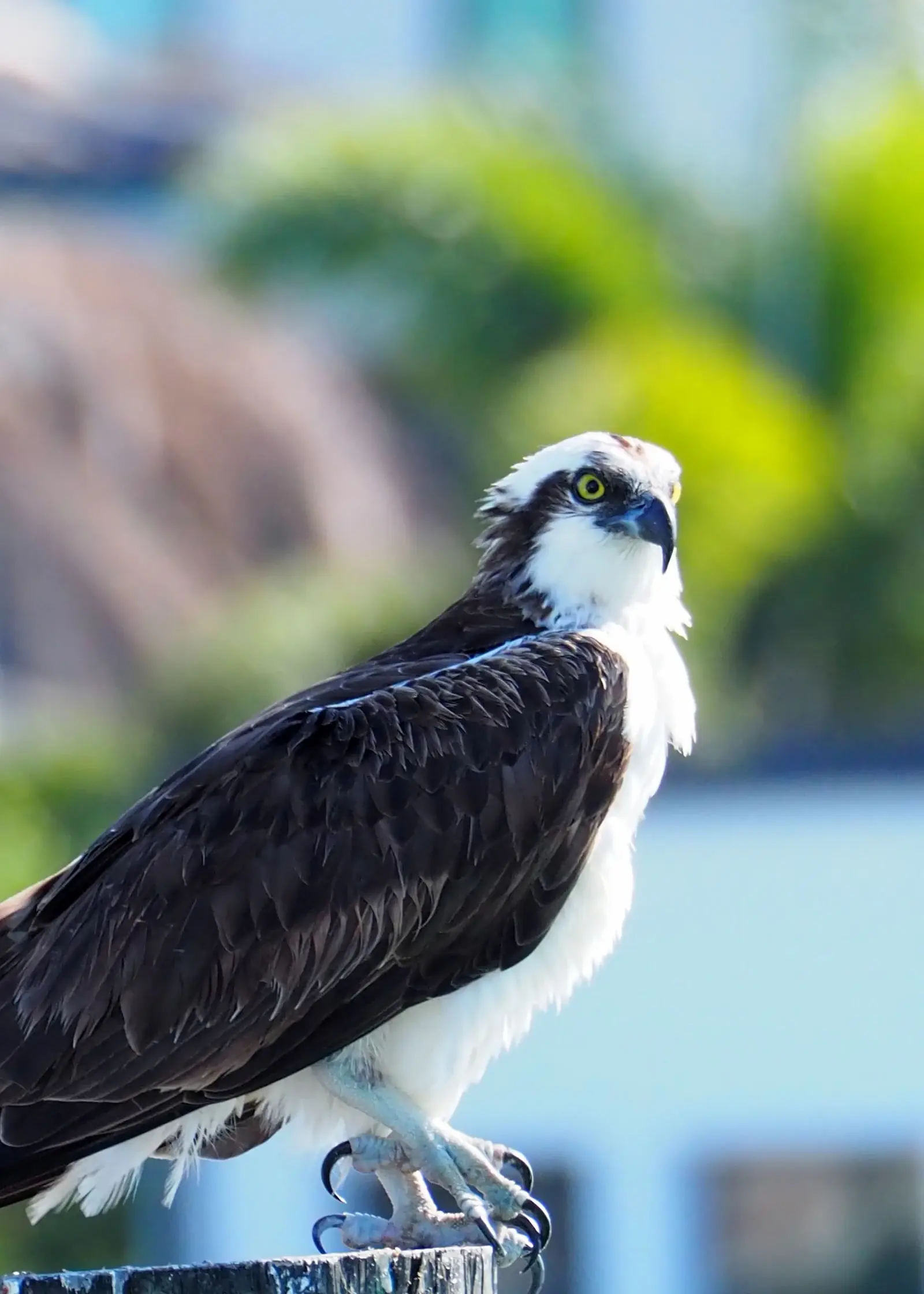
Osprey | Photo: Alexa Heinrich
Ospreys continued to visit mainland Spain in winter even after they had disappeared as a breeding species. Later, a reintroduction programme in Huelva and Cádiz released young birds from elsewhere in Europe, and ospreys began breeding in Huelva’s marshes again. In 2025, nine pairs bred successfully in the Odiel Marshes.
An osprey perched opposite the viewpoint in January might belong to that local population or have arrived from another country. Plumage can help you identify the species, but tracing an individual bird’s origins takes other clues. Sometimes a ring carries a code that can be read at a distance. In the Odiel Marshes, for instance, the same osprey was identified over several winters from 2013 onwards.
How to recognise an osprey in flight and on a perch
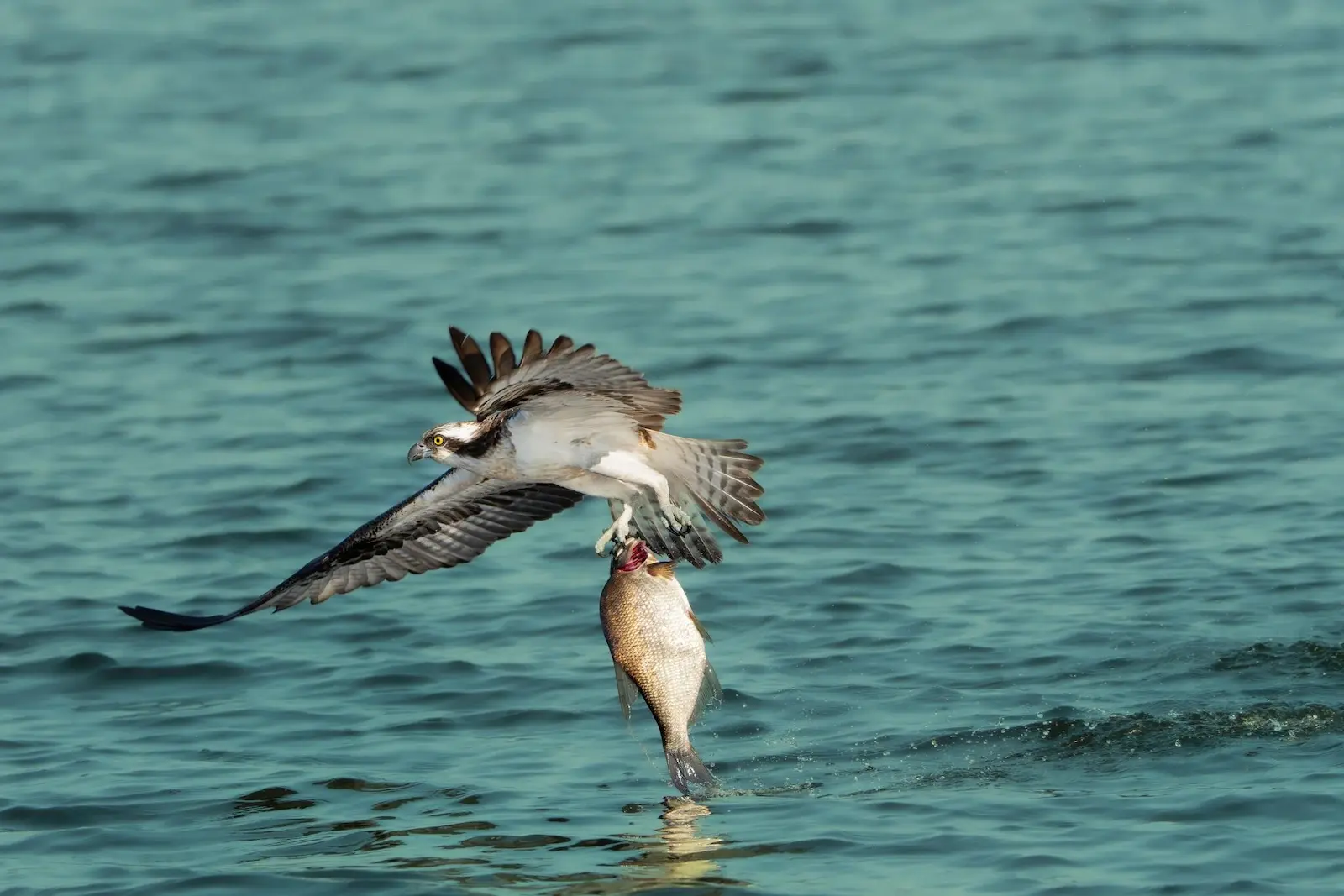
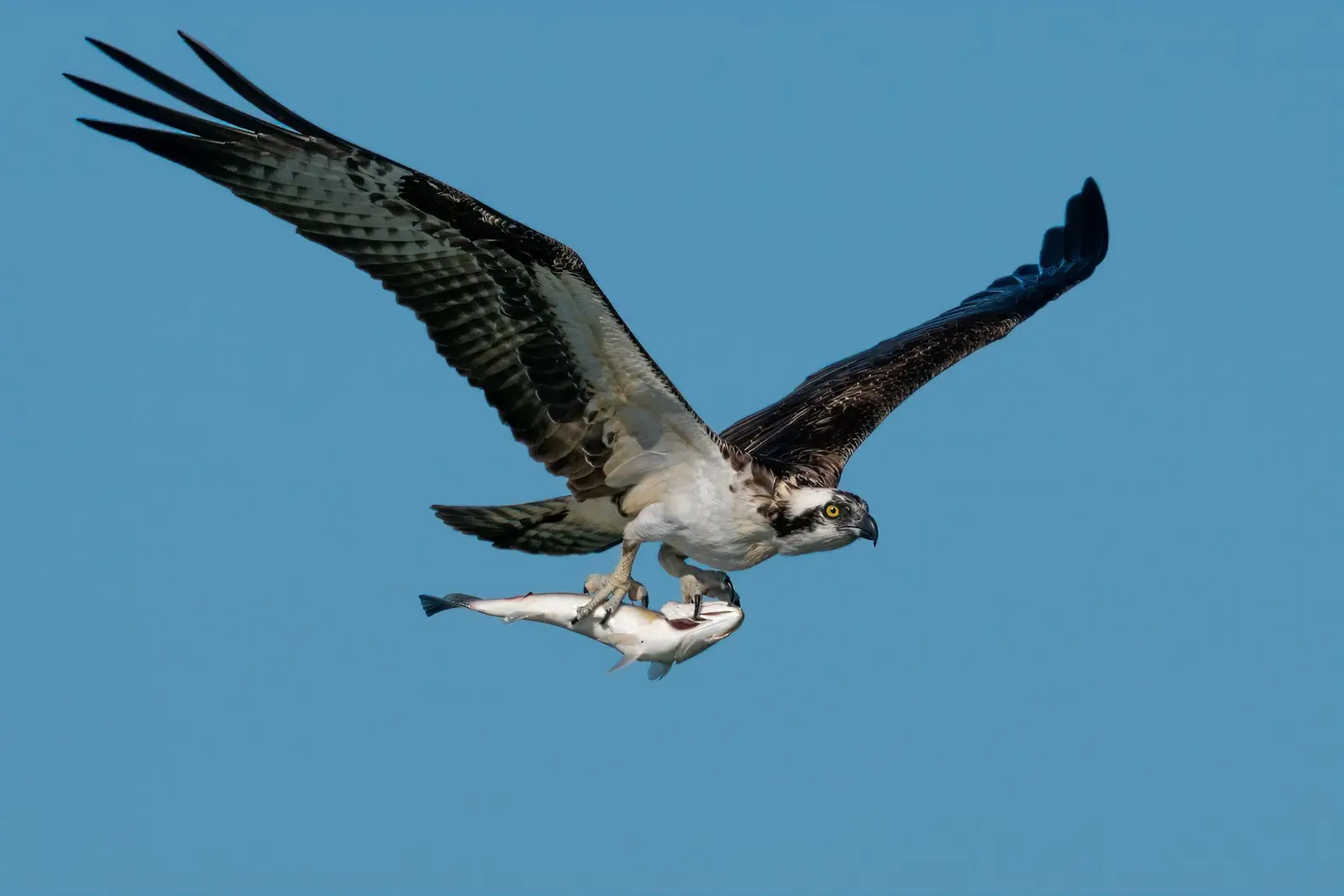
Osprey flying over the water with a fish | Photo: Lorenzo Manera
In the Odiel Marshes, a large gull is one of the easiest birds to mistake for an osprey. At a distance, both can look pale underneath and show long wings with a pronounced bend. Size is particularly hard to judge over the estuary. A gull close to you can look larger through binoculars than a bird of prey flying over the far bank.
In flight, look at the markings on the underwings
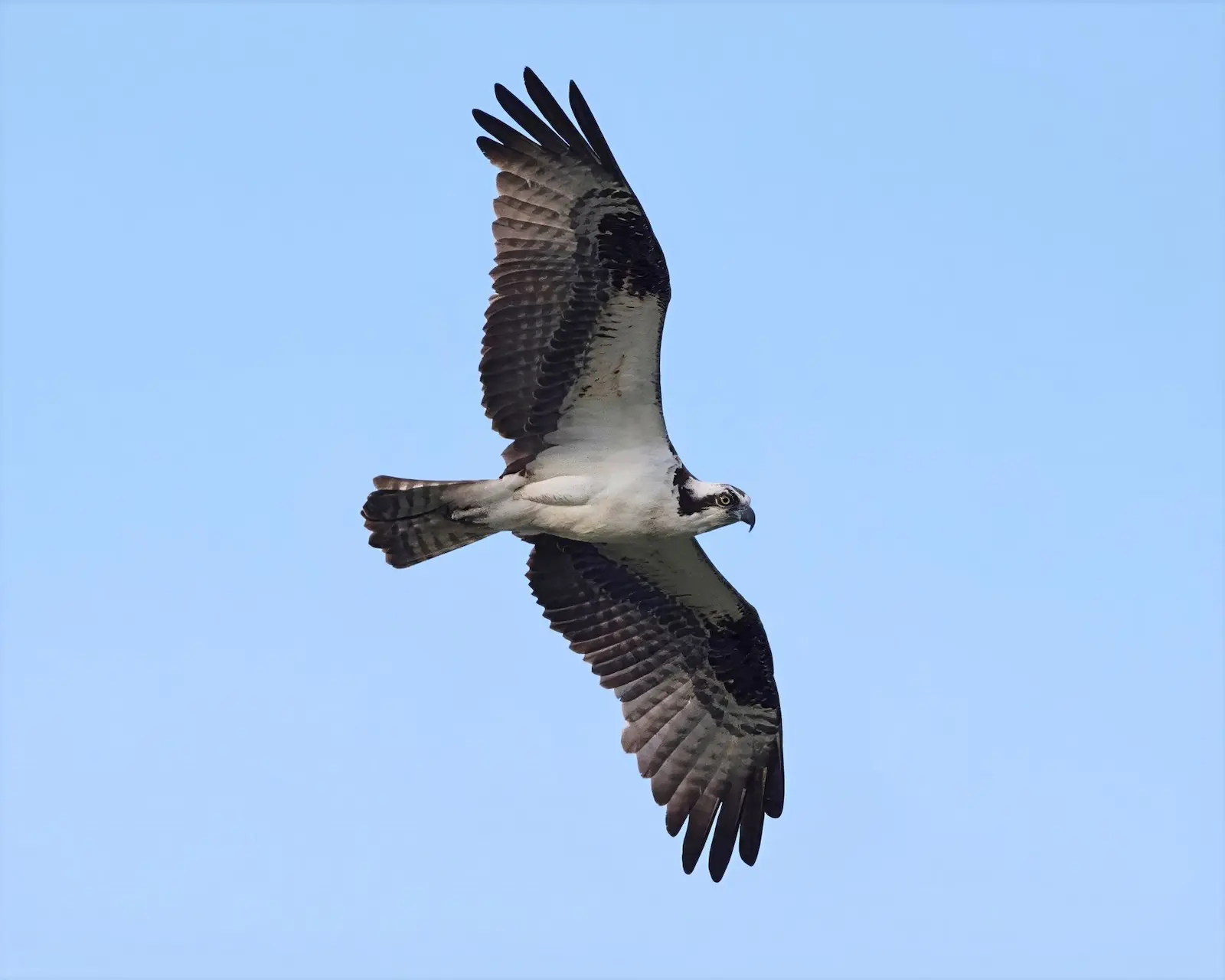
Osprey in flight | Photo: A. G. Rosales
An osprey has a relatively short tail and long, narrow wings that bend at the wrist. As it glides, look for the dark patch at the bend of each wing. When the bird banks and the light catches its underside, you may see the pale belly and the contrast between the white and darker areas of the underwing.
Try concentrating on one feature at a time. When the bird is distant, follow its outline to keep it in view. As it starts to turn, look for the underwing pattern. If you are facing the sun and can see only a dark silhouette, wait for the bird to change direction. A few seconds of side light can reveal more than enlarging a photograph in which the plumage is entirely in shadow.
On a perch, look for the dark stripe through the eye
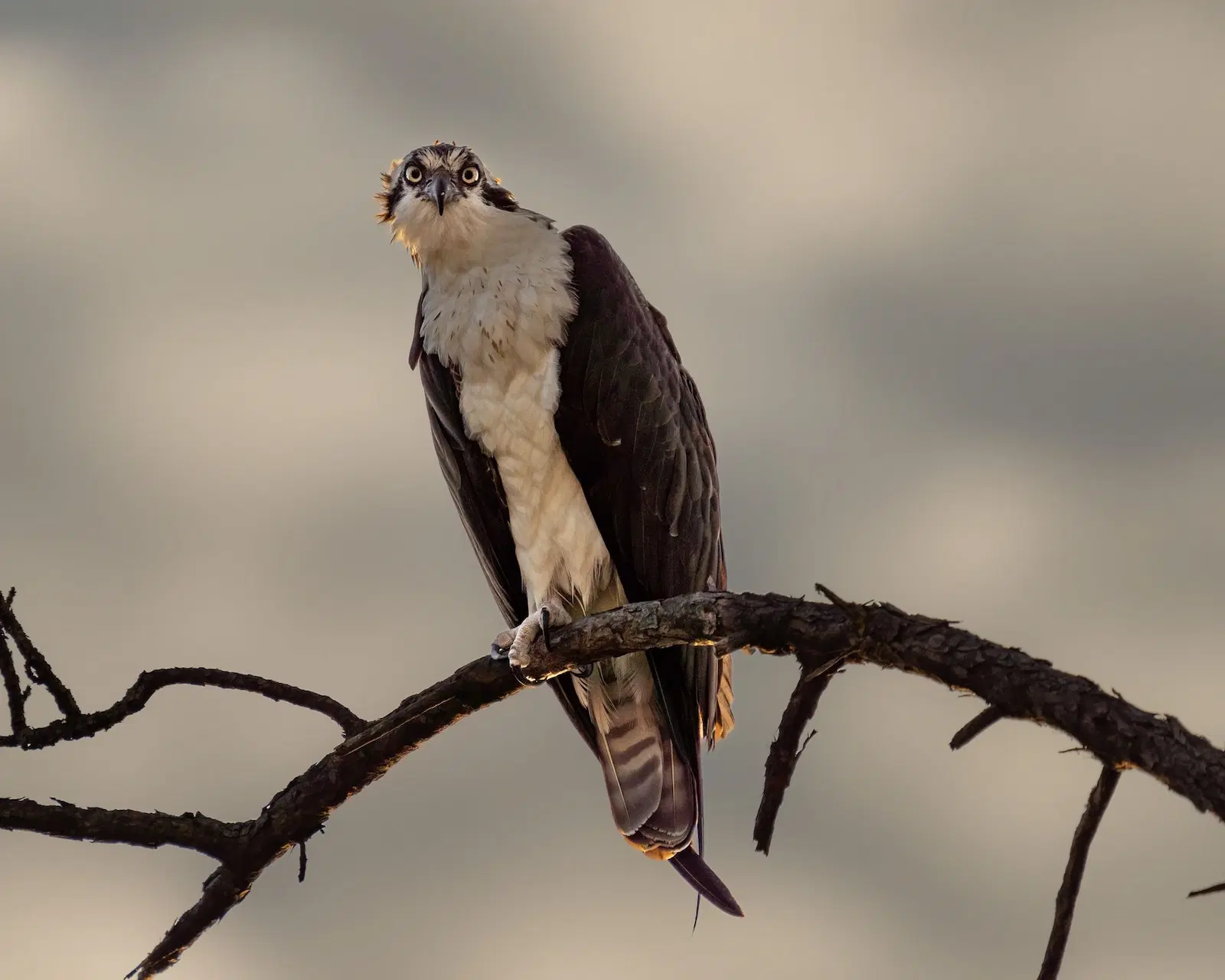
Osprey perched on a branch | Photo: Dmytro Koplyk
A perched osprey looks quite different. With the wings folded, its brown back can blend into the perch. The pale head is often what catches your eye first. In profile, look for a dark stripe running through the eye towards the neck. If the bird turns, you may see the pale breast as well.
From the viewpoint, alternate between watching the sky and scanning the raised perches you can see. Binoculars are usually easiest for finding the bird in the first place. Once you have found it, a telescope can help you make out the head markings or see whether it is holding a fish. If there are two of you, one person can keep the bird in view through binoculars while the other lines up the telescope.
When an osprey is fishing, watch its feet
When an osprey spots a fish near the surface, it may hover briefly, beating its wings to hold its position. It looks down, tips forwards and, if it dives, swings its feet out in front to enter the water talons first. That last movement is particularly helpful for identification at a distance. If the bird emerges with a fish, it may turn it head first as it flies.
One detail that is hard to see from the bank explains how an osprey keeps its grip. It can turn its outer toe backwards to hold the fish with two toes in front and two behind. Small projections on the undersides of its toes also help it grip a slippery catch. Keep your binoculars on the bird after the splash and you may catch the moment it climbs clear of the water, the fish hanging beneath it.
How to plan a morning’s birdwatching around the tide
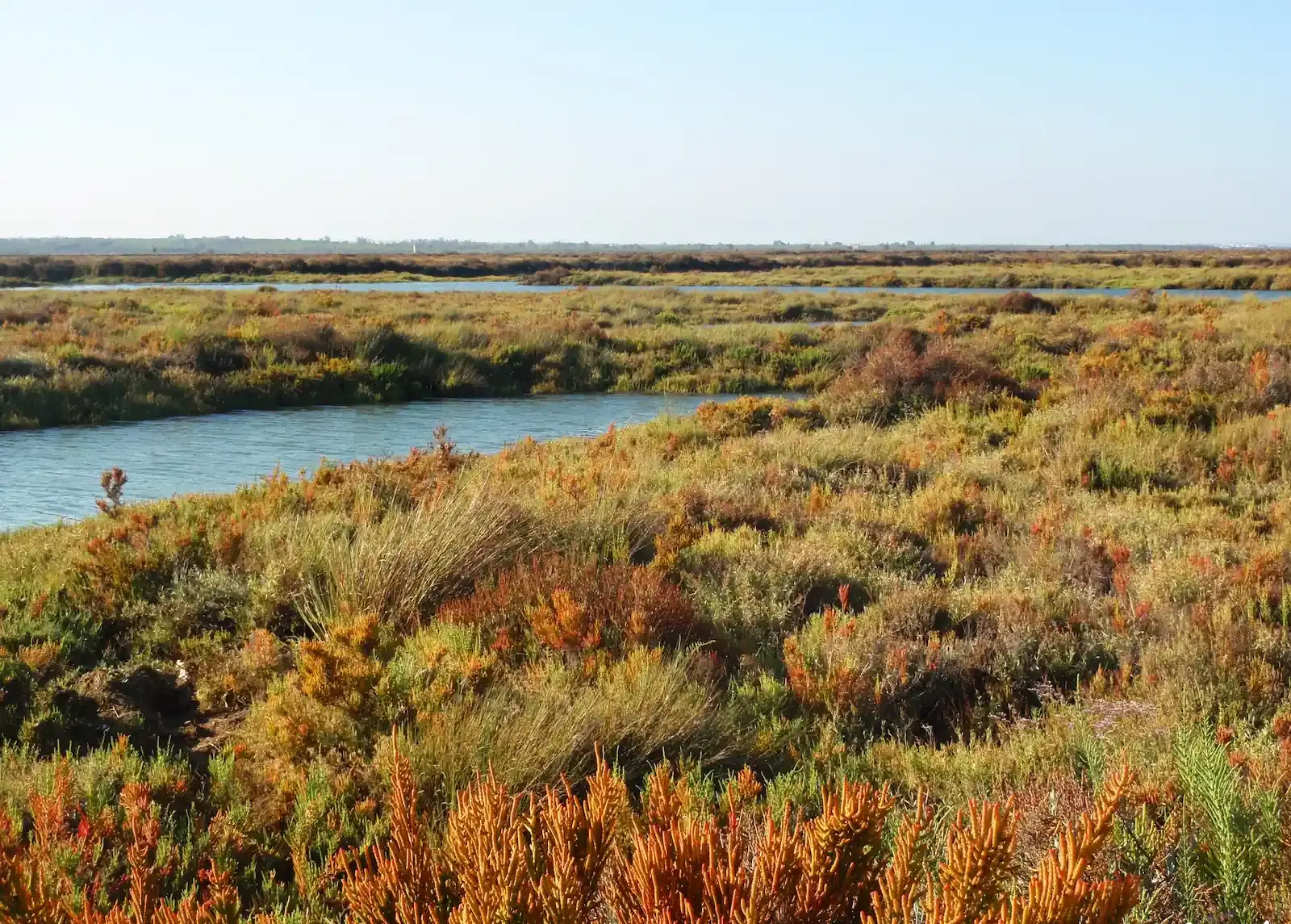
View of the Odiel Marshes in the province of Huelva, Spain | Photo: Jose A, CC BY 2.0
The time of low tide in Huelva changes from day to day. As the water falls, it exposes banks and shallows where many birds feed. From the Isla de Enmedio viewpoint, this is a good time to watch waders working their way across the mud. An osprey needs fish within reach, so keep an eye on the stretches that still hold water and on the birds flying above them.
If you arrive on a rising tide, pick a landmark on the far bank and look back at it after a while. A strip of mud where you could pick out legs and bills may already be covered, with the waterline now closer to the vegetation. Come back at the same time the following weekend and the marsh may look quite different. Ospreys can fish at different stages of the tide.
If you have one to two hours
For a first visit on your own or with a companion, the timings below give you room to stop if a bird appears or spend longer at a viewpoint.
- First 5–10 minutes. Get your bearings at Calatilla, find the start of the trail and see which way the light is falling. Spend a few minutes watching the channel from the path entrance.
- Next 20–30 minutes. Walk the Calatilla de Bacuta trail, pausing where the path opens up a view of the water. Scan the visible perches and watch for birds in flight as you go.
- Next 15–35 minutes. Stay at the Isla de Enmedio viewpoint. Divide your time between the Mojarrera channel, the far bank and the sky.
- Remaining time. Return along the same path. If you have a second hour and would like a different angle, visit the Salinas de Bacuta viewpoint. On a one-hour visit, leave the last part of the hour for the walk back from the Isla de Enmedio viewpoint.
The walking trails in the Odiel Marshes may close temporarily for maintenance. The Calatilla de Bacuta trail closed in June 2026 and reopened in full on 29 July.
What to record if you spot an osprey
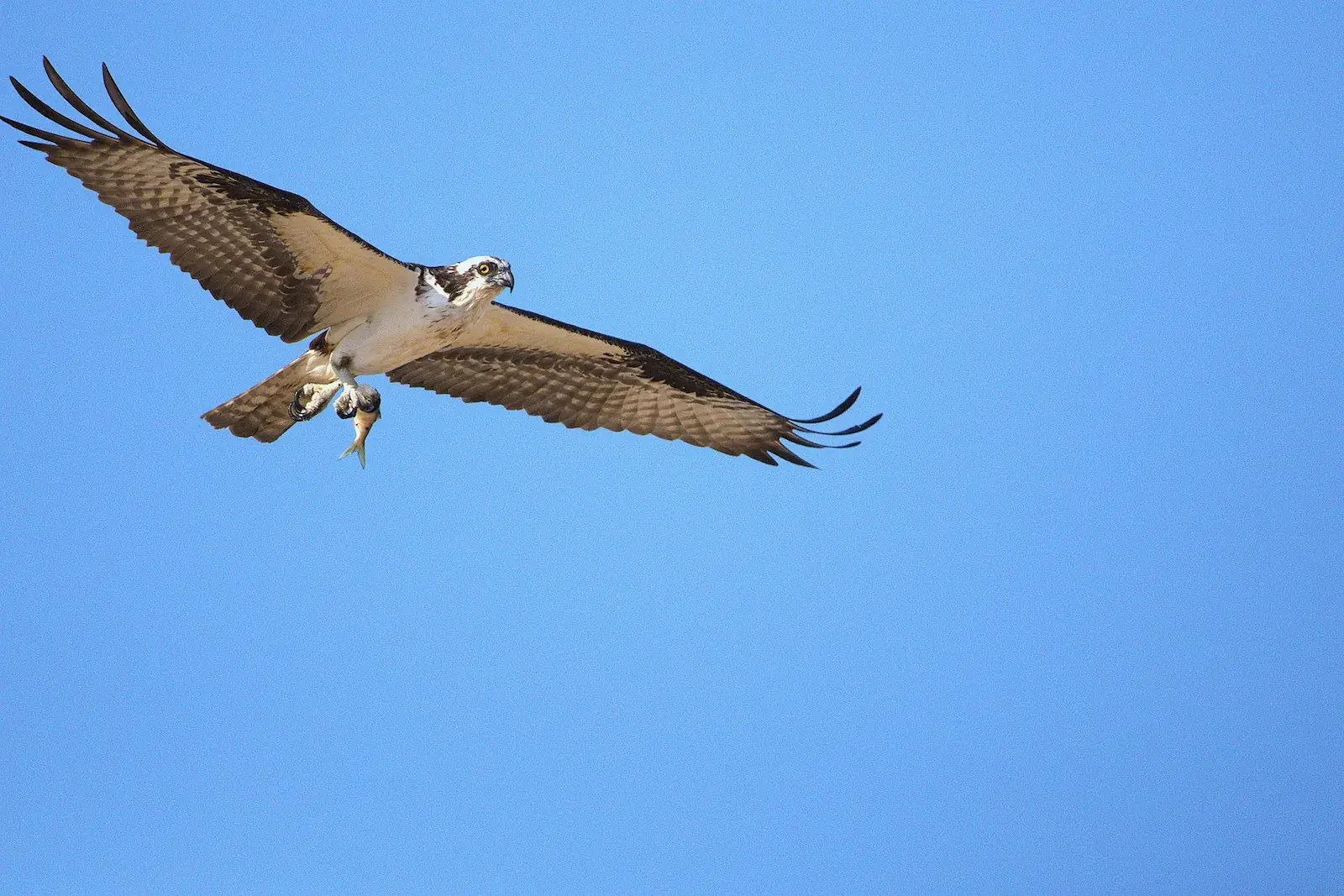
Osprey soaring through the sky with a fish in its talons | Photo: Randy West
A few details will make the sighting more useful when you get home. Note the time, the public viewpoint or path you were watching from, how many birds you could see at once and what each was doing. ‘One perched while another crossed the channel carrying a fish’ tells you much more than two ticks on a list. If a single bird flies past twice, note the time and direction of each flight.
If you can see a ring through your telescope, note its colour, which leg it is on and any characters you can read with confidence. A photograph taken from the same spot may help you check a doubtful letter later. When reporting a ring sighting, include the date and location and say which characters you could not make out. Keep your distance even if the final character stays hidden.
If an osprey is fishing, give yourself a moment before raising the camera. Afterwards, the hardest thing to describe is often the way it entered the water and came out again. A photograph may catch the fish in its talons. Following the bird from the hover to the dive and back into the air lets you see how the fish got there.
Frequently asked questions about ospreys in the Odiel Marshes
Where should I go on a first visit?
The Isla de Enmedio viewpoint, at the end of the Calatilla de Bacuta trail, is a good first stop. It overlooks the Mojarrera channel and the edge of the island reserve. If you have time for just one stop, this is where I would spend it.
Can I visit without a guide?
Yes. Calatilla de Bacuta and Salinas de Bacuta are both open to independent visitors. Access to some other routes in the marshes is restricted. For this walk you can follow the waymarked trails and watch the island from the designated viewpoint.
Do I need to go at dawn or low tide to see an osprey fishing?
You can look for ospreys throughout daylight hours. Low tide is a good time to watch birds feeding on the exposed mud. For ospreys, choose a spot with a clear view of the water and enough light to follow a bird in flight without looking into the glare. There is no set time at which you can count on seeing a catch.
Where else do ospreys spend the winter in Spain?
In the south-west, the Bay of Cádiz and Doñana are both important wintering areas. Ospreys also spend the winter elsewhere along the coast and at some inland reservoirs.
Will I need binoculars or a telescope?
I would start with binoculars. They make it easier to pick up a moving bird and follow it across the channel. A telescope is useful for watching an osprey perched on the far bank, seeing its head markings or trying to read a ring from the viewpoint.