Every autumn, as leaves begin to cover the ground and acorns ripen on oak trees, a small bird travels through the woodland collecting seeds and hiding them in places it will use as food stores over the following months.
Interestingly, some of those acorns are never recovered and, if conditions are favourable, they can germinate and grow into new trees. In this way, a behaviour that helps the bird survive the winter also contributes to the natural regeneration of forests.
The bird behind this remarkable story is the Eurasian jay (Garrulus glandarius), a member of the crow family that lives in many Spanish woodlands and plays a much more important ecological role than its size might suggest.
But how does it remember where it has hidden so many acorns? How far can it carry them? And why is its behaviour so important for the future of holm oak and oak woodlands?
The answers reveal an extraordinary relationship between a bird, its memory and the trees that make up our forests.
The Eurasian jay, one of the most striking birds in our woodlands
Eurasian jay perched on a branch | Photo: Erhan Çoban
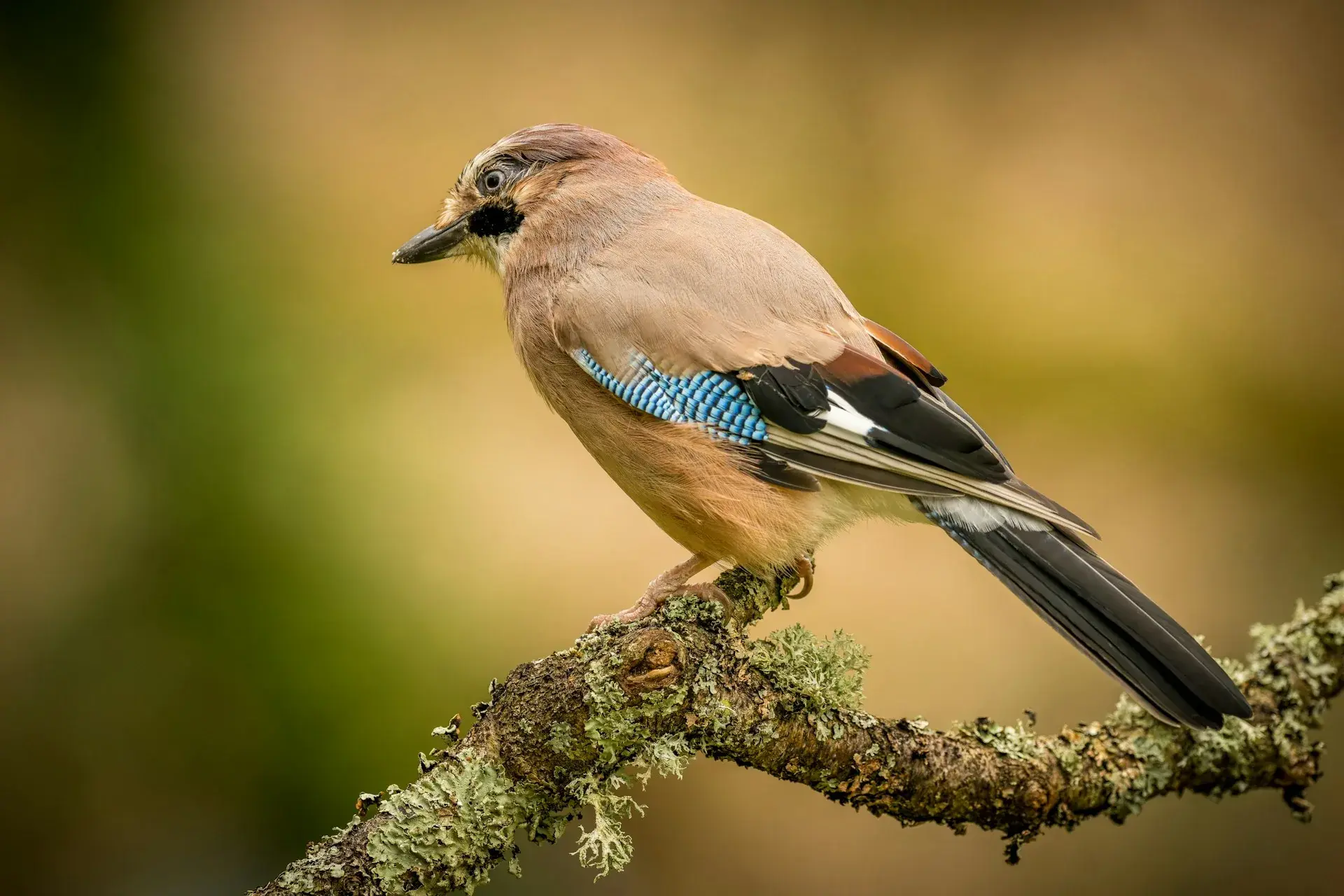
Although it belongs to the same family as ravens, crows and magpies, the Eurasian jay looks quite different from other corvids.
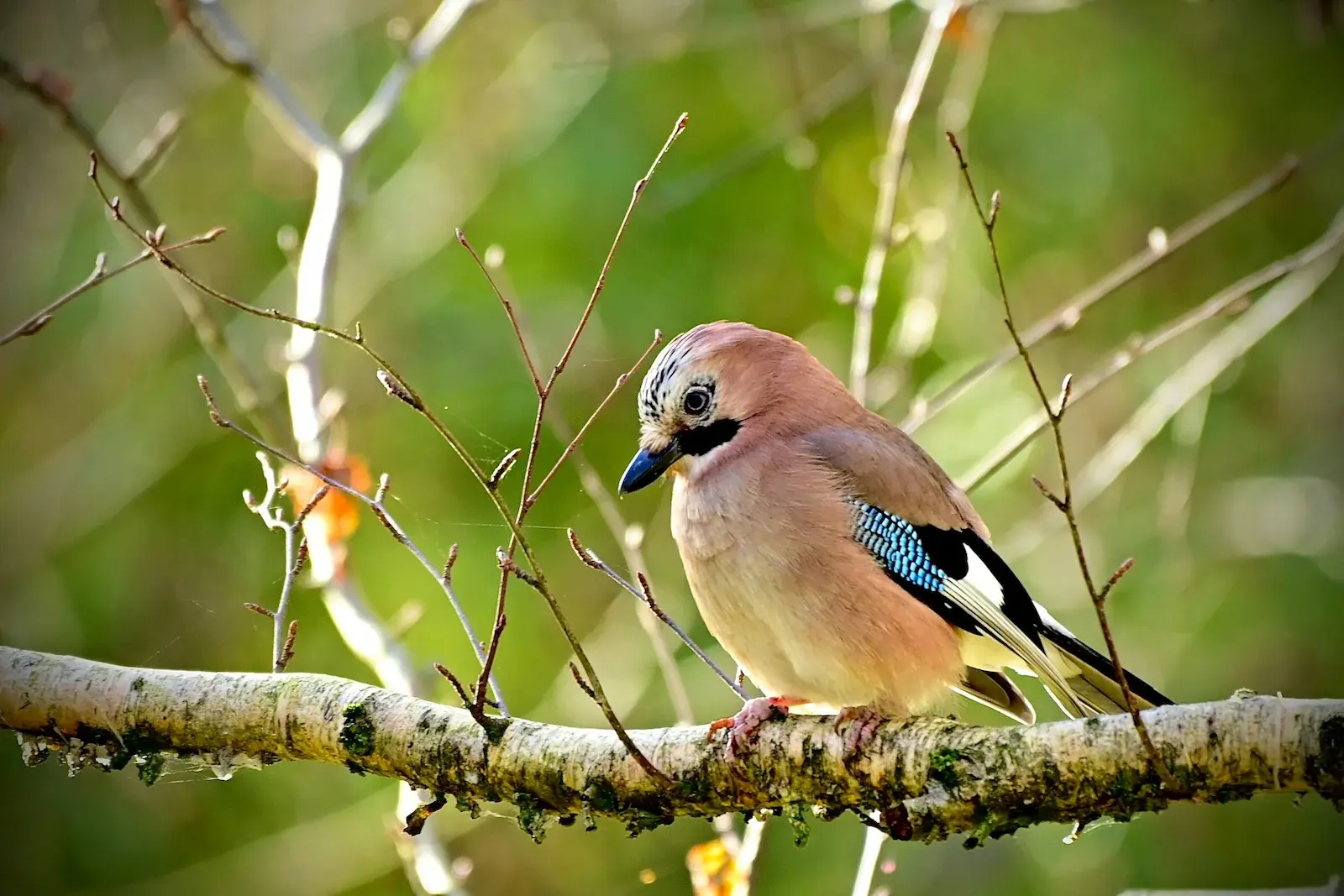
Its plumage combines ochre, pinkish and grey tones, with distinctive black moustache-like markings on either side of its bill. However, its most recognisable feature is the small patch of turquoise-blue feathers crossed by black stripes on its wings.
When flying, it also reveals striking white patches that contrast with its dark tail, making it recognisable even as it moves quickly between trees.
Measuring approximately 32–35 centimetres in length, with a wingspan of around 54–58 centimetres, it is a medium-sized bird that is often easier to hear than to see.
And that is because the Eurasian jay has a very distinctive voice. Its harsh, piercing calls can often be heard among the trees, particularly when it detects danger or something disturbs the peace of the woodland.
Furthermore, it can imitate the sounds of other birds, including certain birds of prey such as the northern goshawk and common buzzard. Its vocal repertoire is far more varied than the typical screech we associate with the species, and can include soft sounds, clicks and other vocalisations that are difficult to recognise.
This combination of colourful plumage, intelligence and vocal ability makes the Eurasian jay one of Spain's most interesting corvids, although its true importance to woodland ecosystems becomes particularly apparent during autumn.
Why the Eurasian jay is known as the bird that plants forests
The relationship between jays and forests begins with something seemingly simple: the need to store food for the months when it becomes harder to find.
The Eurasian jay is an omnivorous bird that adapts its diet to the resources available. During spring and summer, it consumes numerous invertebrates, including caterpillars, beetles, grasshoppers and earthworms, as well as fruit and other foods.
However, as autumn arrives and many insects become scarcer, seeds and fruits take on particular importance.
Among its favourite foods are acorns, especially those produced by different species of oaks and holm oaks, which provide an important source of energy.
But rather than eating them all immediately, the Eurasian jay collects some of them and hides them in different places to retrieve later.
This behaviour is known as scatter-hoarding, a strategy used by various birds and mammals that involves spreading food reserves across numerous hiding places rather than concentrating them in a single location.
This way, if another animal discovers one of its food stores, the jay does not necessarily lose all its reserves.
What makes this behaviour extraordinary is that, during the process, acorns can end up buried far from the tree that produced them. And although the bird's intention is to store food, some of those seeds remain in the ground long enough to germinate.
In this way, the Eurasian jay contributes to the expansion and regeneration of forests, transporting seeds that, because of their size and weight, would struggle to travel long distances through wind dispersal alone.
How Eurasian jays hide acorns and prepare their winter food stores
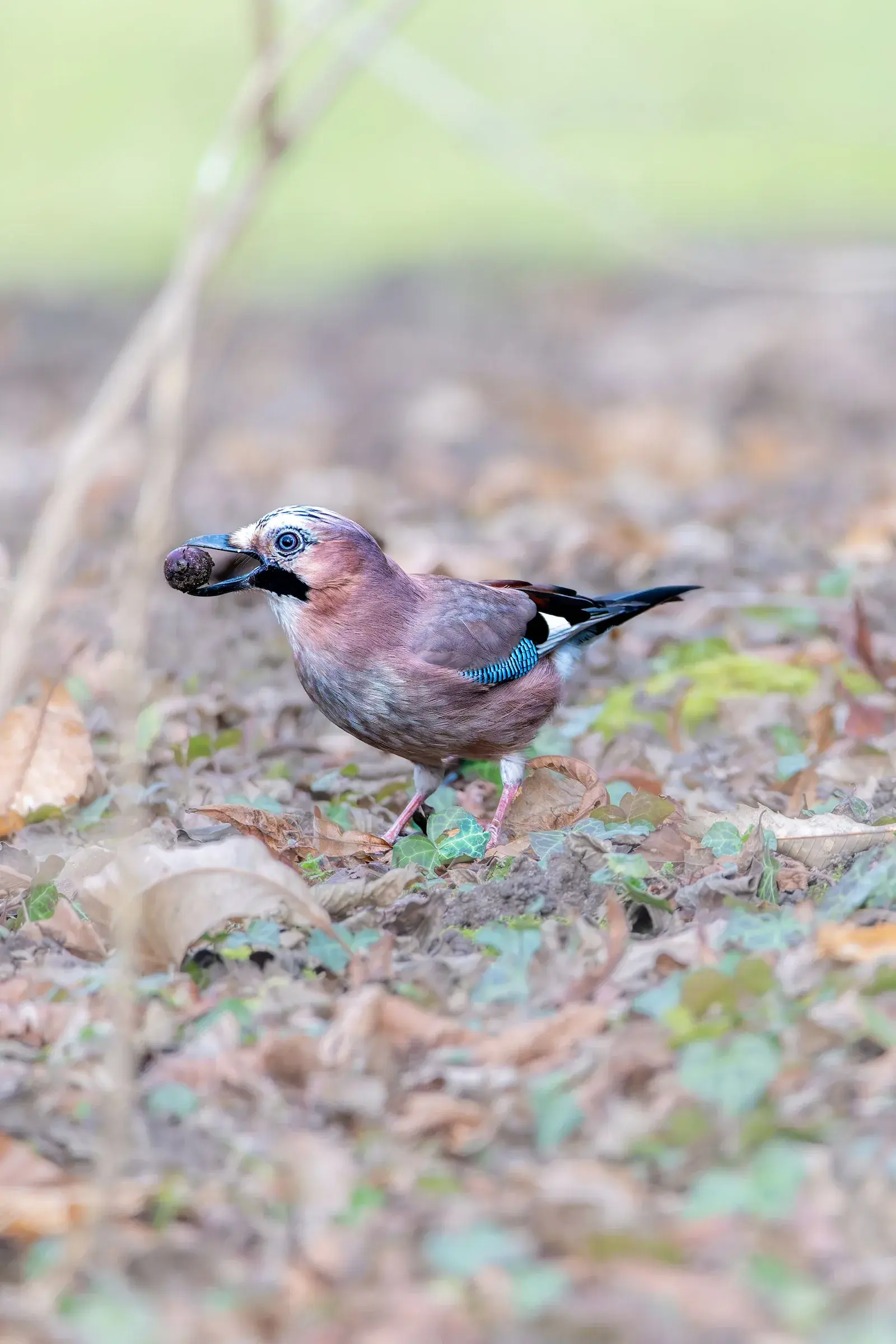
Eurasian jay holding an acorn | Photo: Siegfried Poepperl
During autumn, Eurasian jays can devote a significant part of their daily activity to collecting, transporting and storing acorns.
When they find a tree producing plenty of fruit, they select acorns that they can carry to different locations within the woodland or surrounding areas.
Sometimes they transport several acorns during a single journey, using their mouth cavity and the upper part of their digestive tract to hold some of them temporarily.
They then travel to their chosen hiding places, where they can push the acorns into small holes in the ground and cover them with soil, leaves or plant debris.
Rather than necessarily leaving many acorns together, they commonly distribute them across numerous locations, creating small food stores scattered throughout their territory.
This system offers several advantages. On the one hand, it makes it harder for other animals to find all their reserves and, on the other, it allows the jay to access food in different areas without depending on a single hiding place.
But there is something even more interesting. The Eurasian jay does not choose its hiding places entirely at random.
The locations where it stores acorns can vary according to vegetation, proximity to woodland, ground cover and other characteristics of the terrain.
Some of these locations are particularly favourable for seed germination, although the bird does not bury them with the intention of growing new trees.
How many acorns can a Eurasian jay hide?
Eurasian jays can store large quantities of acorns during a favourable season, and individuals capable of hiding thousands of seeds have been documented.
However, these figures should not be interpreted as a fixed quantity for every jay, as they depend on fruit availability, the length of the season, environmental conditions and individual behaviour.
Furthermore, trees do not produce the same number of acorns every year.
Holm oaks and other oak species can show considerable annual variations in acorn production, with particularly abundant seasons and others when food availability is much lower.
As a result, food-storing activity can vary significantly from one autumn to the next.
What we do know is that this strategy allows Eurasian jays to take advantage of resources when they are plentiful and preserve some of them for less favourable periods.
The surprising memory of Eurasian jays
Hiding food in different places might seem like a good strategy, but it presents an obvious problem.
How does a Eurasian jay remember where it buried its acorns weeks or even months later?
Birds that scatter-hoard food possess spatial memory abilities that allow them to use environmental information to relocate their stores.
In the case of the Eurasian jay, research has demonstrated that its memory can be considerably more sophisticated than we might imagine.
In 2024, a team of scientists investigated the ability of seven Eurasian jays to remember visual information they had previously observed, even when that information did not seem relevant at the time.
The researchers designed an experiment in which the birds watched hiding places prepared by a person and later had to use visual details they had not known they would need to remember.
The results showed that the animals could retrieve incidental information related to a previous experience, an ability that resembles certain characteristics of human episodic memory.
This research into Eurasian jay memory suggests that these birds can remember details of past events that go beyond a simple association between a location and a reward.
However, this does not mean their memory works exactly like ours, nor has it been demonstrated that they consciously recall their experiences in the same way humans do.
What makes this fascinating is that a relatively small bird possesses cognitive abilities that allow it to manage complex information about its surroundings.
And although remembering hiding places is essential for retrieving stored food, not all the acorns that are hidden end up being eaten.
Some may remain unused, others are discovered by different animals, and a proportion survive long enough to germinate.
How a hidden acorn can become a new tree
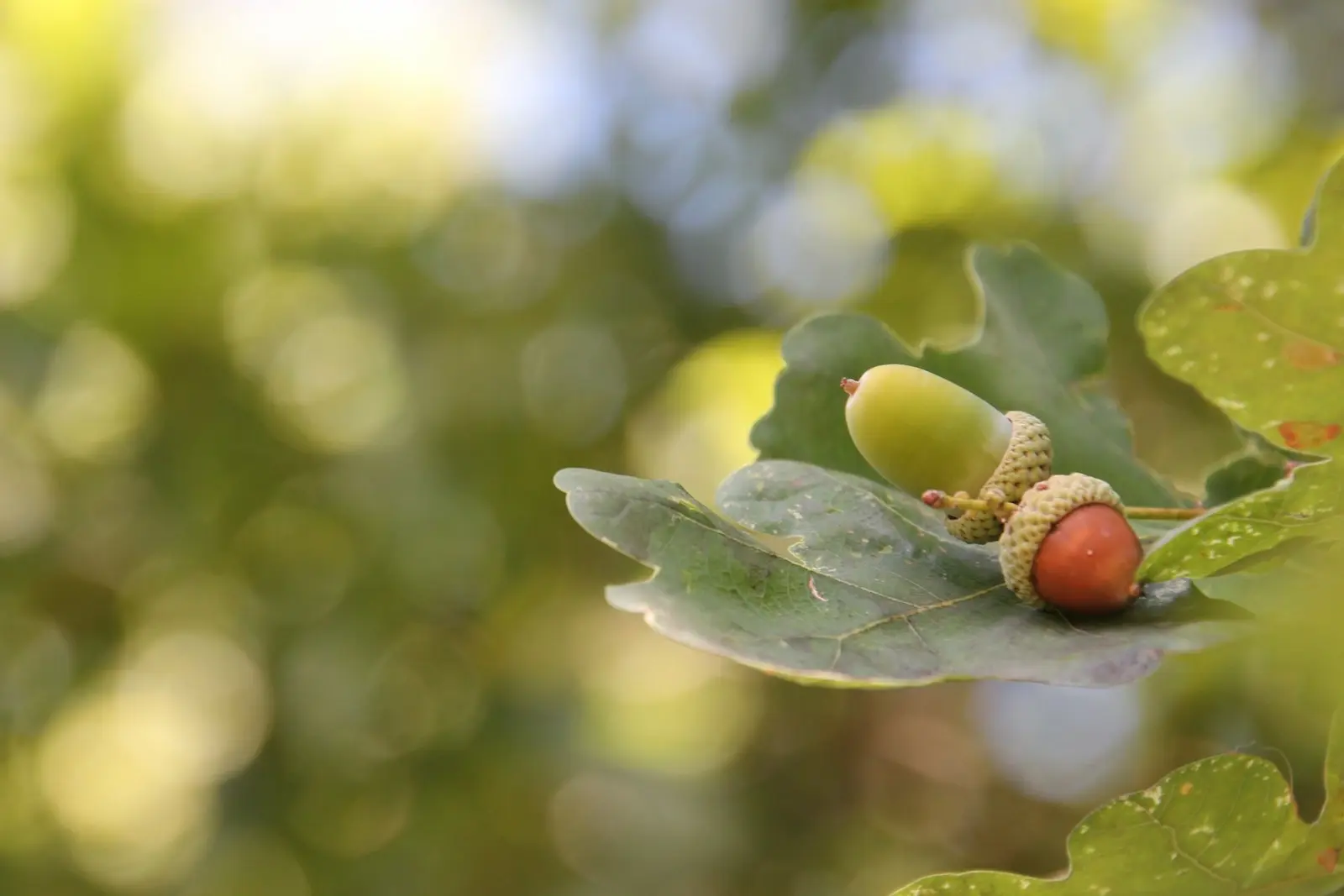
Oak leaf with an acorn | Photo: Dominik Rheinheimer
To understand why the Eurasian jay contributes to forest regeneration, we need to follow the journey of one of the acorns it transports.
Imagine that it collects an acorn from a holm oak and carries it to an area some distance away from the original tree.
When it reaches its chosen location, it places the acorn in the ground and covers it lightly to keep it hidden from other animals.
If the bird does not return to eat it and the seed remains viable, it may begin to germinate when moisture and temperature conditions are suitable.
At that point, the acorn starts developing a root that penetrates the soil, allowing the young seedling to begin establishing itself.
But the process does not end with germination.
To become a tree, the young holm oak must survive dry periods, herbivores, diseases and other challenges that could prevent its development during its first few years.
Therefore, not every acorn buried by a Eurasian jay will become a new tree.
What matters is that the bird allows some seeds to reach places they would have been unlikely to reach on their own, creating new opportunities for natural regeneration.
This phenomenon is known as seed dispersal and is essential for numerous plants, as it allows them to expand their distribution, connect populations and colonise new areas.
In the case of acorn-producing trees, animals that transport and store their seeds play a particularly important role because these fruits are relatively heavy and lack structures adapted to wind dispersal.
How far can a jay carry an acorn?
Although we tend to imagine Eurasian jays hiding acorns close to the trees where they collect them, some studies have shown that they can transport them considerable distances.
Research carried out in Spain used a particularly interesting method to track the movement of seeds.
The researchers inserted small radio transmitters into 239 acorns from holm oaks (Quercus ilex) and cork oaks (Quercus suber), which were subsequently offered to Eurasian jays through experimental feeding stations.
Using radio tracking, they were able to locate numerous hiding places and determine both the distances travelled and the characteristics of the locations where the birds had deposited the seeds.
The results showed that acorns were transported between approximately 3 and 550 metres, with an average distance of 68.6 metres.
This means that some seeds may end up relatively close to the original tree, while others travel several hundred metres before being buried.
Although these figures reflect the conditions of a specific experiment and do not represent a universal limit for the species, they help us understand just how much a bird's behaviour can influence the distribution of trees.
Furthermore, the study found that Eurasian jays frequently used certain recently abandoned areas and forest tracks to hide acorns, while other types of vegetation were used less often.
This choice of location is essential because the fate of a seed depends not only on how far it travels from its parent tree, but also on the conditions of the place where it is eventually deposited.
Not all acorns are hidden underground
Although burying seeds is one of their best-known behaviours, Eurasian jays can also use much more unusual hiding places.
In research published in 2024, scientists tracked the fate of pedunculate oak (Quercus robur) acorns collected by Eurasian jays in different landscapes in southern Poland.
The researchers located 253 of the 259 marked acorns and found that 222 had been stored, while others had been eaten.
Most surprisingly, some acorns were found hidden in unexpected places, including rotting logs, tree cavities, woody stems and the remains of buildings.
In these cases, the hiding places are not always suitable for a seed to germinate and develop into a new tree.
This demonstrates that the Eurasian jay does not behave like a gardener deliberately selecting the best places to plant, but rather like an animal making decisions related to its own food supply and safety.
Even so, many of those decisions end up indirectly benefiting trees.
Why Eurasian jays are so important for Spain's holm oak and oak woodlands
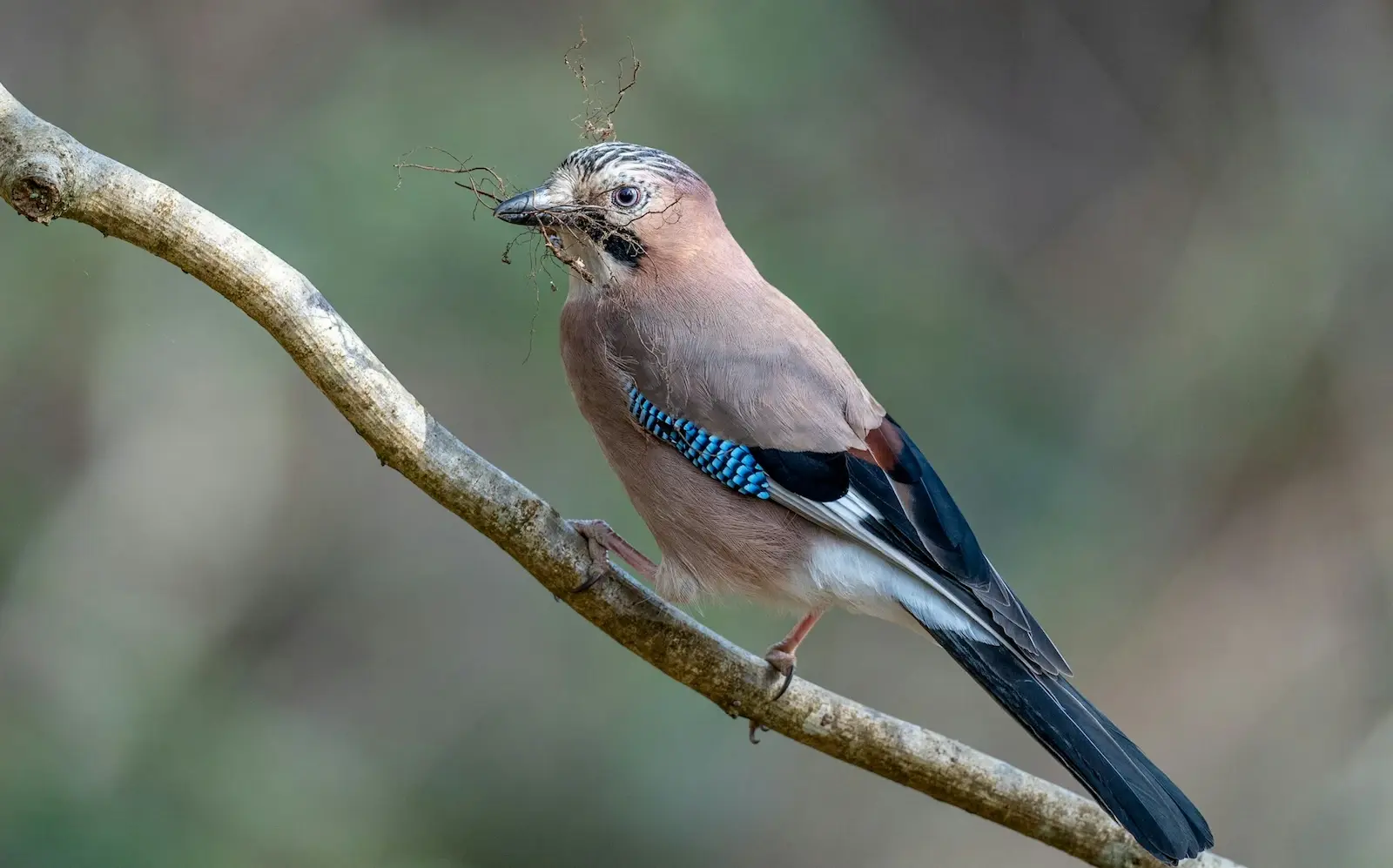
Eurasian jay on a branch | Photo: Bob Brewer
The relationship between Eurasian jays and acorn-producing trees is particularly important in the Iberian Peninsula, where holm oaks, cork oaks and different species of oak form some of our most characteristic woodland ecosystems.
These trees provide food and shelter for numerous animals, help protect the soil and contribute to essential ecological processes.
However, for forests to survive in the long term, it is not enough for mature trees to produce seeds.
Some of those seeds must also reach suitable locations, germinate and survive until they become new individuals.
And this is where seed-dispersing animals play a fundamental role.
The regeneration of holm oaks and other oak species can be limited when woodlands become fragmented and acorn-producing trees grow increasingly isolated.
Under these circumstances, the loss of animals capable of transporting seeds can compromise the establishment of new trees, even when mature trees continue producing fruit.
This shows that conserving a forest is not simply about protecting the trees that already exist, but also about maintaining the ecological relationships that allow it to renew itself.
Can they help restore degraded woodlands?
Acorn dispersal by Eurasian jays can encourage the natural regeneration of certain areas close to existing woodland, particularly when conditions are suitable for germination and seedling survival.
For example, some landscapes containing former agricultural land, partially open areas or connected woodland patches may offer opportunities for seeds transported by birds to grow into new trees.
However, the effectiveness of this process depends on numerous factors.
If a seed ends up in soil that is too dry, is exposed to intense grazing pressure or lands in an area with unfavourable conditions, its chances of survival may be very low.
Furthermore, Eurasian jays are primarily woodland birds, so they do not use all landscapes equally frequently.
The recovery of fragmented holm oak woodlands requires the preservation of nearby woodland and a landscape structure that allows seed-dispersing animals to operate.
Therefore, Eurasian jays can contribute to natural regeneration, but they cannot replace other conservation measures on their own when an ecosystem is severely degraded.
They are not the only animals helping to grow new trees
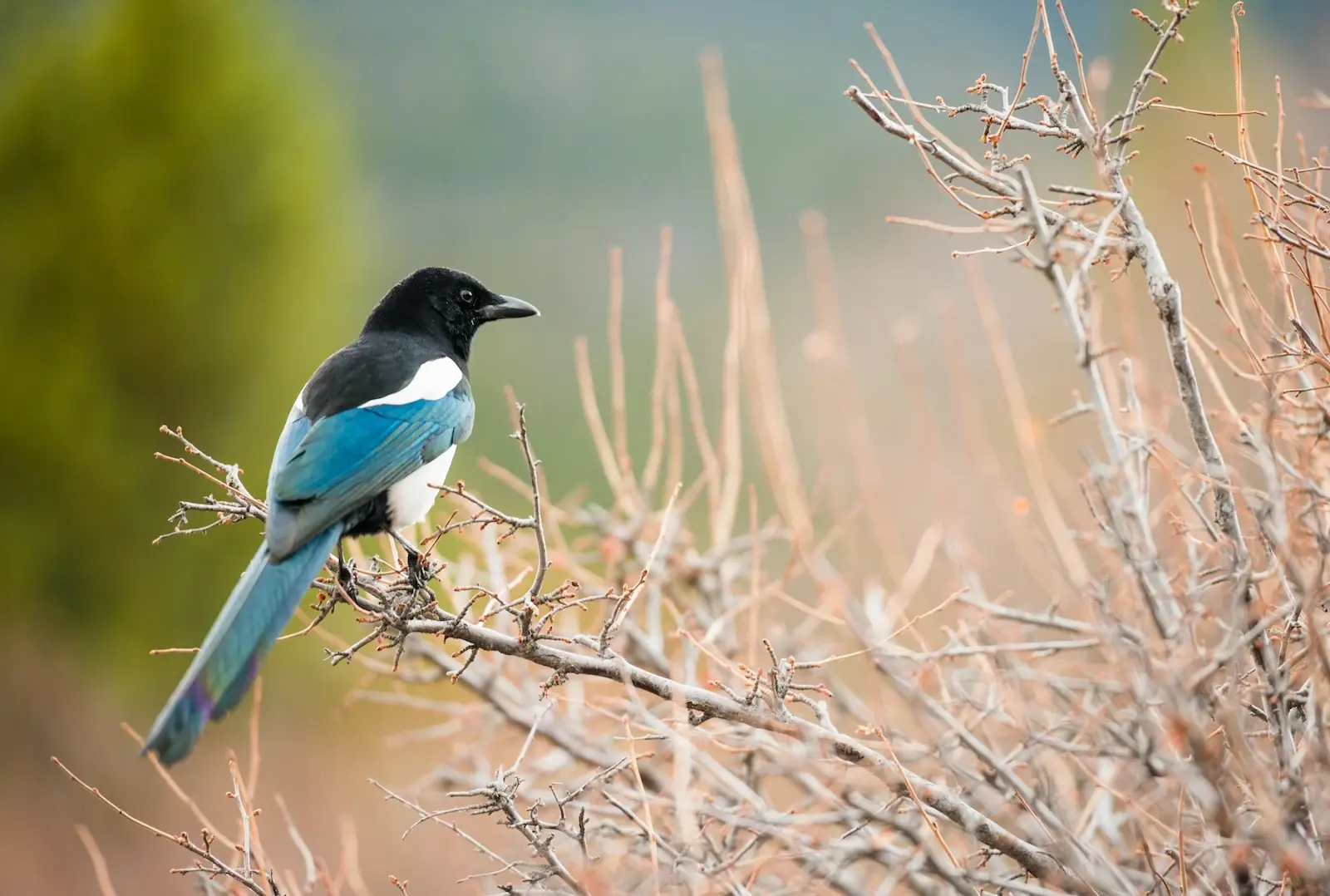
Eurasian magpie | Photo: Natasha Miller
Although the Eurasian jay is one of the best-known acorn dispersers, it is not the only animal that contributes to forest regeneration.
Squirrels and various rodents can also store fruits and seeds, while other birds transport plant-based food to different locations.
In Spain, for example, the Eurasian magpie (Pica pica) can play an important role in acorn dispersal, particularly in certain open landscapes where Eurasian jays are less abundant.
Research carried out in Spanish agroforestry systems found that some magpies could hide large numbers of acorns in the ground and that a small proportion went on to produce new seedlings.
In the study, breeding pairs stored numerous seeds, and researchers estimated that between 0.6% and 2.4% of the hidden acorns produced seedlings, a proportion that may seem small but can have significant effects when hundreds or thousands of seeds are dispersed.
This demonstrates that different species can contribute to forest regeneration through similar strategies, but in different habitats.
The Eurasian jay is particularly important in woodland landscapes and along forest edges, while other animals can participate in seed dispersal across open agricultural land or environments with less tree cover.
Together, these interactions show that forest regeneration depends on a much wider network of relationships between plants and animals.
Where Eurasian jays live in Spain
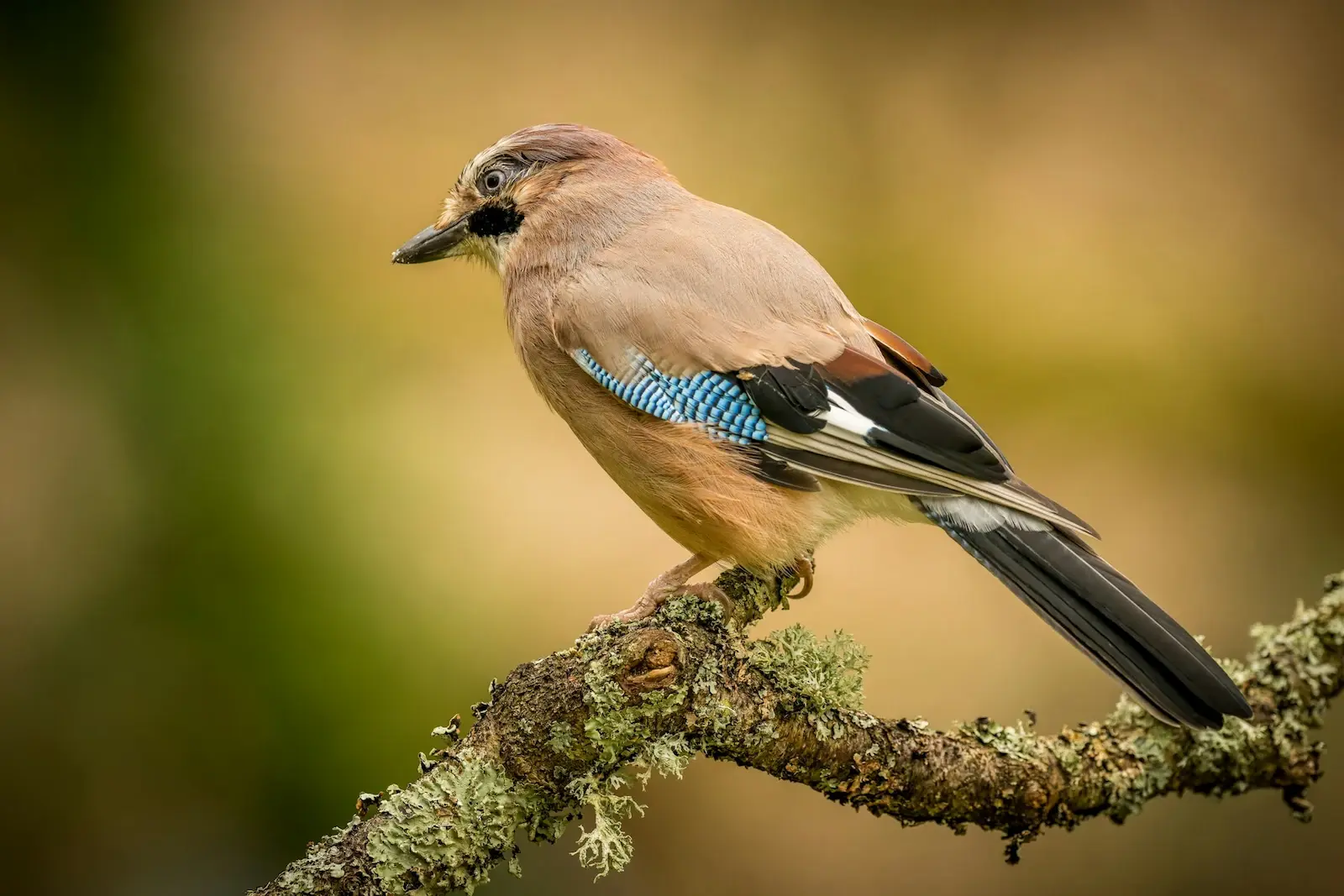
Eurasian jay | Photo: Doncoombez
The Eurasian jay is widely distributed throughout the wooded areas of mainland Spain, although it is not equally common in every region.
Its presence is particularly continuous in the north, where it finds extensive areas of deciduous and mixed woodland, while in other regions it depends on the availability of sufficiently large or connected forest patches.
In Galicia, Asturias, Cantabria and the Basque Country, it can be found in different woodlands and tree-covered landscapes, while in Navarre and the Pyrenees it also inhabits beechwoods, oak woodlands, pine forests and other wooded environments.
In Castile and León, it occurs in wooded areas and mountain ranges, from parts of the Cantabrian Mountains to the Central System.
Catalonia, Aragon and different areas of the Valencian Community also have populations, particularly in wooded landscapes, while in Andalusia it can be found in numerous mountain ranges and forest areas.
However, it is less common in extensive open agricultural areas, very arid regions and territories where woodland cover is scarce.
The distribution of the Eurasian jay in Spain is closely linked to the availability of woodland habitats, with a more continuous presence in the Eurosiberian region and a more fragmented distribution across the rest of the peninsula.
The species does not maintain established breeding populations in the Balearic or Canary Islands and, on the mainland, it is mainly resident, meaning it can be found throughout the year.
Why autumn is the best time to watch jays hiding acorns
Although Eurasian jays can be observed in different seasons, autumn is particularly interesting for understanding their relationship with trees.
During these months, the acorns of many holm oaks and other oak species ripen, encouraging the collection and storage of food.
In the Sierra de Guadarrama, for example, Eurasian jays can be seen carrying and hiding Pyrenean oak acorns during October, which they may later use as food reserves during winter.
This behaviour can also occur in other woodlands across the peninsula, although the exact timing depends on fruit ripening and the environmental conditions of each region.
To observe it, the best approach is to pay attention to woodland edges, clearings and areas with holm oaks or other oak species producing acorns.
Eurasian jays may appear moving between treetops, collecting acorns or travelling towards other areas with an acorn in their bill.
However, they tend to be wary birds, particularly when they detect people nearby.
That is why a good strategy is to remain quiet at a respectful distance and watch their movements through binoculars, without trying to follow them to their hiding places.
It is also worth listening.
Their loud, harsh calls can reveal their presence even when they remain hidden among the foliage, and with a little practice, it becomes possible to recognise them before actually seeing them.
Of course, seeing a Eurasian jay carrying an acorn does not necessarily mean it is going to bury it. It may also be transporting the acorn to eat elsewhere, so food-storing behaviour should be identified by observing the bird's complete sequence of movements.
How to observe Eurasian jays without interfering with their behaviour
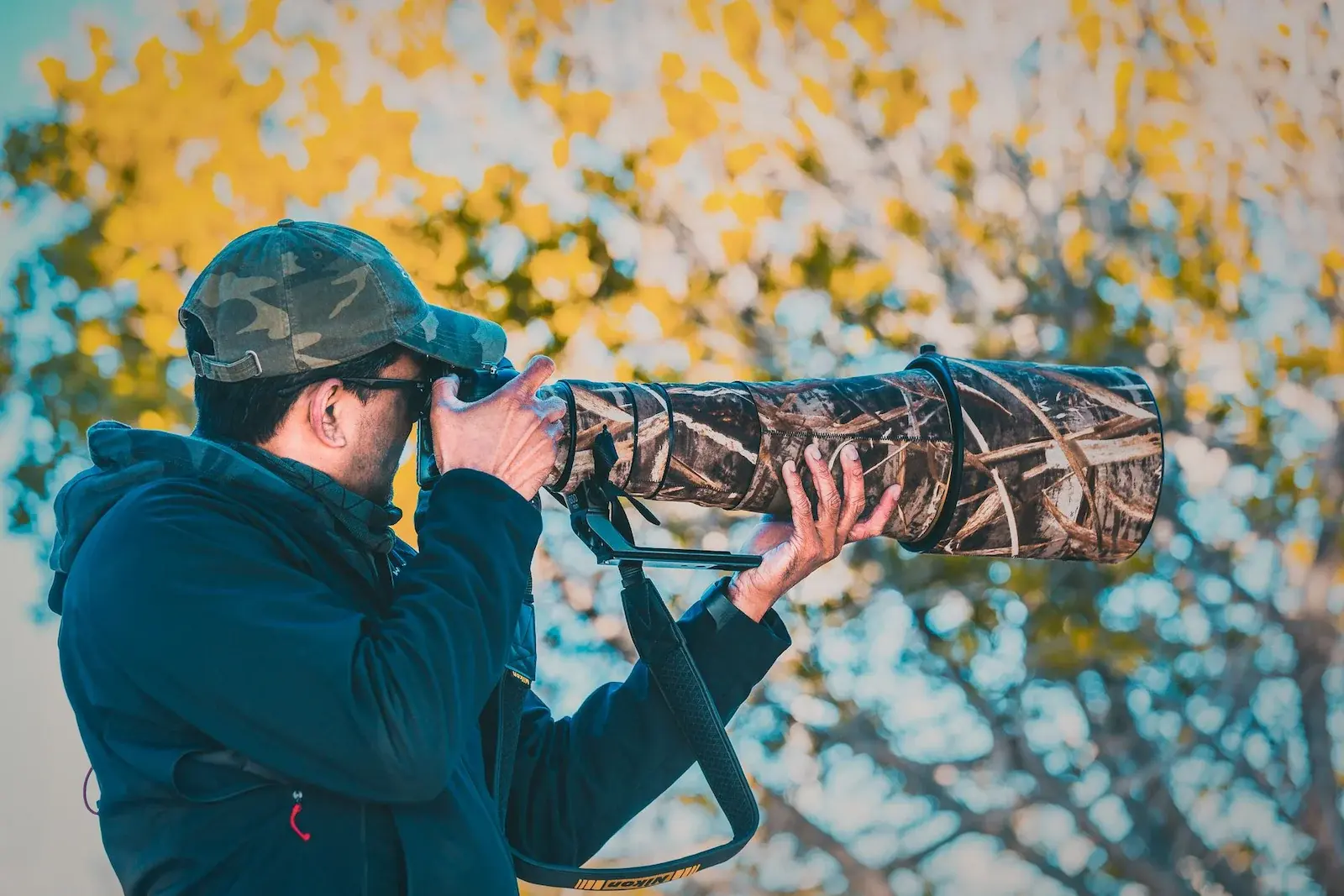
Photographer with a telephoto lens | Photo: Lio Photography
The Eurasian jay's role in seed dispersal makes its behaviour a fascinating opportunity to learn about the relationships between wildlife and vegetation.
However, observing these activities should not involve disturbing their hiding places or repeatedly approaching the areas where they store food.
If we find a Eurasian jay collecting acorns, the best approach is to maintain enough distance for it to continue behaving naturally.
We should also avoid digging in the ground to look for its food stores, removing hidden acorns or moving them to other locations, as this can affect both its food supply and the natural fate of the seeds.
During spring, we should also avoid approaching nests or using recorded calls to provoke responses, particularly when the birds are breeding.
Quiet observation from a path can be much more interesting than pursuing the bird, as it allows us to appreciate its movements, vocalisations and decisions without interfering with them.
Furthermore, learning to recognise the relationship between Eurasian jays and acorns can help us understand woodland ecosystems from a different perspective.
What looks like a bird simply carrying food may be part of an ecological process that continues for months or even years after our visit.
A forest that grows thanks to relationships we rarely notice
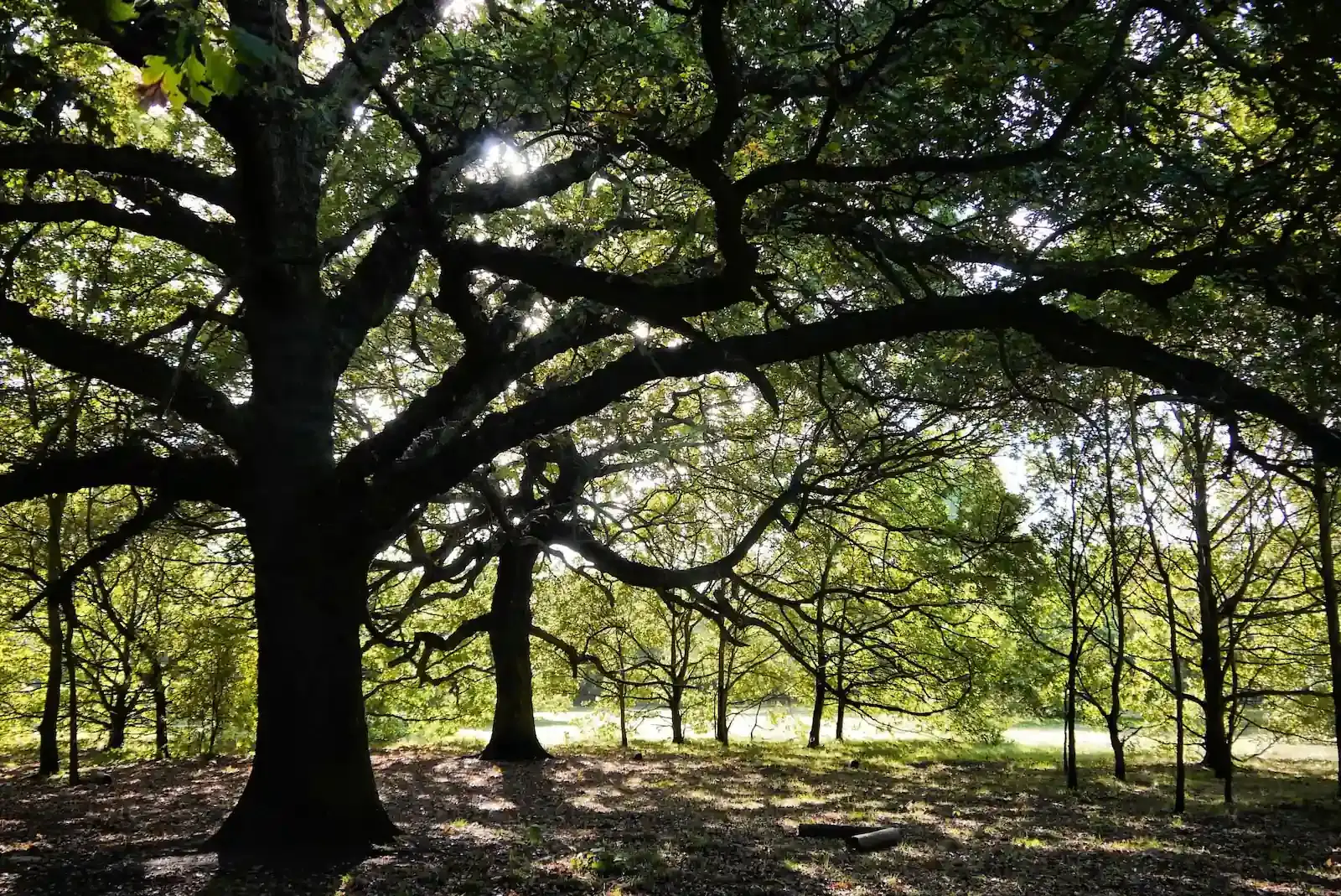
Oak forest | Photo: Leticia Golubov
When we imagine how a forest develops, we often think of seeds falling to the ground, young trees growing slowly or people taking part in reforestation projects.
However, part of that story unfolds thanks to animals that transport seeds while searching for food, moving between habitats or preparing reserves for survival.
The Eurasian jay is one of the best examples.
Every autumn, it collects acorns, carries them from one place to another and hides them to eat over the following months. Many will eventually be consumed, others will not survive, and some will find the conditions they need to germinate.
Of those seeds, a small proportion may eventually grow into new trees.
And perhaps that is the most fascinating part of this story. A behaviour essential to a bird's survival can contribute, without any intention of planting trees, to the regeneration of the forests that future generations will inhabit.
The next time you hear the call of a Eurasian jay among the branches, remember that you are not just listening to one of the most striking birds in our woodlands. You are also encountering one of the animals helping to shape their future.
Frequently asked questions about Eurasian jays and forest regeneration
Which bird plants trees by hiding acorns?
The Eurasian jay is one of the best-known birds contributing to natural forest regeneration by storing acorns. By transporting seeds and burying them in different locations, some may remain in the ground and germinate, eventually growing into new trees.
Why do Eurasian jays hide acorns?
They hide acorns as food reserves for periods when finding food becomes more difficult, particularly during autumn and winter. This strategy allows them to spread their resources across different hiding places and reduce the risk of losing everything.
How many acorns can a Eurasian jay hide?
During favourable seasons, some Eurasian jays can store thousands of acorns, although the quantity varies according to food availability, territory and environmental conditions. There is no fixed figure that applies to every individual.
Do Eurasian jays remember where they hide their acorns?
Yes. Eurasian jays possess memory abilities that allow them to use spatial information to retrieve stored food. Furthermore, different studies have demonstrated that they can remember details of past experiences, although not every hidden seed is eventually recovered.
How far can an acorn travel from its original tree thanks to a Eurasian jay?
In a study carried out in Spain, dispersal distances of approximately 3 to 550 metres were documented, with an average of around 69 metres. However, these figures reflect the conditions of the experiment and do not necessarily represent every possible dispersal distance for the species.
Where can you see Eurasian jays in Spain?
They can be found in numerous woodlands throughout mainland Spain, particularly in the north and the main mountain ranges. They inhabit oak woodlands, beechwoods, holm oak forests, pine forests and other wooded environments, although they tend to avoid extensively deforested landscapes.
What is the best time of year to see Eurasian jays collecting acorns?
Autumn is particularly interesting because it coincides with acorn ripening and the preparation of food reserves for winter. In many Spanish woodlands, October and November can offer opportunities to observe this behaviour, although the timing depends on the region and the particular season.